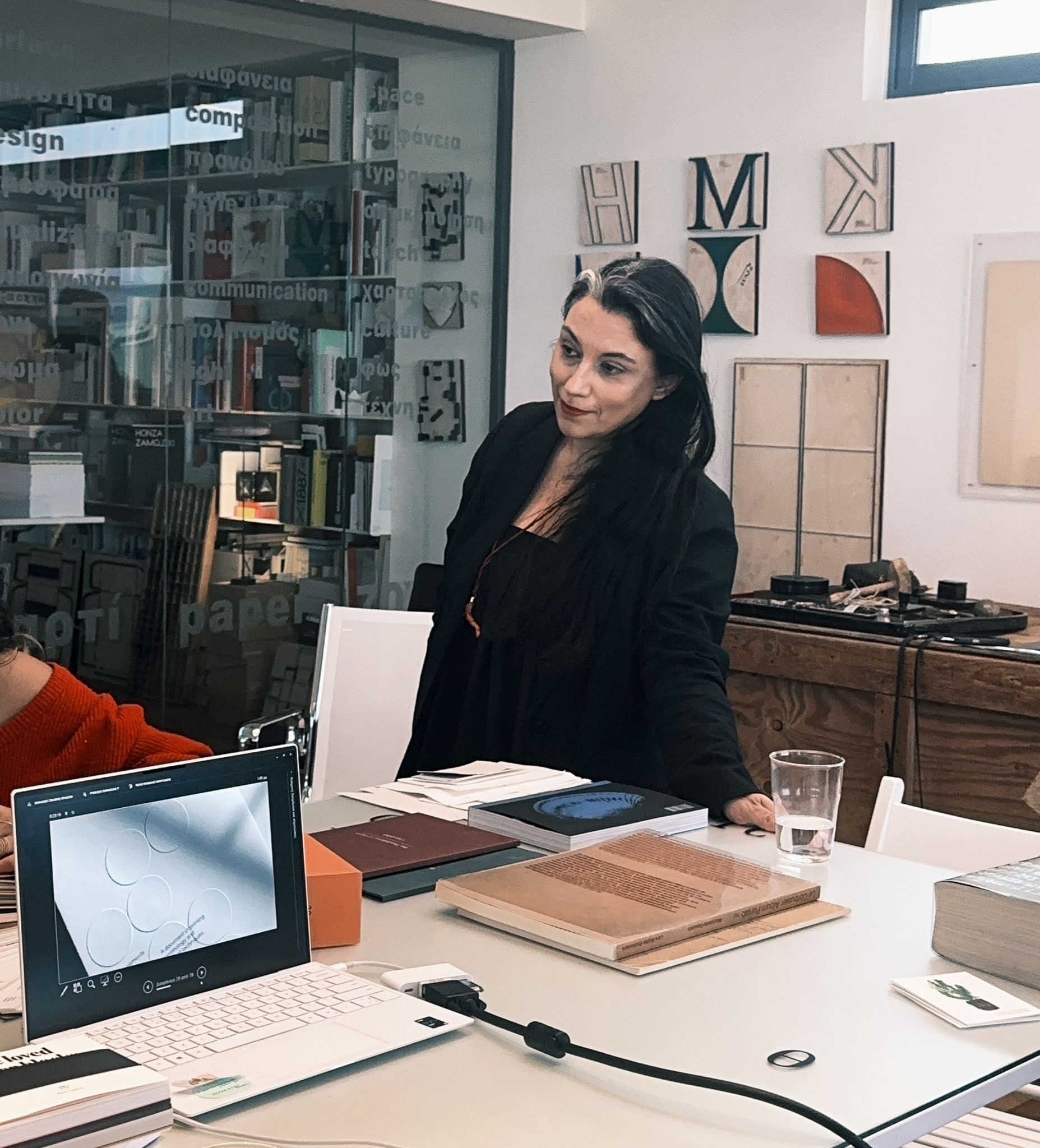
Weaving together architecture and art, Hesperia Iliadou is an established curator based in Venice, advocating for “charting paths for women” and being true to yourself and where you come from. In this interview, we look at why context matters, maintaining conceptual integrity of exhibitions through artistic, institutional and practical dimensions, as well as the three key markers for the future of exhibits based on today’s cultural landscape and current affairs.
The unique and cosmopolitan experiences and outlook of Hesperia Iliadou anchors her as an advocate for innovation and community-centered art curation. Alongside an extensive academic journey, Iliadou has served as an acting Commissioner for the Venice Biennale since 2014 and as the head curator of the Malta pavilion at 58th Venice Biennale. Currently Iliadou works on local initiatives like Venice Museums’ and Exhibitions’ Study Society which “aims to put the Curator at a focal point”. She is co-curator of برغأ كاردإ | Aghrab Idrāk: Thresholds of Perception, at Palazzo Cavanis on view until 22 November 2026. We discussed ways of reflecting and incorporating cultural nuance, viewing curation as an act of translation, while preserving the richness of their differences, as well as tips on the ways to navigate current industry conditions around funding, partnership and climate change.

THE INTERVIEW WITH HESPERIA ILIADOU
You understand island culture (ie. Greece, Malta, Cyprus, Venice), you speak several languages and have worked in multicultural settings. You have also experienced geographical differences having worked on exhibitions in Europe and the Middle East. This is also marked in your academic journey ‒ educated at the NTU Athens, the University of London, the Sotheby’s Institute of Art, the City University of Hong Kong and the University of Leicester. How does your multicultural and cross-cultural academic journey impact your curatorial approach?
I think my multicultural journey has taught me, above all, to resist looking at cultures as closed or self-contained systems. Perhaps this also comes from my familiarity with island cultures. We tend to think of an island as something isolated, defined by the sea that surrounds it; historically, however, islands such as those of Greece, Cyprus, Malta or indeed Venice, have often functioned in precisely the opposite way: as points of encounter, exchange, passage and cultural translation. This has profoundly shaped the way I approach curating. I am interested in what happens in the space between cultures: how ideas, objects, images and forms travel; how their meanings change as they move; and how something apparently belonging to one place may carry within it traces of many different geographies and histories. My academic journey reinforced this way of thinking. Studying and working within very different educational and cultural environments taught me that there is never only one intellectual tradition through which an object, an artwork or a historical narrative can be understood. Different places teach you different ways of looking and, perhaps more importantly, they teach you to question the assumptions of your own way of looking. Working across Europe and the Middle East has made this particularly tangible for me. Curating across cultures requires more than transporting an exhibition concept from one geography to another. It requires listening. Context matters: the institution, the audience, language, cultural memory and even the ways in which people inhabit and understand space. I therefore tend to think of the curator less as someone who imposes a narrative and more as someone who creates conditions in which different narratives can encounter one another. Architecture has also remained fundamental to this approach. I rarely think of an exhibition independently of its site. Space has memory; buildings carry histories, political meanings and cultural associations. Whether I am working within a Venetian palazzo, an industrial site or in a very different cultural context in the Gulf, I am interested in allowing that specificity to enter into the curatorial thinking rather than treating architecture simply as a container for art.
Perhaps, ultimately, this cross-cultural experience has made me comfortable with complexity. I do not necessarily look for a single, definitive reading. I am much more interested in creating exhibitions in which connections can emerge, sometimes expected, sometimes surprising and where the visitor is invited to move between histories, geographies and perspectives. For me, curating is very much an act of translation, but translation in its most creative sense: not making different cultures identical or completely legible to one another, but allowing them to meet while preserving the richness of their differences.
Could you share more about working with the Venice Museums’ and Exhibitions’ Study Society and specifically the First Curatorial Biennial initiating the Murano Lab Residency for Curators and Artists? What was the inspiration behind it and what was particularly rewarding about it?
This is an ongoing project that is very close to my heart. The Venice Museums’ and Exhibitions’ Study Society aims to put the Curator at a focal point, at a time when the curator’s role in the exhibition-making process is going through a self-imposed identity- crisis, where curators and curatorial methodology and process is being critiqued and questioned. Being able to focus, research and investigate this through the Study Society is particularly rewarding and inspiring for all those who participate in our programmes and activities.

As the only woman elected in the Europa Nostra IEH committee, focusing on museum and cultural spaces within historic buildings, could you share your experience in charting paths for women?
Being the only woman elected to the committee inevitably made me conscious of representation, although I have always been slightly cautious about defining my professional experience primarily through gender. I wanted, first and foremost, to be there because of the knowledge and experience I could contribute. At the same time, being the only woman in a room does change your awareness of that room. You become conscious not only of having a voice, but of the importance of using it. And I think this is where the idea of “charting paths” for women becomes meaningful to me. For me, charting a path is not simply about reaching a position yourself. It is about making that position less unusual for the woman who comes after you. Throughout my career I have moved between architecture, academia, museums, heritage and contemporary art, fields in which women are certainly present in great numbers, but where visibility, authority and decision-making have not always been distributed in the same way. I have learned that one of the most important things we can do is to make our expertise visible and to claim intellectual space without feeling that we need to apologise for occupying it.
What are your insider tips, tricks of the trade, and absolute no-no’s for up-and-coming curators looking to build authentic, meaningful partnerships across institutions, geographies, time zones, and cultures?
Just be true to yourself and where you come from and all the thematics that truly mean something to you! And never try to follow trends in curating, never be dismayed by what others do. You are different and your voice counts!
THE PROJECTS BY HESPERIA ILIADOU
You started your career as an architect engineer, could you share milestone moments on your professional journey bridging architecture to art?
I am not sure I have ever experienced architecture and art as two entirely separate worlds. Looking back, I would say that I did not really leave architecture in order to enter art; rather, my understanding of architecture gradually expanded into curatorial practice. My training as an architect taught me to think spatially to understand proportion, movement, material, light, context, and, perhaps most importantly, the relationship between people and the spaces they inhabit. These remain fundamental to the way I approach an exhibition today.

You have served as an acting Commissioner for the Venice Biennale in various editions since 2014. Could you share more about your responsibilities and duties? What surprised you in this role? What is your overall view of the Venice Biennale institution?
Serving in the role of Commissioner gave me a very different understanding of the Venice Biennale. From the outside, we naturally experience the Biennale through exhibitions, artists, curators and ideas. From the inside, you become aware of the extraordinary, and largely invisible structure required to make all of this possible. The Commissioner occupies an interesting position because the role sits at the intersection of the artistic, institutional and practical dimensions of a national participation. You are responsible not only for supporting the curatorial vision, but also for ensuring that this vision can exist within a much larger framework: working with institutions and cultural authorities, coordinating different partners, navigating procedures and deadlines, overseeing aspects of production and communication, and constantly mediating between ambition and what is actually possible.
You penned a piece titled “Venetian industrial heritage beyond the Venice Biennale; a traditional shipbuilding museum and arts-based strategies of community participation in planning a future for inner urban industrial sites in the city of Venice”. This spoke to sites, beyond the Arsenale, becoming spaces of extraordinary social dynamics and activating community to invest cultural capital into the city. How can activist and residents’ groups in the city, who want to reclaim these spaces for the local community, do so, alongside the Venice Biennale, in a complicated place like Venice, characterised by overtourism and property developments that often overshadow the city’s cultural offering?
I think the fundamental question is not simply how we preserve these spaces, but for whom we preserve them. When I wrote that piece, I was interested in looking beyond the monumental industrial heritage of the Arsenale towards the extraordinary network of smaller industrial sites embedded within the urban fabric of Venice: former glass furnaces, workshops, textile spaces and other places of production that had lost their original functions. Many had become empty architectural shells, but they were anything but empty in terms of memory, identity and potential. What interested me particularly was what happened when local communities began to reclaim these places through relatively modest cultural gestures, an exhibition, a workshop, an artist intervention, a community museum, a conversation about the future of a building. Culture in these circumstances becomes much more than programming. It becomes a way of establishing a relationship between a community and a place. I still believe very strongly in this small-scale approach.
In 2019, at the 58th Biennale, you served as the head curator of the Malta pavilion. Several partners across government, creative arts and academia were involved. Could you talk about the pressures of being a solo curator for a national pavilion, and how you balanced the array partnerships in the decision process while staying true to the theme, concept and artistic works?
Curating a national pavilion is an extraordinary privilege, but it also carries a particular kind of pressure. You are not simply curating an exhibition; you are temporarily entrusted with a country’s presence on one of the most visible international platforms for contemporary art. I was the lead curator of the Malta Pavilion, but I would hesitate to describe the process itself as solitary. A pavilion of this scale can never be the work of one person. It involved artists, architects and designers, production specialists, Arts Council Malta, government and cultural partners, as well as academic and institutional relationships. My responsibility was to hold these different elements together while protecting the conceptual integrity of the exhibition.

We had the pleasure of attending the opening of the current exhibition, برغأ كاردإ | Aghrab Idrāk: Thresholds of Perception, you are co-curating with Chase Westfall at Palazzo Cavanis in Venice as a Collateral Event of the Art Biennale. What was the initial inspiration that landed the concept for you in the early stage of its development? How did you ensure the essence of that continued through the development and evolution of it?
The starting point for Aghrab Idrāk was quite different from my previous experience of curating for the Venice Biennale. In the case of a national pavilion, I had begun with a curatorial narrative and the artworks subsequently developed in dialogue with it. Here, Chase Westfall and I were confronted with something almost opposite: an extraordinary spectrum of existing research, different disciplines, methodologies and voices emerging from the Institute for Creative Research at VCUarts Qatar. Our task was not to impose a narrative upon them, but to listen carefully enough to discover what already connected them. The conceptual moment came, for me, through language. I work a great deal with etymology, and at the time I was reading around the meeting points between Greek and Arabic philosophical thought. I became fascinated by this notion of the in-between: the condition that has not yet been fully defined or classified.
THE FUTURE ACCORDING TO HESPERIA ILIADOU
At the moment we are seeing many institutions, both public and private, experiencing large funding cuts. We also see newer global leaders, like academic and research institutes with capital who are keen to invest, and step into cultural diplomacy and leadership roles. What would you say are the top three key markers of how the future of exhibits will evolve over the next five years?
I think the next five years will be less about a single new exhibition format and more about a profound change in who produces exhibitions, how knowledge enters them, and what we expect an exhibition to do. If I had to identify three key markers, I would choose these. First: new alliances and new centres of cultural leadership. The traditional museum model is under enormous financial pressure, and I think this will inevitably change the cultural map. We are already seeing universities, research institutes, foundations and institutions from regions that were previously considered peripheral to the established Western museum network becoming increasingly important cultural actors. Second: research itself will increasingly become exhibition material. This is something I am particularly interested in through my recent work. I think the boundaries between the artist, researcher, designer, scientist and curator will become much more porous. Third: I believe we will see a renewed emphasis on experience ‒ but not simply more technology. Digital and immersive technologies will undoubtedly continue to transform exhibition-making, and they can extend access far beyond the physical museum. But I don’t believe the future is a replacement of the physical exhibition by the virtual one. Current exhibition-sector research similarly suggests that blended physical-digital experiences are more promising than digital-only formats, while visitors continue to value encounters with real objects.

In Venice, the summer of the Art Biennale was marked by extreme heat that swept across the city, the region and the whole world. In Paris, London and other cities, museums closed or adjusted their opening hours. How do you see climate impacting the future of exhibition spaces and how we interact with them?
In Venice, and particularly during the Biennale, this becomes very visible. Exhibitions occupy extraordinary historic buildings, former industrial spaces, palazzi and temporary venues, many of which were never designed to respond to the extreme temperatures we are increasingly experiencing. The people guarding exhibitions, mediating with visitors, working at entrances, installing works, maintaining spaces and supporting production are often those who experience these environmental conditions most continuously. For me, therefore, climate adaptation in the cultural sector must also become a question of labour conditions and care.
If you had unlimited resources, including time, what would be your dream exhibition project? How would you approach it and why?
Perhaps surprisingly, if I had unlimited resources and unlimited time, my dream exhibition would be very close to home. I would like to give the spaces of the Venice Biennale to the children of Venice. I would invite children living in the city and its lagoon to create work and then exhibit it within the spaces normally occupied by one of the most important international art exhibitions in the world, not as a parallel educational activity, not in a children’s corner, and not as something secondary to the “real” exhibition, but with the same seriousness, care and visibility that we give to professional artistic practice. Because perhaps the most important exhibition we could create in Venice would not be another exhibition about the future. It would be an exhibition made by the people to whom that future belongs.
Aman K Sidhu
Hesperia Iliadou
Museums & Exhibitions Studies Society
Biennale Arte 2019, Padiglione Malta. Photo Italo Rondinella. Courtesy Archivio Storico della Biennale di Venezia Biennale Arte 2019, Padiglione Malta. Photo Italo Rondinella. Courtesy Archivio Storico della Biennale di Venezia Biennale Arte 2019, Padiglione Malta. Photo Italo Rondinella. Courtesy Archivio Storico della Biennale di Venezia Biennale Arte 2019, Padiglione Malta. Photo Italo Rondinella. Courtesy Archivio Storico della Biennale di Venezia 
Biennale Arte 2019, Padiglione Malta. Photo Italo Rondinella. Courtesy Archivio Storico della Biennale di Venezia Hesperia Iliadou. Photo Nishi Rafols