Through 4 October 2026, Manifesta 16 transforms twelve post-World War II churches in the Ruhr region – in Gelsenkirchen, Bochum, Essen, and Duisburg – into venues for its sixteenth edition, under the emblematic title “This is not a church.” The project addresses the crisis facing religious buildings in Germany by reinterpreting individual church spaces as community infrastructure through the work of over one hundred artists and curators. But what does it mean to stage an exhibition in such a distinctive space? And what dynamics arise within a varied group of curators? We have tried to answer these questions.
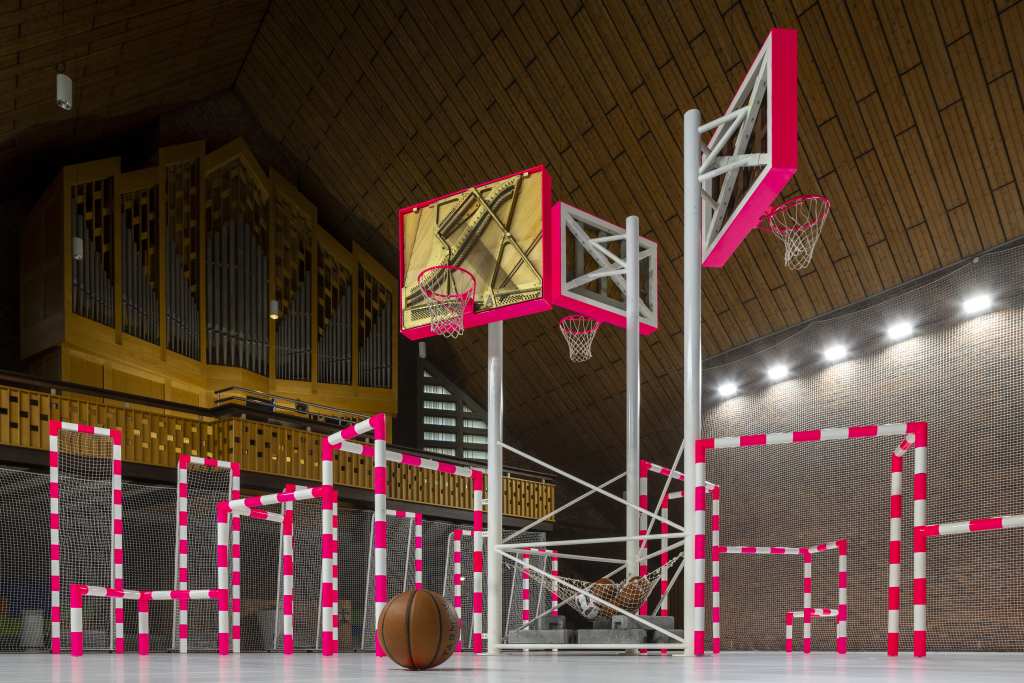
Manifesta 16, scheduled from 21 June to 4 October 2026, has chosen the Ruhr region, a German industrial area marked by decades of depopulation and lack of economic restructuring, as the venue for its sixteenth edition. Considered the nomadic biennial of contemporary art, Manifesta has no fixed location and moves to a different city every two years, selecting areas undergoing transformation and on the fringes of established art circuits; it is based on a research process involving artists, curators, architects, urban planners, and local communities. It is within this context that the choice of churches as exhibition spaces takes place: in Germany, in fact, nearly half of existing religious buildings will close, be sold, or be demolished within the next decade (source: This is not a church. Urban Vision, Verlag Kettler – Manifesta, 2026).
Twelve post-World War II churches, spread across four cities in the region, thus become the venues for the biennial, within the curatorial framework This is not a church, under the guidance of eight Creative Mediators organized into generational pairs: René Block and Leonie Herweg, curators at St. Gertrud in Essen; Gürsoy Doğtaş, curator at the Thomaskirche in Gelsenkirchen; Michael Kurtz and Henry Meyric Hughes, curators at the Kulturkirche Liebfrauen in Duisburg and the Markuskirche in Essen; and Anda Rottenberg and Krzysztof Kościuczuk, curators at Christ-König and St. Anna in Bochum, coordinated by First Creative Mediator Josep Bohigas, who also developed the curatorial project for St. Josef in Gelsenkirchen.
THE PROJECT AND RESEARCH FOR MANIFESTA 16
The choice of theme for this edition stems from an urban-planning study of the region conducted in collaboration with Josep Bohigas, this edition’s First Creative Mediator. The study focused on what are known in German as Pantoffelkirchen (source: Manifesta 16 Ruhr, Monopol, 2026), literally “slipper churches”: buildings constructed in the postwar period, close enough to homes that one could walk there in slippers. Over a thousand of these churches were built in the Ruhr region in the twenty-five years following World War II, becoming a symbol of the community’s rebirth (source: This is not a church. Urban Vision, Verlag Kettler – Manifesta, 2026). For 2026 edition of Manifesta, however, these churches serve as a curatorial tool, not merely as empty spaces to be reactivated, but as architectural testimonies to a process of transformation and reconstruction. Behind this decision lies a year of field research: hundreds of buildings visited and mapped throughout the region, public consultations, and workshops designed to understand the real needs of the neighbourhoods. The most emblematic example of the intense processes of economic, political, and social change that have affected the Ruhr region is Gelsenkirchen, one of the wealthiest cities in the area in 1865, but today one of the poorest, with an urban fabric that Hedwig Fijen compares to Los Angeles due to its car culture, shopping malls, and the very few remaining public spaces where people can still meet (source: Manifesta 16 Ruhr, Monopol, 2026). Consequently, a need has emerged for accessible shared spaces that can serve as gathering places, cultural centers, and venues for the community. This process led to the selection of twelve churches in Essen, Bochum, Gelsenkirchen, and Duisburg as exhibition venues, complemented by art schools, textile workshops, and concert halls to round out the cultural project. The twelve churches, however, do not form a uniform group: most belong to the post-World War II religious modernist movement, featuring a wide architectural variety ranging from emergency structures, designed for displaced communities, to churches originally built as convents and subsequently converted, as well as buildings with triangular floor plans – with the notable exception of St. Josef Church in Gelsenkirchen, a late 19th-century Neo-Gothic building. The histories and architectural identities of each of these churches thus serve as the starting point for Manifesta 16, which, without wishing to reduce the narrative and curatorial choice of space to the concept of “reuse of the sacred”, does not designate abandoned heritage as a general category, but rather isolates a specific typology and transforms it into the entire framework of the biennial.
THE ARTISTIC INTERVENTIONS AT MANIFESTA 16
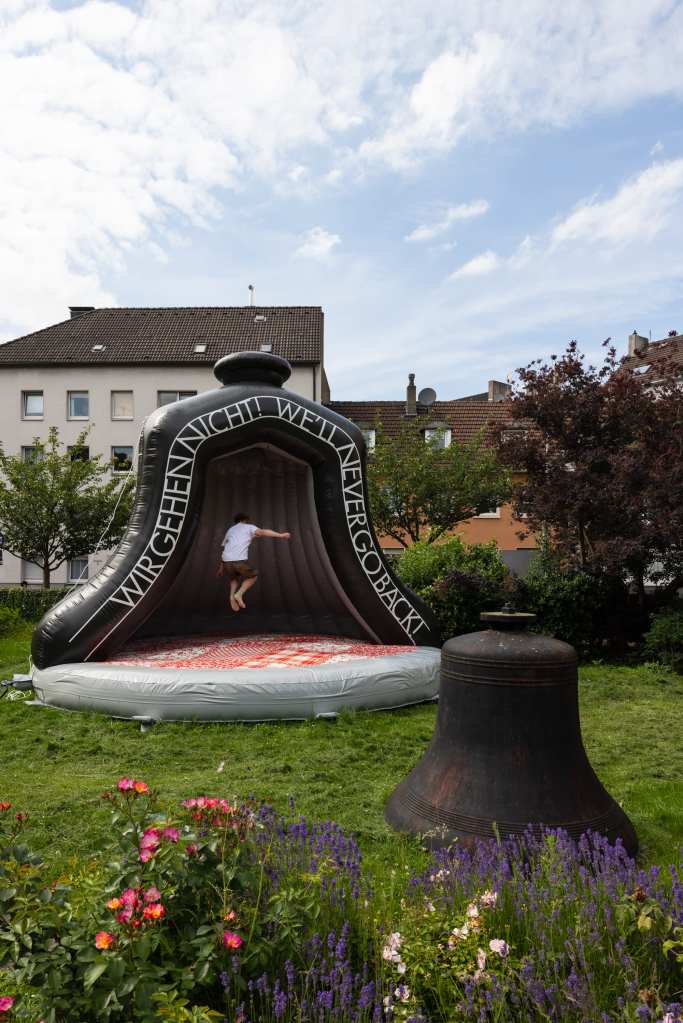
The theme of this edition, This is not a church, has granted participating artists and curators considerable freedom in the selection of works and approaches, as well as in their display within the exhibition space, paving the way for a multitude of solutions ranging from painting to sculpture, including printmaking, photography, video, site-specific installations, and fully participatory experiences. This great freedom is reflected in the variety of themes addressed across the many exhibition venues, ranging from a reinterpretation of the local history of the Ruhr region and the complex folk traditions that characterize it, to issues of migration, diverse contemporary reinterpretations of the sacred, and even narratives that are purely political, social, or related to queer themes. The group of artists itself is very numerous: there are 107 artists in total, some deeply rooted in the German context as well as artists, collectives, and studios with proven international experience, like Jason Dodge, SUPERFLEX, Eva Koťátková, Katarzyna Kozyra, Luc Tuymans, and Mona Hatoum.
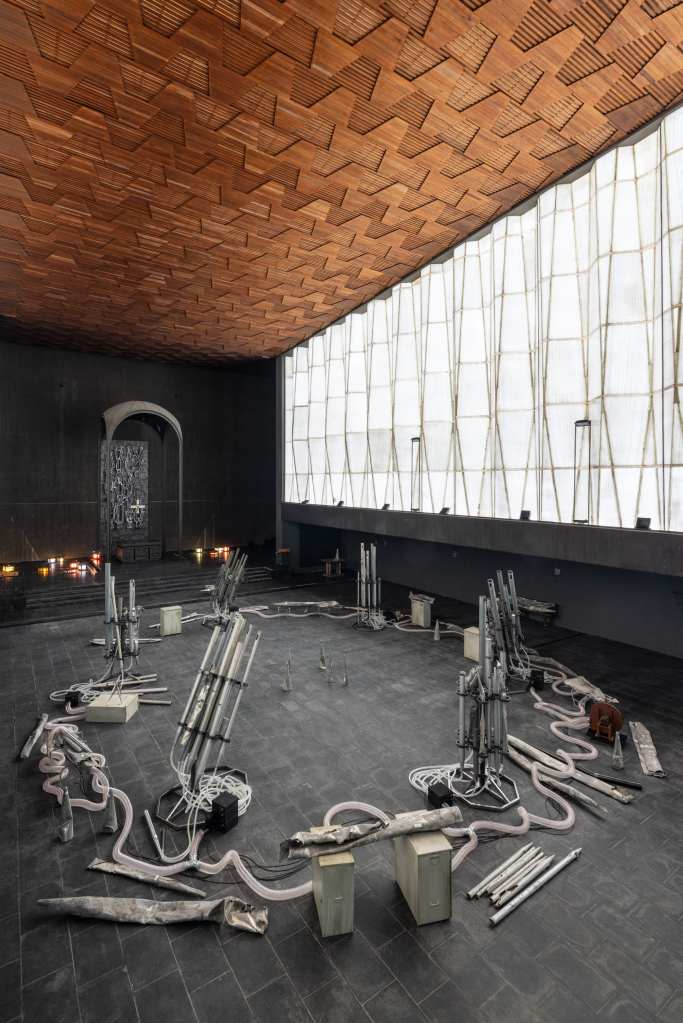
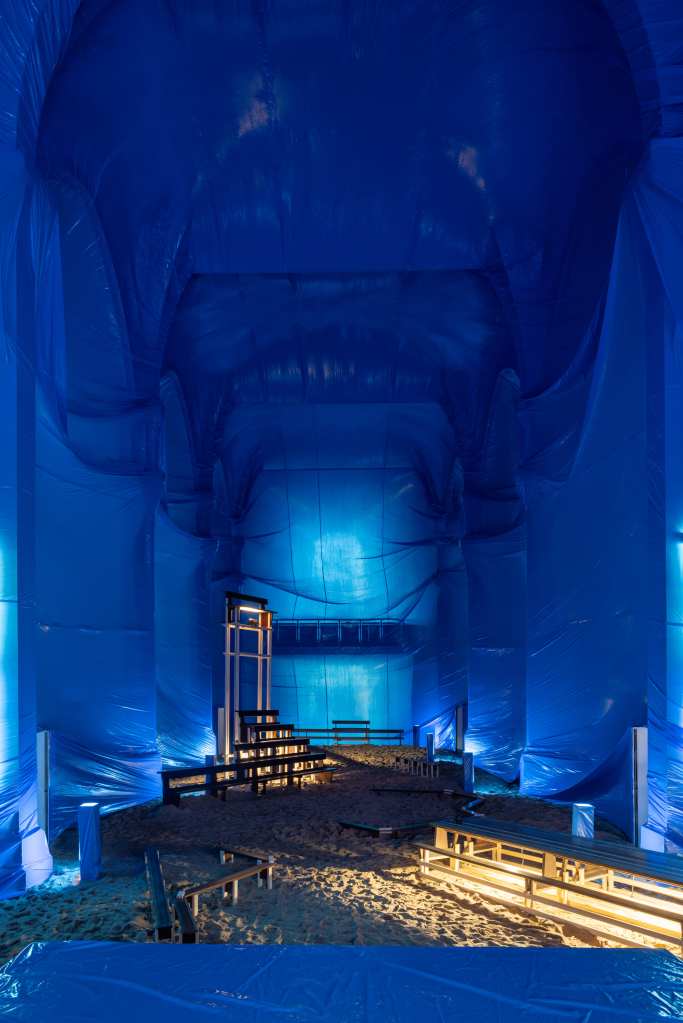
As a result of the multifaceted and ongoing negotiations with the venues and the wide range of ideas and sensibilities involved, the twelve exhibition sites present markedly different outcomes. Overall, the most successful installations are those capable of reinterpreting the environments, starting from a clear concept for reimagining the space and creating a coherent atmosphere. The Kulturkirche Liebfrauen in Duisburg, for example, curated by Michael Kurtz and Henry Meyric Hughes, hosts a series of artistic interventions that reimagine the space of the former church through installations made from recycled materials, pieces of decommissioned church organs and old windows from the Duisburg train station, and lighting elements inspired by traditional folk lanterns, with a clear nod to modernist geometries characterized by sharp, defined forms and a strong visual impact. The project is completed by video art installations that explore the history of religious buildings. At St. Josef Church in Gelsenkirchen, curator Josep Bohigas reinterprets the space of the central nave with a large blue membrane designed by Penique Productions and accompanied by an expanse of sand on the floor, thereby evoking a profound sense of estrangement in the viewer, who is thus invited to engage with the spaces and constituent elements typical of a sacred environment in an unexpected way.
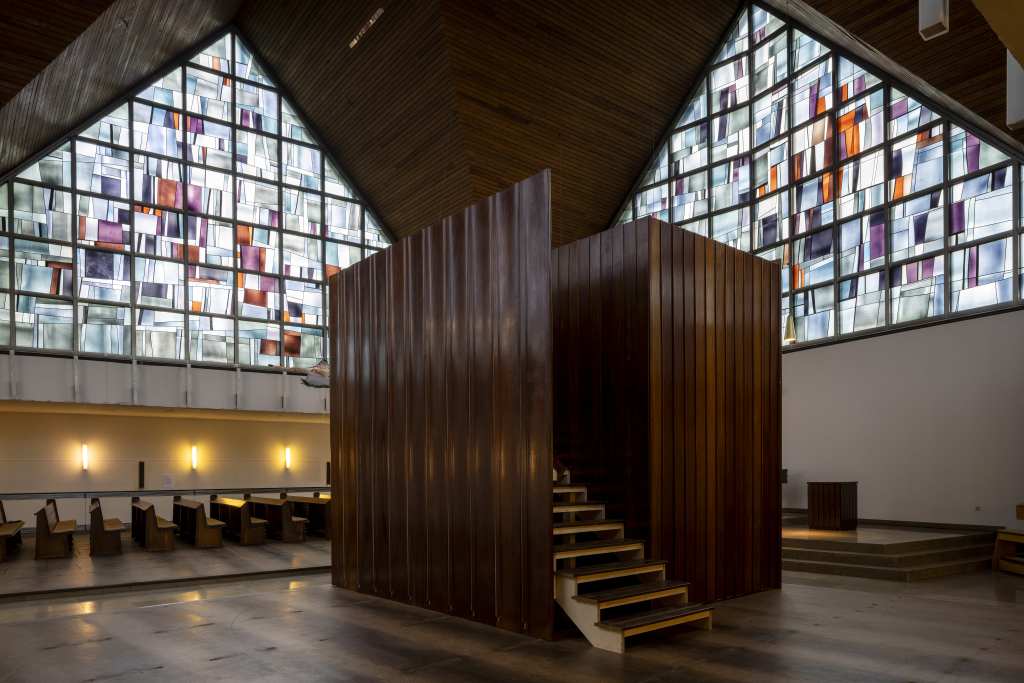
In Essen, at St. Marien Church, the curatorial project by René Block and Leonie Herweg draws on the subdued atmosphere to explore themes of abandonment and neglect, as exemplified by the works of Jarosław Kozłowski, who created a cluster of sculptures using the church’s furnishings, and Jason Dodge, who covered the floor with humble, discarded materials. Further developed through the work of nine other artists, the curatorial reflection underlying these works evokes the nature of the building, suspended between its past and an uncertain future for the space itself and for its community. In the Markuskirche, where Michael Kurtz and Henry Meyric Hughes serve as curators, the sacred space is conceived as a metaphor for a ship: at its center stands a large wooden cube by Augustas Serapinas, crafted from the church’s own pews. Climbing onto it and moving closer to the ceiling, one can better appreciate Lilli Lake’s sound installation, inspired by the creaking of ship timbers. Finally, Sara Bichão’s sculpture, itself composed of recycled materials and clearly inspired by the sea, towers over the church’s pews, completing a redefinition of the space characterized by a sober and thoughtful minimalism.
THE CURATORIAL APPROACH OF MANIFESTA 16
In line with the exhibition’s widespread geographical distribution and the considerable freedom afforded by this edition’s themes, the curatorial approach of Manifesta 16 also features several significant distinctive elements. First and foremost, a curatorial team comprising eight curators was brought on board: Josep Bohigas, Gürsoy Doğtaş, and three intergenerational pairs consisting of Michael Kurtz and Henry Meyric Hughes, René Block and Leonie Herweg, and Krzystof Kosciuczuk and Anda Rottenberg. In fact, a large portion of the exhibitions staged in the individual churches was curated by a pair consisting of a younger curator and a more experienced one, thereby highlighting an approach rooted in generational diversity and the evolution of curatorial practices ultimately involving, as noted, as many as eight curators. Furthermore, the very layout of the buildings had a decisive influence on the curatorial and exhibition design solutions: in some cases, the decision was made to intervene directly on the architecture, radically modifying and reinterpreting the space and making use of its constituent elements; in others, however, a necessarily more respectful approach to the existing layout was prioritized, employing solutions capable of integrating into the environment without causing substantial alterations to its structure or perception. Furthermore, the confined nature of the ecclesiastical spaces made it possible to develop, within each church, more or less autonomous thematic clusters, allowing for the exploration of profoundly different issues. This edition thus appears to serve as a testing ground for exploring art’s potential to reimagine neglected urban spaces and realities, where curation becomes a practice of critical consciousness, with the aim of fostering a dialogue between contemporary art and the need for the rebirth of a local community marked by complex historical events and social challenges. Behind a theme that seems marginal in contemporary sensibilities, curation, thanks to the extensive research conducted, becomes a fundamental mediator, enabling a local community to foster cultural renewal through the languages of contemporary art, so that the Pantoffelkirchen, whose function is currently the subject of more debate than ever, may once again become a hub for the social and intellectual life of the community.
Elia Castello, Sara Collivasone
21 June – 4 October 2026
Manifesta 16 Ruhr: This is not a church
curated by René Block, Josep Bohigas, Gürsoy Doğtaş, Leonie Herweg, Krzystof Kosciuczuk, Michael Kurtz, Henry Meyric Hughes, Anda Rottenberg
https://manifesta16.org
The text has been translated in English using AI
Möglich Unvorhersehbar, 2026 © Penique Productions/Sergi Arbusà. Photo © Manifesta 16 Ruhr / Ivan Erofeev 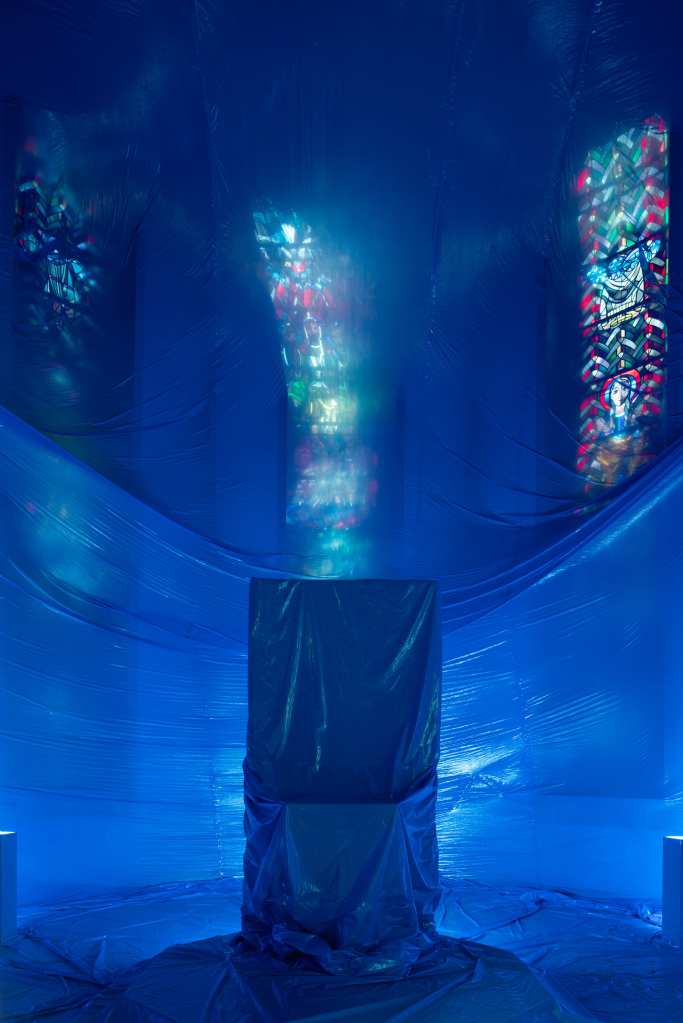
Möglich Unvorhersehbar, 2026 © Penique Productions/Sergi Arbusà. Photo © Manifesta 16 Ruhr / Ivan Erofeev 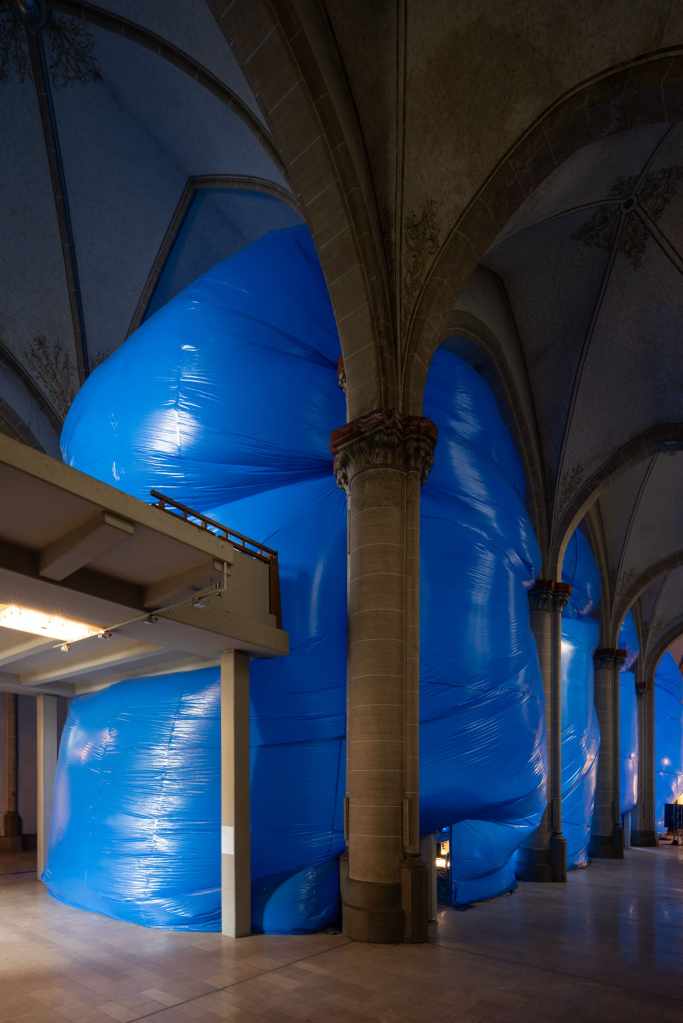
Möglich Unvorhersehbar, 2026 © Penique Productions/Sergi Arbusà. Photo © Manifesta 16 Ruhr / Ivan Erofeev 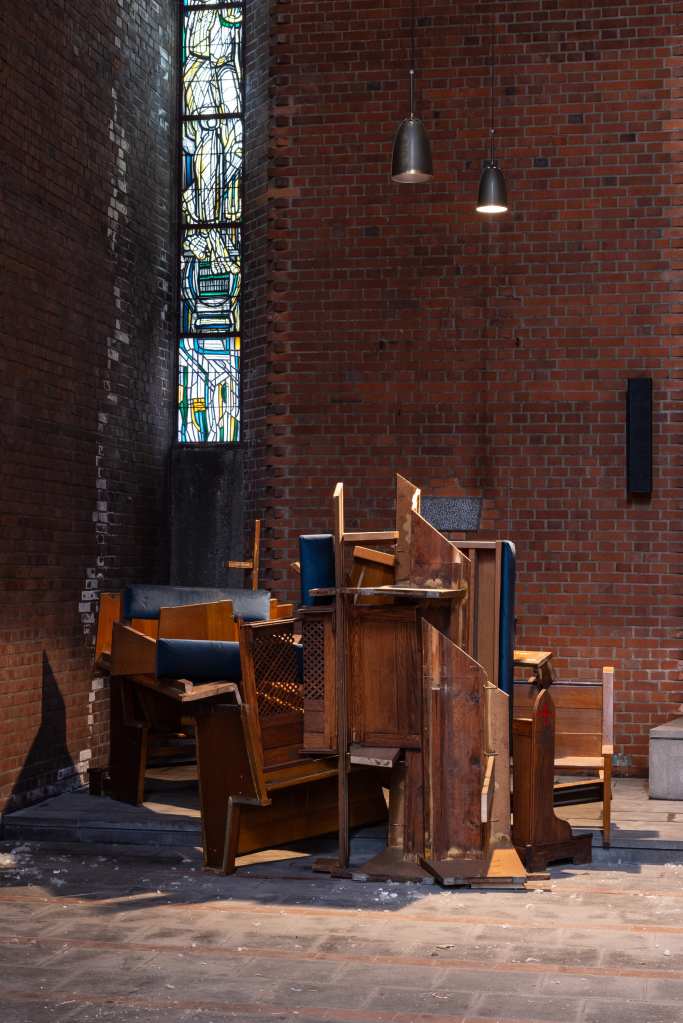
© Jarosław Kozłowski. Photo © Manifesta 16 Ruhr / Ivan Erofeev 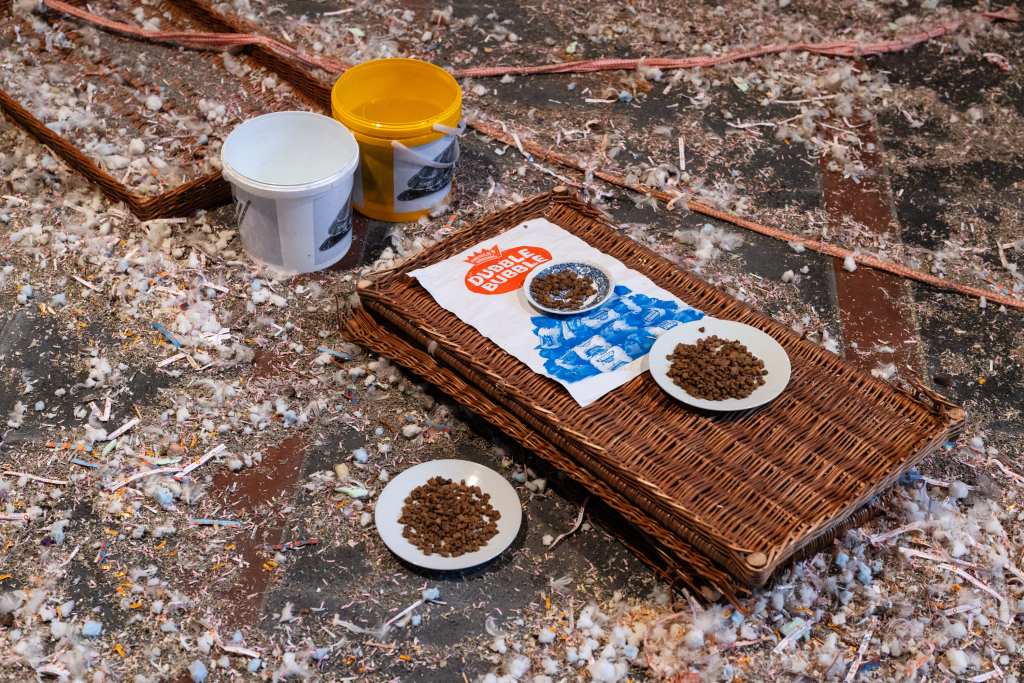
Ohne Titel, 2026 © Jason Dodge. Photo © Manifesta 16 Ruhr / Ivan Erofeev Pew Tower, 2026 © Augustas Serapinas. Photo © Manifesta 16 Ruhr / Rainer Schlautmann 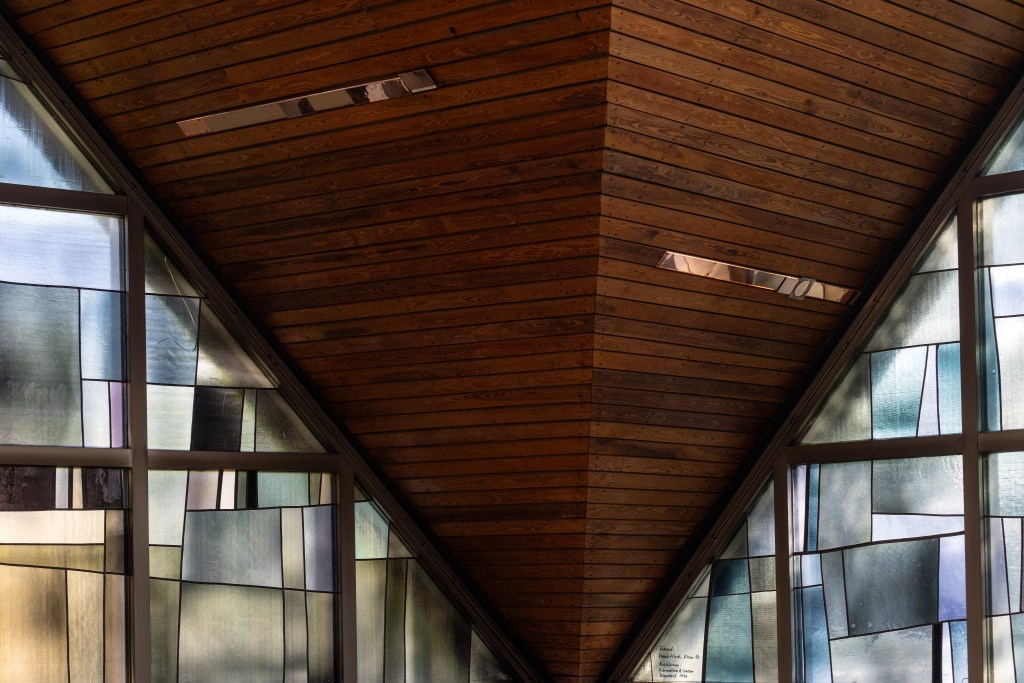
Rhythm looks for two, 2026 © Lilli Lake. Photo © Manifesta 16 Ruhr / Rainer Schlautmann 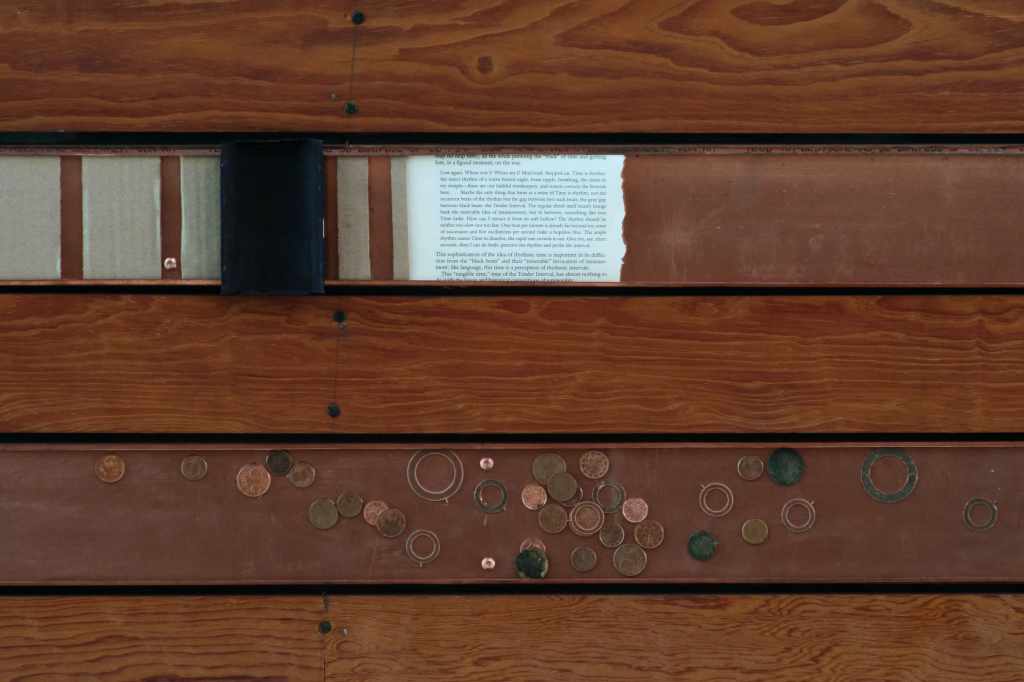
Rhythm looks for two, 2026 © Lilli Lake. Photo © Juri Löchte 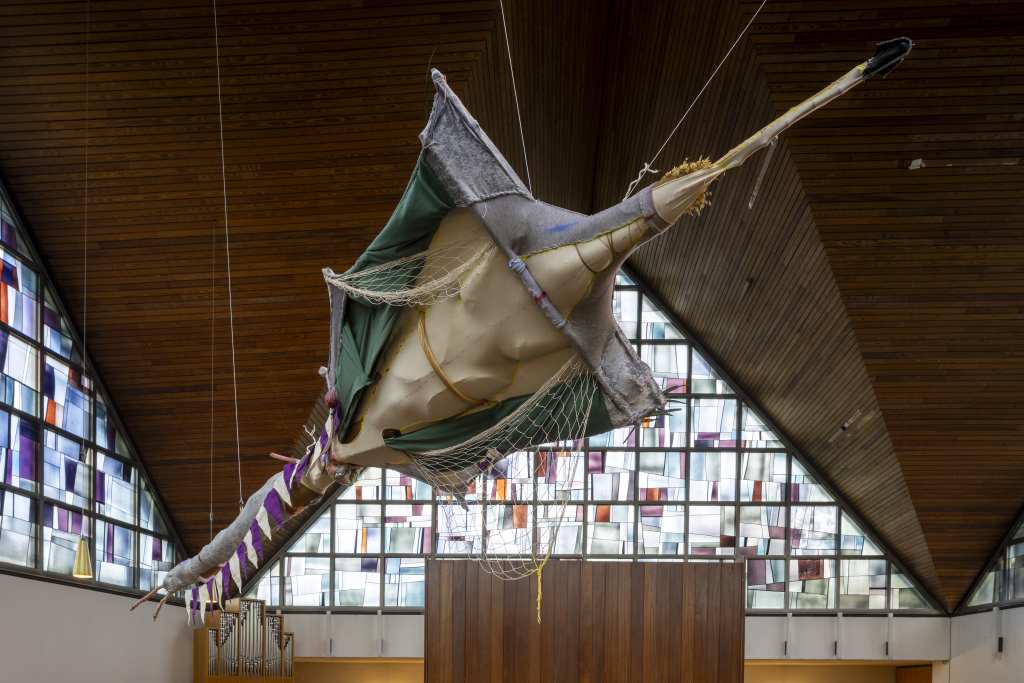
She has been here before, but when or how I cannot tell, 2026 © Sara Bichão. Photo © Manifesta 16 Ruhr / Rainer Schlautmann 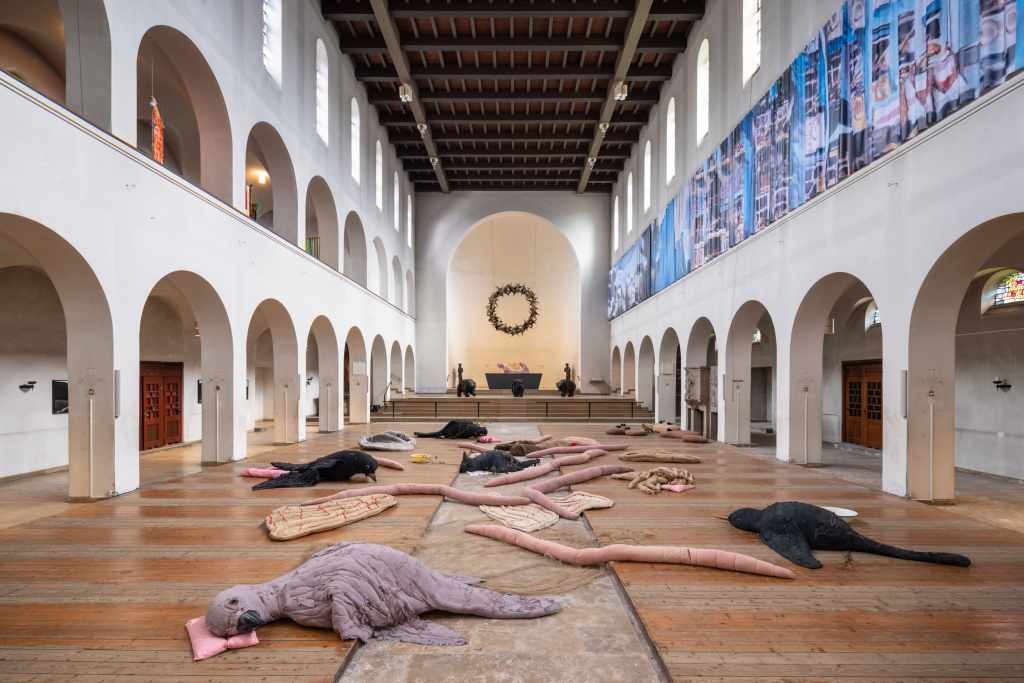
When Animals Fall From the Sky, 2026 © Eva Koťátková (and children from Bochum and Prague). Photo © Manifesta 16 Ruhr / Ivan Erofeev Ouranophobia 47051, 2026 © Abbas Zahedi. Photo © Manifesta 16 Ruhr / Ivan Erofeev FailAgainFailBetter, 2026 © Cabosanroque Collective. Photo © Manifesta 16 Ruhr/ Rainer Schlautmann kein Geläut, 2026 © Marina Naprushkina. Photo © Manifesta 16 Ruhr / Ivan Erofeev 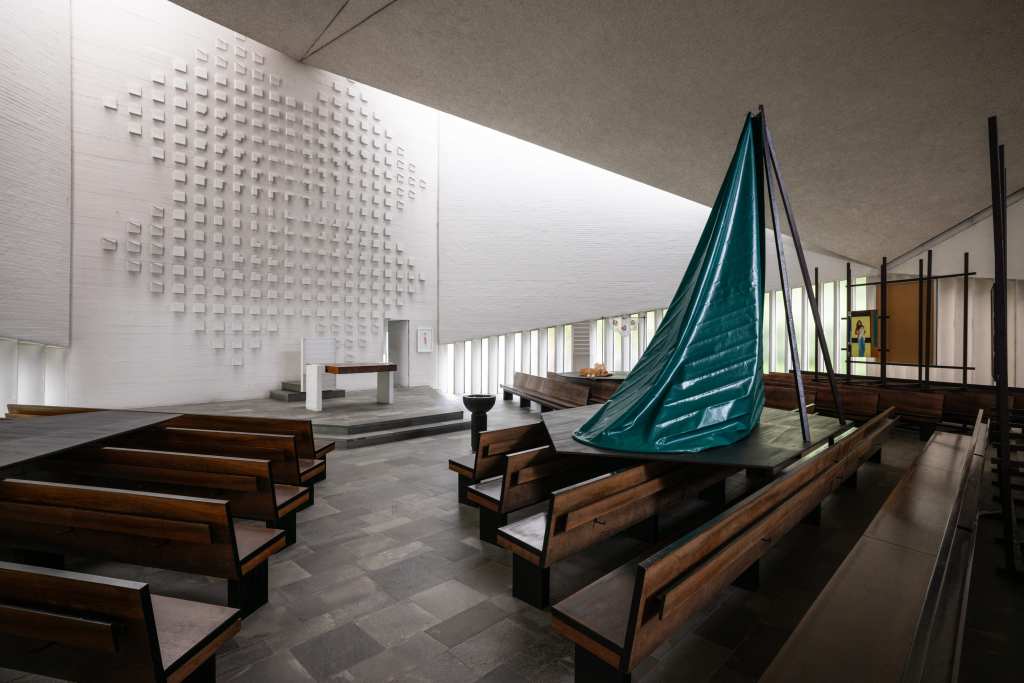
Minaret / Konfektion (Minaret / Ready-to-Wear), 2007/2026 © Bettina Allamoda. Photo © Manifesta 16 Ruhr / Ivan Erofeev 
Untitled, n.d., n.d. © Fatma Ceylan. Photo © Manifesta 16 Ruhr / Ivan Erofeev 
Elevation, 2026 © Nasan Tur. Photo © Manifesta 16 Ruhr / Rainer Schlautmann 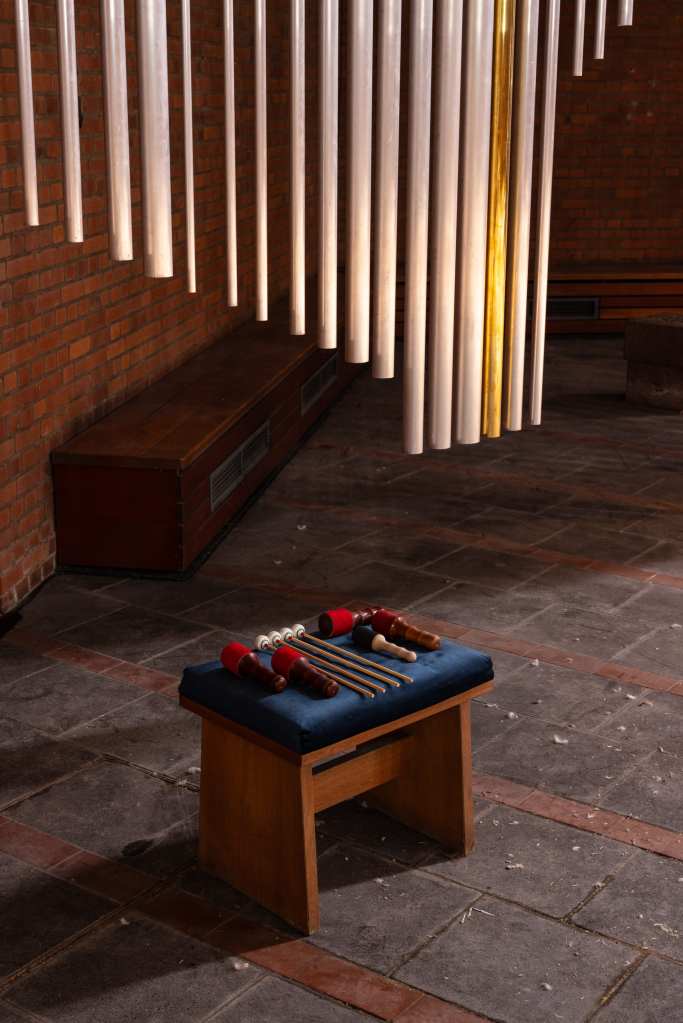
Variation on Godspeed in 4/4, 2026 © TimeWilliam Engelen. Photo © Manifesta16 Ruhr / Ivan Erofeev

