An architect and curator, artistic director of Bangkok Kunsthalle and Khao Yai Art Forest, Stefano Rabolli Pansera has built his curatorial practice through a constant dialogue between architecture and contemporary art. This interview explores his path between the two disciplines, the fundamental aspects of his practice, and the characteristics of contemporary curating.
Stefano Rabolli Pansera, born in Brescia in 1980, graduated from the Architectural Association School of Architecture in London in 2005, worked for three years at Herzog & de Meuron in Basel, and taught at the aforementioned university as a Unit Master until 2011. In 2009, he founded Beyond Entropy Ltd, a curatorial agency dedicated to the relationship between art, architecture, and geopolitics, with projects in Africa, Europe, and the Mediterranean.
He subsequently directed the Hauser & Wirth galleries, a position he left in 2023 to lead the non-profit organization Khao Yai Art in Bangkok. Through two complementary projects, the Bangkok Kunsthalle and the Khao Yai Art Forest, he now presents works by contemporary artists, revitalizing the relationship with nature through learning, care, and active participation. He is an architect and curator. In this interview, he reflects on his transition from architecture to curation and the concept of healing that defines his practice.
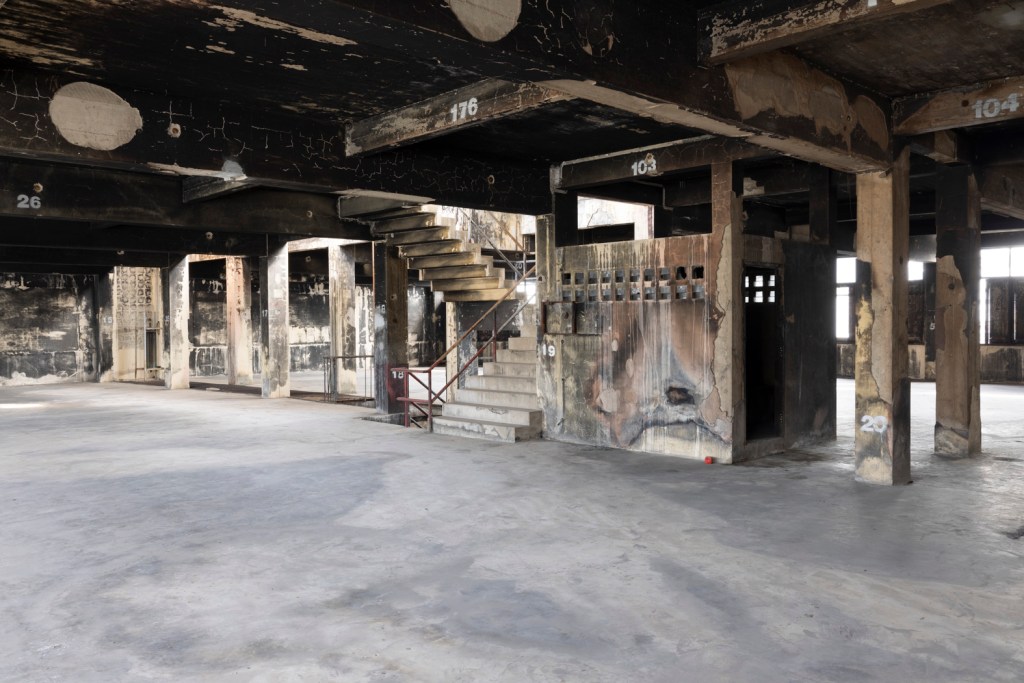
The Kunsthalle in Bangkok, where you are currently the artistic director and curator, bears the marks of a 2001 fire, such as charred staircases and exposed beams, which give it a very strong architectural identity. To what extent does this influence your curatorial and exhibition design choices? And how do visitors, accustomed to conventional museum spaces, react when faced with a place like this?
Space always influences content, and, conversely, content transforms space. Architecture or the natural context are never neutral elements: they alter the artwork and the way it is perceived, while the artwork, in turn, changes the space in which it is installed. This symmetry, this short-circuit, constitutes the fundamental premise of the entire project, both for the Bangkok Kunsthalle and for Khao Yai Art Forest.
I often return to a verse by Osip Mandel’štam that, for me, perfectly embodies this condition: “I am both flower and gardener; in the prison of the world, I am not alone.” In the aesthetic experience, the artwork is simultaneously container and content, object and environment, that which is transformed and that which transforms.
At the Bangkok Kunsthalle, I invite artists to choose a space and give them the freedom to decide what to do and how to intervene. Each artist creates a site-specific installation, while we carry out only the architectural interventions necessary to make the work possible and accessible. If a work requires painting a room, we paint it; if it requires leaving the surfaces intact, we preserve them as they are. There is therefore no architectural project that precedes and conditions the works: it is the work itself that determines, on a case-by-case basis, the transformation of the building. In this sense, the project defines a third way, which is neither renovation nor preservation. I would define it as a form of healing, which for me coincides with a process of domestication. We use the building in the sense that Giorgio Agamben attributes to the word “use,” as a paradigm opposed to consumption. Caring for the building through works of art means inhabiting it, using it, entering into a relationship with its materiality and its memory, without erasing them.
Many artists have been fascinated by the fact that the building, once the headquarters of Thailand’s leading publisher of textbooks, was destroyed by fire. In a culture that is deeply animistic and sensitive to the energies of places, including through principles related to feng shui, this story possesses a very intense symbolic power. Not Vital, for example, created a fountain simply by letting water flow along the existing handrail of a staircase. He did not introduce a foreign object but revealed a latent possibility within the architecture. Korakrit Arunanondchai, on the other hand, used the ashes of the books, found in the building twenty-three years after the fire, to create a mixture for a floor. The work thus became a metaphor for the building’s rebirth from its own ashes, like a phoenix.
Faced with this space, visitors initially lose some of the familiar reference points of a conventional museum: the white cube, the neutrality of surfaces, and the clear separation between artwork and architecture. But it is precisely this loss of orientation that makes the experience more intense. The public does not merely observe the works; they must physically and mentally engage with the space, its scars, its darkness, its materials, and its memory.
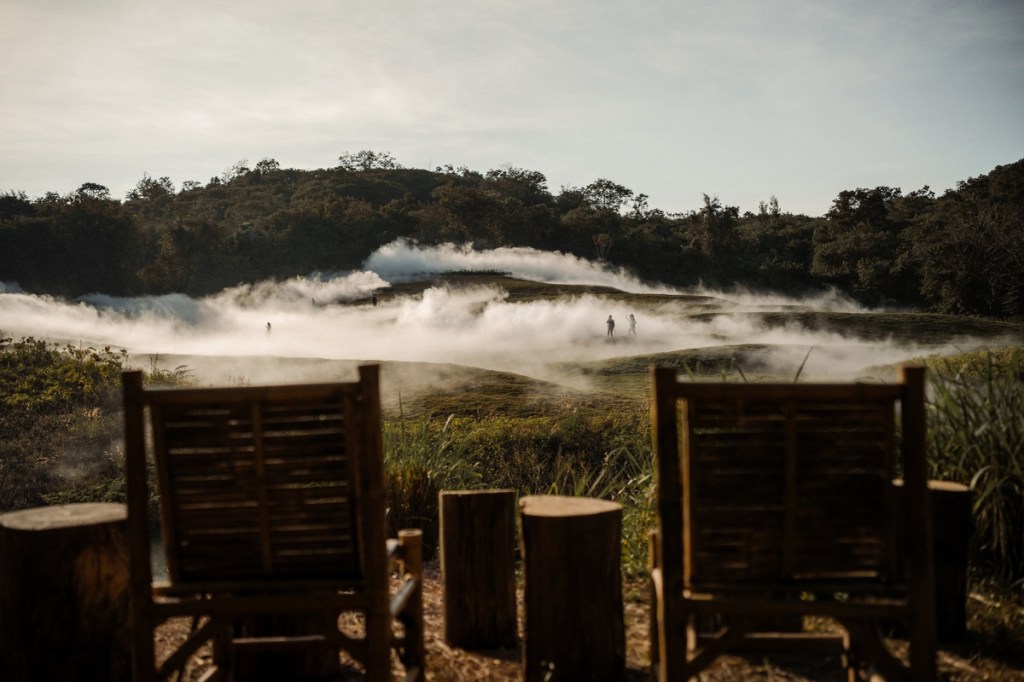
At Khao Yai Art Forest, a project linked to the Kunsthalle in Khao Yai National Park, a UNESCO World Heritage Site northeast of Bangkok, the work precedes the landscape, given that it is a degraded forest that is gradually being reforested. Is there, therefore, an intention to define and construct the landscape through the artworks? An example in this case could be Fujiko Nakaya’s work Fog Forest, since it will alter the vegetation over time and create a new ecosystem. Is art, therefore, a catalyst for ecological and social processes?
Yes. I’m interested in subverting the traditional procedure through which museums and sculpture parks are built. Normally, the process is linear: first, a master plan is defined; then the buildings are designed; next, the landscape; and only at the very end are the artworks installed. In this model, the artworks inevitably end up as a decorative addition to a project that’s already complete. At Khao Yai, we sought to reverse this logic. The project does not start with architecture, but with the artworks. The artists intervene first, within a natural environment that is still degraded or wild; the landscape is then shaped around the artworks, and only later is it determined whether a building is necessary and what form it should take. The master plan, therefore, does not precede the project: it emerges progressively from the relationships that develop between art, the territory, and time. The artworks thus take on a truly generative value: they are not the conclusion of the design process, but rather its beginning. Fujiko Nakaya’s Fog Forest perfectly embodies this idea. The fog is not merely a spectacular effect: it alters humidity levels, interacts with the vegetation, influences the microclimate, and, over time, contributes to the formation of a new ecosystem. At the same time, Nakaya has altered the topography of the hill to slow the dispersion of the fog. This means that the artwork consists not simply of the fog, but of the entire system of relationships it activates between the ground, the atmosphere, the vegetation, the climate, and the visitors. For this reason, I like to say that the landscape becomes a timescape. The material of the artwork is not only space but time itself. The artwork continues to transform along with the landscape, and the landscape continues to transform along with the artwork. I am particularly interested in that moment when a visitor observes a landscape and does not realize that what they are looking at is already a work of art. The artwork disappears into nature, relinquishing its own exceptionality to become a perceptual condition. In this sense, I consider Fog Forest the paradigm of a possible Land Art 2.0: not a monumental gesture imposed on the territory, but an ecological device capable of working with biological, climatic, and temporal processes. The project is also significant from a technological standpoint. We collaborated with Aquaria, a California-based startup specializing in the condensation of atmospheric moisture, to drastically reduce water consumption from wells. The technology, therefore, does not serve the spectacle, but rather the sustainability of the work itself. This is why I believe that art can be a powerful catalyst for ecological and social processes. Not because it replaces the work of ecologists, foresters, or scientists, but because it raises awareness of phenomena that normally remain invisible: the water cycle, plant growth, soil erosion, biodiversity, and the relationship between humans and other forms of life. Khao Yai Art Forest is therefore not a sculpture park nestled in nature. It is an ecosystem in which art, architecture, agriculture, reforestation, water management, and environmental education form a single project. The works do not merely represent nature; they interact with it. In this sense, curation is not limited to arranging objects in space, but rather fosters relationships capable of generating new territories, new temporalities, and new forms of life.
CURATORSHIP AD ARCHITECTURE ACCORDING TO STEFANO RABOLLI PANSERA
Korakrit Arunanondchai used the ashes from the 2001 fire to create a floor; Delcy Morelos transformed an “impossible” excavation into a garden of stones, in both cases, the site took precedence over the artwork. Are there differences between working with a building’s traumatic history and working with the degradation of a forest, or is it the same process applied to different scales and materials?
There are obvious differences in scale, temporality, and material, but the methodological approach remains essentially the same. In both cases, the starting point is a radical engagement with a pre-existing condition that carries with it a wound. At the Bangkok Kunsthalle, the trauma is historical, cultural, and material: the fire, the destruction of the books, the building’s abandonment for over twenty years, and the loss of its original function.
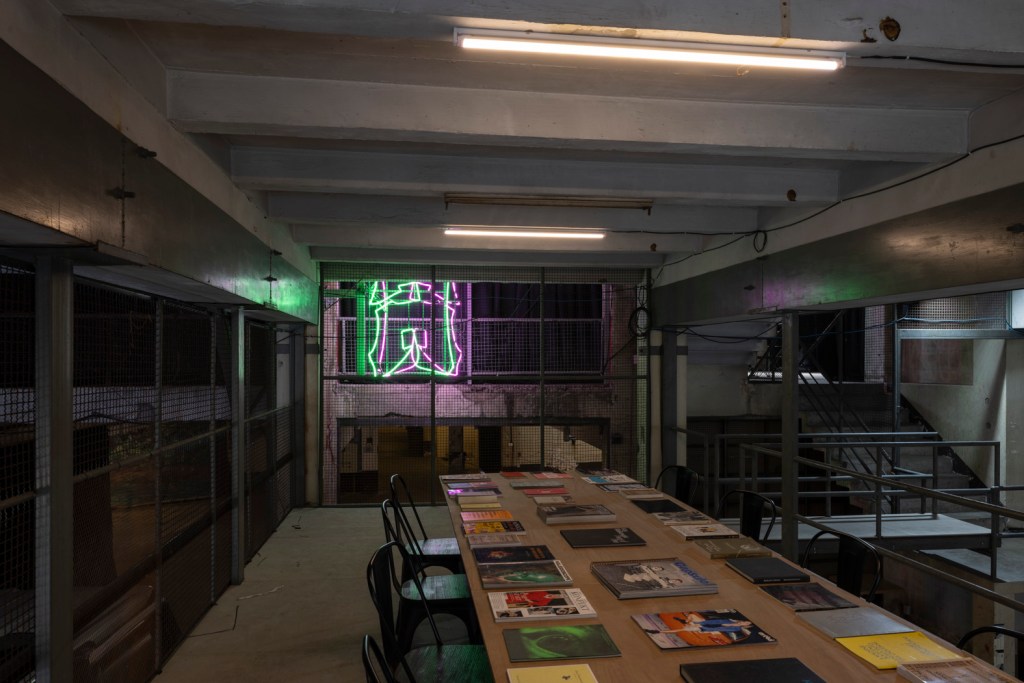
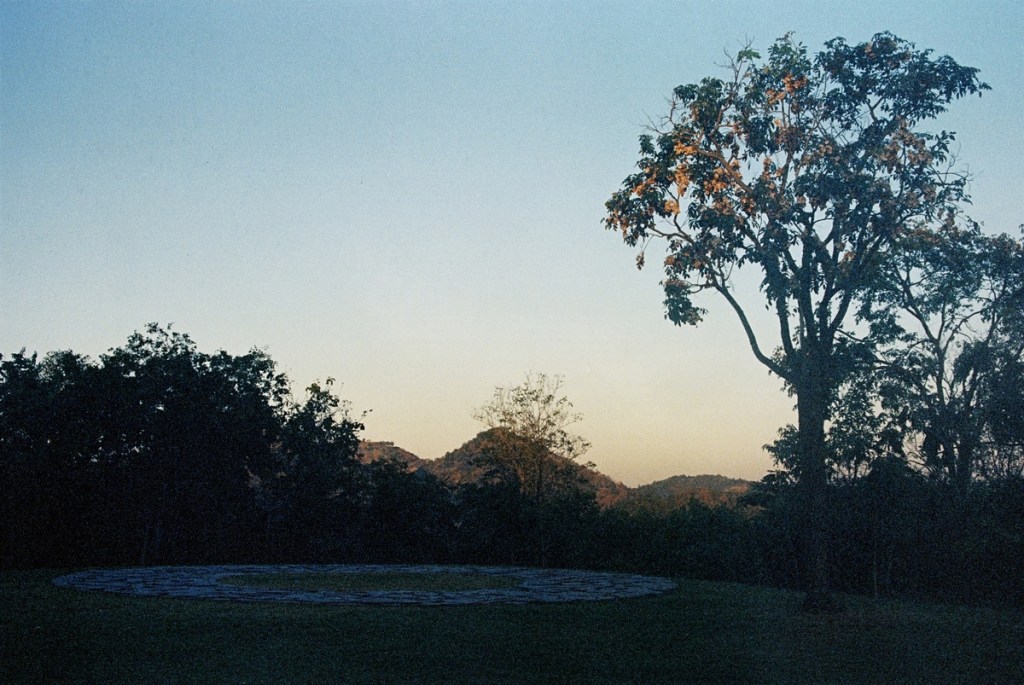
In Khao Yai, the trauma is ecological: soil degradation, the loss of biodiversity, the alteration of water systems, and the gradual disappearance of the forest. In neither case should the artwork impose itself as an autonomous and indifferent form. Rather, it must engage with what it encounters, interpret it, and make it legible once again. Korakrit transforms the ashes of the books into a building material, establishing a continuity between destruction and construction. Delcy Morelos’s OVUM project, engaging with a massive excavation site, takes that condition as the work’s point of origin: the 300-meter-long table, which encircles the excavation and serves as a place of encounter and meditation for visitors, constructs a new perspective that transforms the excavation into a Japanese rock garden without directly altering the stones. Both artists recognize that the limitation imposed by the site can become a generative condition. Art, in this sense, neither erases the trauma nor claims to restore an original state. It reframes it and makes it habitable. This is where the concept of healing comes into play: not as a cure understood as the elimination of the wound, but as the construction of a new relationship with it. The trauma is not hidden, but incorporated into the project. The ash, the excavation, the depleted soil, or the burnt staircase are not problems to be solved, but materials through which the site can regain meaning. In this sense, working with a building or a forest does not imply a substantial difference, but rather a variation in intensity and duration: what changes is the scale of the process, not its logic. The operation remains the same ‒ transforming a condition of loss into an expressive and poetic opportunity.
Your method does not involve master plans or preemptive renovations: the work comes first, then the space adapts; this requires a client willing to accept that the results are not certain in advance. How did you convince Marisa Chearavanont, an entrepreneur, philanthropist, and founder of the project in 2023, to trust this approach? And how do you maintain a certain degree of curatorial autonomy in cases like this?
I don’t think it was really a matter of convincing the client. Rather, it was a process through which we identified the critical issues and gradually built a shared vision. The first decision was to conceive a hybrid institution, structured simultaneously across two locations: the city and the forest, following a logic that draws, in part, on the model of the Dia Art Foundation. It would have been extremely complex to launch a project exclusively in Khao Yai, three hours away from Bangkok, without an urban presence capable of generating continuity and an audience. The second decision was to develop two projects in parallel, but according to different timelines: Bangkok Kunsthalle with a fast-paced rhythm, capable of immediately fostering a community and launching a program; Khao Yai Art Forest with a slower pace, in harmony with the cycles of nature and the gradual transformation of the landscape. Finally, the fact that the initial budget was relatively modest made it possible to propose a radical approach, in which the architectural design coincided with the curatorial program. In the absence of resources for a total preliminary transformation, it became necessary to work toward successive phases of activation, ensuring that each intervention was both operational and foundational. The relationship with the client could be described using an image: that between a cloud and a bolt of lightning. Marisa Chearavanont is a cloud of intuitions, visions, and possibilities; my role is that of a bolt of lightning that brings these energies to life, transforming them into concrete proposals, systems, and processes.
Marisa Chearavanont has come to understand that the most ambitious projects are not necessarily those defined in every detail from the very beginning. She has recognized that the absence of a definitive master plan does not equate to a lack of rigor, but rather implies a more demanding form of rigor: a situated rigor that is built over time.
My “fast and furious” method is not improvisation, but a deliberate strategy to set processes in motion ‒ to make things happen before conditions change. This approach requires a very high level of attention and the ability to listen, because every decision takes on a foundational character and influences subsequent possibilities. From the very beginning, we shared some clear principles: the centrality of the artists, the symmetrical relationship between artwork and space, the idea of healing, the rejection of purely cosmetic transformations, and the desire to build institutions capable of evolving over time. Trust arises from the consistency with which these principles are put into practice. This does not mean proceeding without direction, but rather recognizing that direction can be precise even in the absence of a predetermined final form. In this sense, the project takes the form of an open, but not arbitrary, process. Curatorial autonomy is a form of respect for the shared vision, the artists, the institution, and the public. It is maintained through clear roles and through ongoing dialogue with the founder and the working group. Autonomy does not mean doing whatever one pleases, but rather being able to develop a coherent line of thought without the works being subordinated to demands for representation, immediate consensus, or financial return. In this sense, the client’s trust becomes an epistemological condition of the project: it makes it possible to accept uncertainty not as a risk to be eliminated, but as a productive dimension intrinsic to the process itself.
THE PROJECTS BY STEFANO RABOLLI PANSERA
You founded the St. Moritz Art Film Festival in 2020 as a festival dedicated to video art, auteur cinema, and film production, and you serve as its artistic director alongside your role at the Kunsthalle in Bangkok. In your curatorial practice, does the festival remain a separate and autonomous project from the Kunsthalle, or is it a laboratory for you where ideas can flow into the Kunsthalle’s projects?
The festival is an autonomous project, with its own identity, its own audience, and a very specific relationship with the region of St. Moritz and the Engadine Valley. At the same time, it inevitably serves as a fundamental laboratory for my broader curatorial practice. Many artists I’ve met or presented in St. Moritz have subsequently been invited to Bangkok, such as Teddy Williams or Stephanie Comilang. At the Bangkok Kunsthalle, I work primarily with space; at the festival, I work with time. Film introduces issues of duration, editing, rhythm, repetition, silence, movement, and memory. These are dimensions that are not confined to the language of cinema but also profoundly inform the way I conceive the festival program. In both projects, a narrative dimension takes shape, though not in a linear sense. At the festival, each year, a curatorial theme is developed as a poetic and philosophical trajectory that transforms over time: from Face to Face to Becoming Landscape, to Meanwhile Histories, to Emerging Virtualities, and finally to If Music. These are not closed themes, but processes that evolve, layer upon one another, are rearticulated, and foreshadow the following year’s theme. I never consider cinema simply as an image projected into a given space. On the contrary, the festival’s concept stems from the desire to create space through an image ‒ or, more precisely, through a beam of light. This beam of light is capable of constructing an immaterial territory, made up of stories, times, and presences, around which a community gathers. In this sense, the festival, the Kunsthalle, and Khao Yai Art Forest can be understood as spatio-temporal devices. Film editing becomes a form of architecture: it organizes sequences, thresholds, openings, accelerations, and suspensions. Similarly, an exhibition can be conceived as a musical score or a choreography, in which the visitor constructs their own path through varying durations and intensities. The ideas developed during the festival can thus flow into the Kunsthalle, but not through a direct transposition of works or programs. What is transferred is rather a way of thinking: a sensitivity toward the relationship between space and narrative, between image and sound, between presence and absence, between memory and sequence, between movement and perception. The institutions remain autonomous, but they are part of the same endeavor. In both, what interests me is not so much producing content as creating the conditions for an experience ‒ spatial, temporal, and collective ‒ to take place.
In 2013, you curated the Angola Pavilion for the Venice Art Biennale, which was awarded the Golden Lion for Best National Participation; between 2017 and 2022, you worked for Hauser & Wirth in London and St. Moritz, an internationally renowned commercial gallery. You then moved to Thailand with two projects very different from his previous ones. Do you think the models of the Kunsthalle and the Khao Yai Art Forest can be replicated elsewhere? What did you bring from your previous experiences to these projects?
The method is replicable, but I don’t believe in replicable forms or solutions in the strict sense, nor in a literal transposition of the models. The Bangkok Kunsthalle and Khao Yai Art Forest arose from extremely specific geographical, cultural, economic, climatic, and social conditions. To separate the project from these conditions and reproduce it elsewhere uncritically would mean stripping it of its necessity. What can be transferred is not a form, but an attitude and a method: the idea that art can be generative in relation to space; that the project can emerge rather than be imposed; that one can work with what already exists, rather than replace it; and that an institution can be defined as a process, rather than as a finished object. From the Angola Pavilion, I developed a principle that has guided my work ever since: “To change nothing so that everything is different,” in Godard’s words. This has translated into the ability to work with very limited budgets, but also into the idea of intervening in space through minimal strategies capable of triggering profound transformations. I have learned to work simultaneously on multiple scales ‒ from the artwork to the city ‒ and to conceive of an exhibition not as an isolated entity, but as a relational field. That experience also taught me that an exhibition does not necessarily have to occupy a neutral institutional space, but can engage with architecture, a city, and history, making the context an integral part of the project. At the same time, it allowed me to grapple with a cultural complexity that cannot be reduced to a representation of identity or nationhood. At Hauser & Wirth, on the other hand, I learned how to operate within complex international structures, to closely oversee the production of artworks, and to build lasting relationships with artists. I came to understand how a cultural project can engage with diverse audiences, collectors, institutions, and regions without losing its coherence. My experience at the gallery also showed me the importance of creating contexts tailored to the artworks, rather than simply placing them in predefined spaces. Hauser & Wirth Somerset, for example, demonstrates how art, landscape, architecture, agriculture, and hospitality can form a single ecosystem. The move to Thailand therefore does not represent a break from my previous experiences, but rather a radicalization of them. At the Bangkok Kunsthalle and in Khao Yai, I was able to fully develop the idea that curatorial practice can produce space, architecture, landscape, and institution.
In a 2025 interview, you described space as a mental projection, shaped by perception and memory. How do you design an exhibition experience for an audience that brings with it such diverse memories and backgrounds?
Space is not merely a physical, measurable reality. It is also a mental projection, constructed through perception, memory, desire, language, and imagination. Each visitor moves through an exhibition carrying their own archive of images, experiences, and cultural references. The goal should not be to neutralize these differences or to lead everyone toward the same interpretation. On the contrary, an exhibition design should allow these differences to emerge and give rise to multiple interpretations.
For this reason, I tend to avoid overly didactic devices or narratives that are too rigid. Information should not exhaust the experience. Rather, I seek to create open situations in which the space and the artwork establish a unique relationship with each visitor. In this sense, I conceive of the exhibition experience as a choreography rather than a linear narrative. One can define thresholds, trajectories, pauses, accelerations, points of view, and intensities; however, one cannot completely predetermine what the visitor will feel or understand. This indeterminacy is not a failure of curation. It is its redemption and its deepest value. The curator does not produce definitive meanings but constructs a context in which works, spaces, and people can enter into a relationship.
In this sense, the curation at Khao Yai Art Forest was particularly revealing. The fundamental gesture often consists of leveling the ground ‒ in Thai Brap na din ‒ to allow the artwork to exist. It is a primary, almost archetypal action: creating an opening, establishing a condition, making the event possible.
In this minimal gesture, I recognize, in retrospect, the logic and process behind many installations: from Louise Bourgeois’s Maman to the works of Francesco Arena and Richard Long.
TAMING AND HEALING
Bangkok Kunsthalle occupies a historic building in Chinatown that is being “tamed” gradually, floor by floor, according to the works that enter it, without a definitive master plan and without prior renovation. Khao Yai Art Forest, on the other hand, operates on a much longer timescale due to reforestation and the slow transformation of the landscape. Can you imagine a moment when these projects might be considered “complete,” or is their incompleteness part of the project itself?
Conceptually, these projects have no conclusion but exist in a state of permanent transformation: they are ongoing construction sites.
Alison and Peter Smithson defined the construction site as “a ruin in reverse.” From this perspective, Bangkok Kunsthalle and Khao Yai Art Forest constantly maintain a tension between ruin and construction, between what has already been and what is not yet. For this reason, I cannot imagine a moment when they can be declared definitively complete. Their incompleteness is not a temporary limitation, but a structural condition. At the Bangkok Kunsthalle, the building is gradually transformed, floor by floor, through the installation of artworks. Each installation alters the space and leaves a trace that shapes what may happen next. The architecture does not proceed toward a predetermined final form, but takes shape as a constantly expanding palimpsest in which uses, experiences, and memories are layered. The artworks do not merely occupy the space, but continually extend and rewrite its structure. In Khao Yai, this temporal dimension is even more radical, because the project aligns with the rhythms of the forest. Trees grow slowly, water systems transform, vegetation evolves, animals return, and the artworks change in response to the climate and landscape. Here, the material of the project is not merely space, but biological time. And a project whose material is time cannot, by definition, be completed. Both projects therefore function as organisms: they do not strive for a definitive form, but rather for a state of dynamic equilibrium. In this sense, the institution is not a finished object, but a structure capable of transforming itself without losing its identity.
Coherence does not stem from the immutability of form, but from the rigor of the method and the principles that guide change. It is this continuity that guarantees the project’s identity, not its fixation on specific forms. Incompleteness thus becomes an operational condition: it allows unpredictability to enter the project. It leaves room for artists we do not yet know, for the changes in the territory, for cultural transformations, and for needs we cannot foresee.
In this sense, rather than finished works or established institutions, I am interested in working on ongoing processes: structures that do not close off but remain open to becoming.
Over the years, you’ve worked in contexts that are worlds apart, yet all on the margins of contemporary art circuits: Luanda, where you curated the Angolan Pavilion, winner of the Golden Lion in 2013; Bangkok, where you founded a kunsthalle in an abandoned building in Chinatown; and Sulcis, in Sardinia, where you designed Mangiabarche, an open-air gallery. Looking back, was it a successful experiment, or did it reveal the limitations of working in this type of context? And is this common thread a conscious choice, or a meaning assigned only in hindsight?
Yes, I recognize the value of marginality. However, I have never deliberately sought out the margins as a geographical or cultural category. Rather, I have sought contexts in which it was still possible to build something that was not already entirely defined. Looking back, I recognize a certain coherence. Luanda, Sulcis, St. Moritz, Bangkok, and Khao Yai are very different places, but they share a common condition: the possibility of challenging established models of contemporary art and cultural institutions. In this sense, marginality is not a peripheral position relative to a center, but a space of possibility, an open field where forms have not yet been fixed. Working in these contexts offers great freedom, but it also entails a greater sense of urgency: that of inventing new paradigms, new forms of thought and action. In already established centers, there are shared infrastructures, audiences, economies, and languages; in particular, market forces tend to impose pre-established codes and forms, which are often difficult to dismantle. In contexts considered peripheral, however, nothing can be taken for granted. It is necessary to build the context, create partners, and develop the material and cultural conditions so that the project can exist. In this sense, curatorial work approaches an almost constitutive practice: rather than producing objects or exhibitions, it is about generating conditions, activating relationships, and making the emergence of a field possible. This is perhaps the true common thread running through my practice: not so much producing works or exhibitions, but rather constructing contexts and cultivating the appropriate audience. In other words, establishing territories, creating worlds. When the right interlocutors and the appropriate spatial, intellectual, and relational conditions are in place, the results can emerge almost organically. Of course, there are also limitations. Distance from established circuits can lead to isolation; infrastructure can be fragile; and processes take much longer. There is also the risk of projecting a romanticized image of freedom onto the so-called margins, overlooking the social, economic, and political complexities that permeate them. For this reason, I would not simply speak of successful or failed experiments. Every project has revealed possibilities and contradictions. What matters is that the work does not treat the context as an exotic backdrop or as a periphery to be culturally colonized, but as a reality endowed with its own intelligence and its own capacity to transform the project. In this sense, the margin is not a place to depart from or arrive at, but a critical condition: a space where the project can still take place.
In the case of the Kunsthalle first and Khao Yai later, curatorial practice and architectural design come together through the concept of “healing”: you spoke of “taming” the building, achieved through the artworks and installations placed within the space. How did you “tame” these spaces? To what extent did your training as an architect influence this process?
Taming occurs through use, through minimal adaptations, not through a radical transformation. It is not a cosmetic operation: it is not a matter of making the spaces more comfortable or more familiar, but of establishing an ongoing relationship of care. In this sense, taming is not a formal operation, but a practice.
At the Bangkok Kunsthalle, we didn’t restore the building beforehand to adapt it to a museum model. We began to inhabit it through the artworks. Each intervention made a portion of the space usable, while simultaneously drawing new attention to what was already there: a staircase, a handrail, a charred wall, a threshold, a trace of the fire. The building was not normalized, but reactivated. Not Vital ran water along the handrail, transforming the staircase into a fountain and a waterfall. Nicola Amato polished the staircase handrail with green Venetian terrazzo, turning the staircase from a mere circulation element into a true feature of the space. Taming, therefore, does not erase the traumatic or unstable dimension of the space: it preserves it and makes it habitable. It is, even before a physical transformation, a transformation of the gaze. In this sense, it approaches what Agamben would define as a practice of use: entering into a relationship with something without exhausting it, without consuming it, without reducing it to a commodity or a relic. Something similar is happening in Khao Yai, but on a territorial scale. We do not seek to transform the forest into a controlled garden, nor to impose an external form on the landscape. We intervene in water management, reforestation, and agriculture, but always by following and amplifying the forces already present. The project does not superimpose itself on the territory, but emerges from it. Here, my training as an architect is crucial. It allows me to interpret space not as a neutral container, but as a field of relationships: between materials, light, proportions, structure, use, climate, memory, and bodies. Space is not something to be occupied, but something that comes alive in the relationship between the body and the world. In this sense, the relationship with food and agriculture also becomes significant: food is not reduced to gastronomy, but implies a relationship with the soil, with natural cycles, and with time. Agriculture itself can be understood as a form of Land Art: a practice that shapes the landscape, not by imposing a form, but by working with its processes. The concept of healing arises precisely from this convergence: it is neither a return to an original state nor the erasure of a wound, but the construction of a new relationship with what has been. Caring for a building or a forest means allowing them to continue to exist as places of experience, open to time, to others, and to the unexpected.
THE IMPORTANCE OF THE SPACE
In the past, you worked for Herzog & de Meuron, an internationally renowned architecture firm based in Basel, whose projects place great emphasis on the building envelope and materials, as well as on the human perception of space. To what extent have these elements carried over into your curatorial practice and your approach to exhibition spaces?
Once an architect, always an architect. An interest in space constitutes an ontological dimension of my research, even when my work does not result in the construction of a building. My experience at Herzog & de Meuron fits, in a nonlinear way, within a tradition that stretches from Aldo Rossi ‒ their mentor ‒ and his idea of memory as the operational structure of the project, to the reflections of Rémy Zaugg, who shifts the focus from the object to the act of seeing. In this transition, architecture ceases to be conceived as form and instead takes shape as the condition of possibility for experience.
In this sense, the material, or the context, is never neutral. The material is not simply building material, but a field of forces: it retains memory, modulates light, absorbs and reflects, resists and yields. The material acts upon the body and perception, determining a situated relationship between subject and space. I am interested in the moment when architecture does not represent space, but makes it happen.
Here, a connection emerges with my curatorial practice: space is not a container but a lived dimension that emerges in the relationship between the object and the environment. Architecture is therefore a device that organizes this relationship, constructing thresholds, orientations, proximities, and distances.
At the same time, the concept of use ‒ in the meaning that Giorgio Agamben attributes to the term ‒ has been fundamental to my practice. To use a space does not mean to consuming it, but to enter into a relationship with it without exhausting it, without possessing it. In this sense, architecture is not a finished state, but a continuous practice.
This is why I am increasingly convinced that architecture today can manifest itself as an act of resistance to construction. It is not a matter of denying the act of building, but of suspending the automatism that makes it necessary, opening up a space in which the project can emerge from the given conditions, rather than imposing itself upon them.
Architecture, then, does not coincide with the building itself, but with the rigor with which every decision arises from the specificity of a context. It is a situated practice, irreducible to universal models.
In this sense, even when I work as a curator, I continue to operate as an architect. The difference is that my architecture now unfolds in unexpected and varied forms: it can be a sequence of works, a relationship with the landscape, a fog, a film screening, a path, or a temporary way of inhabiting a place.
I have simply shifted my focus from building to inhabiting. And inhabiting means safeguarding, caring for, allowing to be-
Healing, or caring, is, literally, making space. Curatorial practice thus becomes an extension of architecture: not the production of objects, but the creation of conditions. It is not a matter of giving form to space, but of setting up a field in which space can emerge as an experience ‒ to be perceived, invented, and continually reactivated.
Sara Collivasone
Stefano Rabolli Pansera
Bangkok Kunsthalle / Khao Yai Art Forest
The text has been translated in English using AI
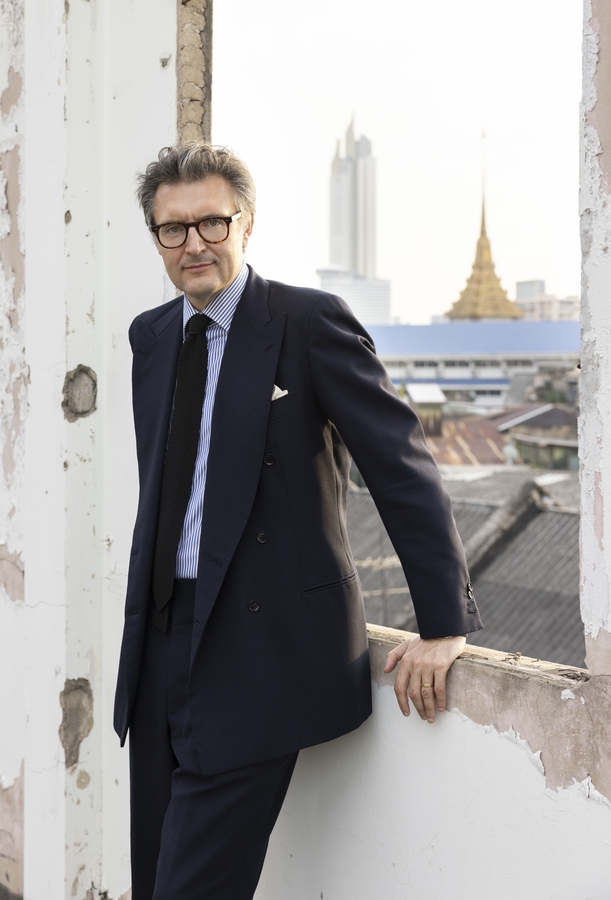
Stefano Rabolli Pansera. Photo by Andrea Rossetti 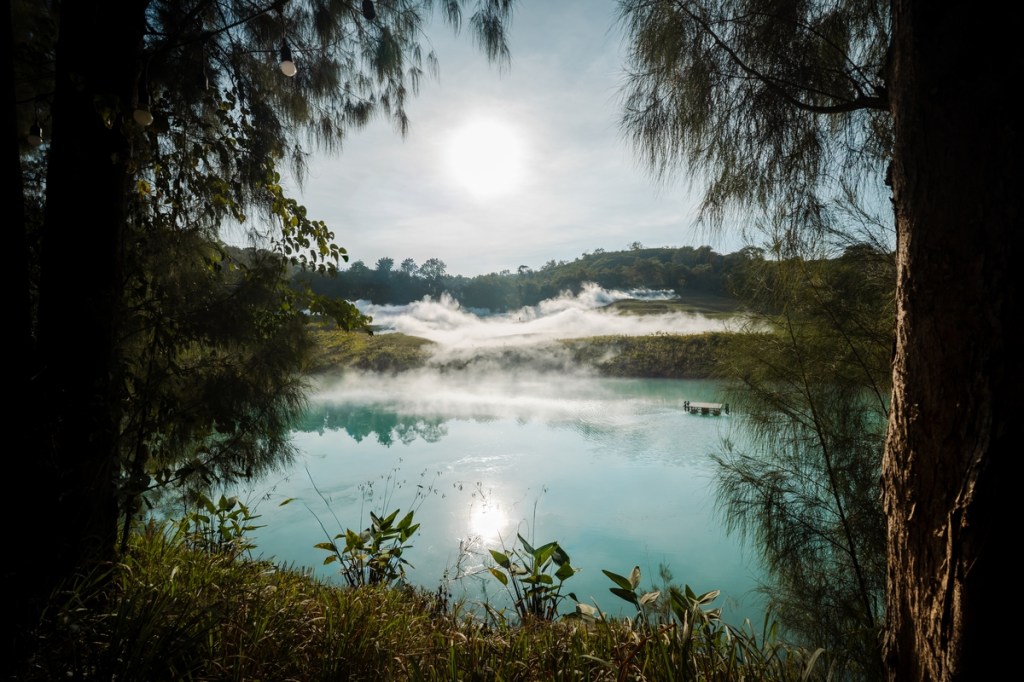
Fujiko Nakaya, Khao Yai Fog Forest, Fog Landscape #48435, 2024, Khao Yai Art Forest, Courtesy Khao Yai Art. Photo by Chittawan Limcharoen 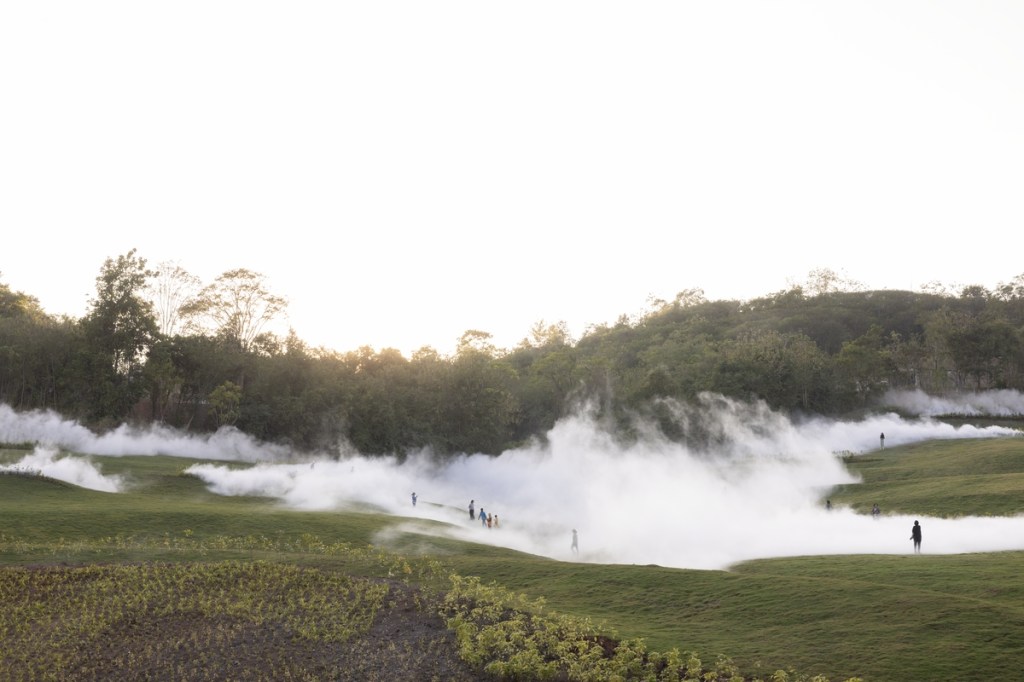
Fujiko Nakaya, Khao Yai Fog Forest, Fog Landscape #48435, 2024, Khao Yai Art Forest, Courtesy Khao Yai Art. Photo by Andrea Rossetti 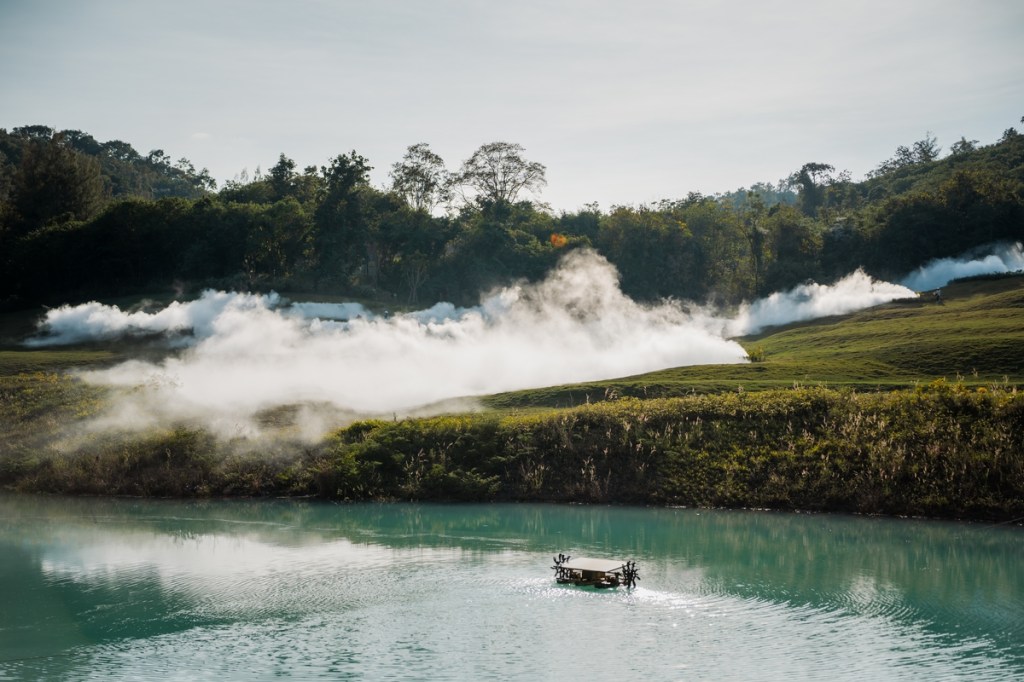
Fujiko Nakaya, Khao Yai Fog Forest, Fog Landscape #48435, 2024, Khao Yai Art Forest, Courtesy Khao Yai Art. Photo by Chittawan Limcharoen 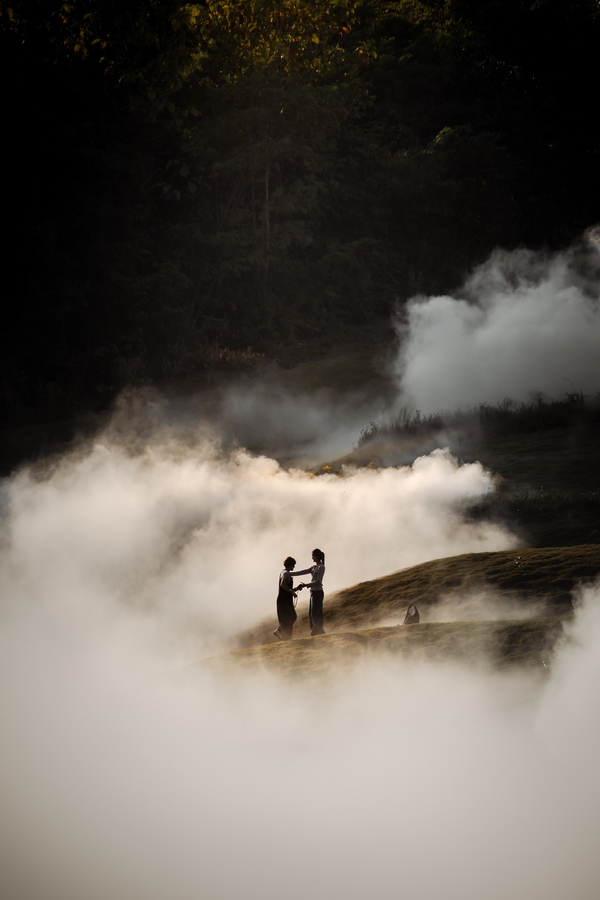
Fujiko Nakaya, Khao Yai Fog Forest, Fog Landscape #48435, 2024, Khao Yai Art Forest, Courtesy Khao Yai Art. Photo by Chittawan Limcharoen Fujiko Nakaya, Khao Yai Fog Forest, Fog Landscape #48435, 2024, Khao Yai Art Forest, Courtesy Khao Yai Art. Photo by Chittawan Limcharoen 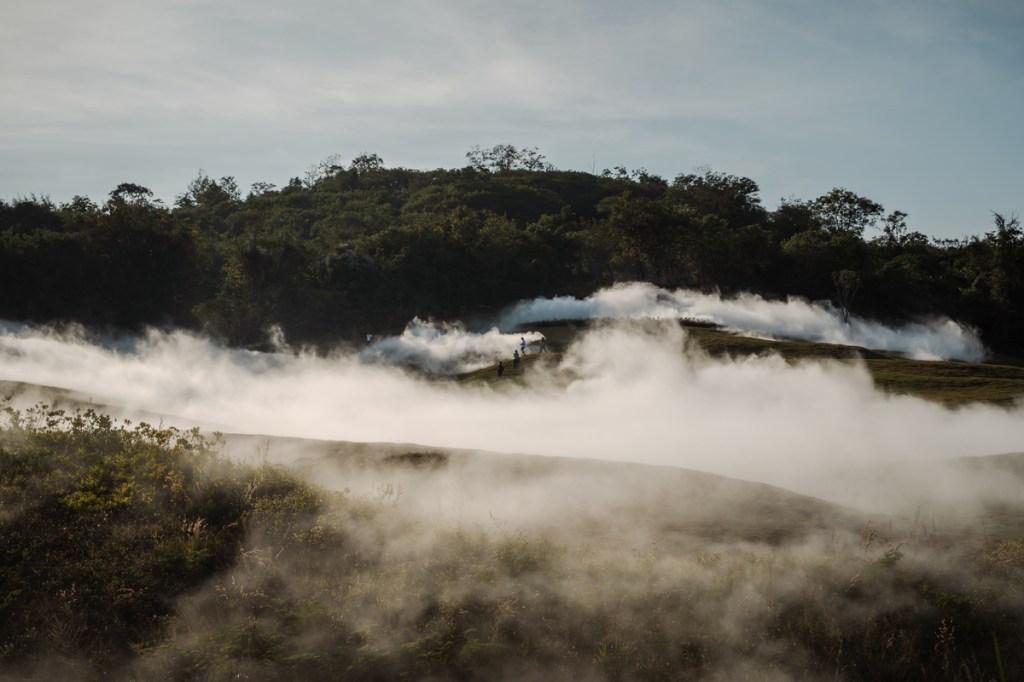
Fujiko Nakaya, Khao Yai Fog Forest, Fog Landscape #48435, 2024, Khao Yai Art Forest, Courtesy Khao Yai Art. Photo by Chittawan Limcharoen 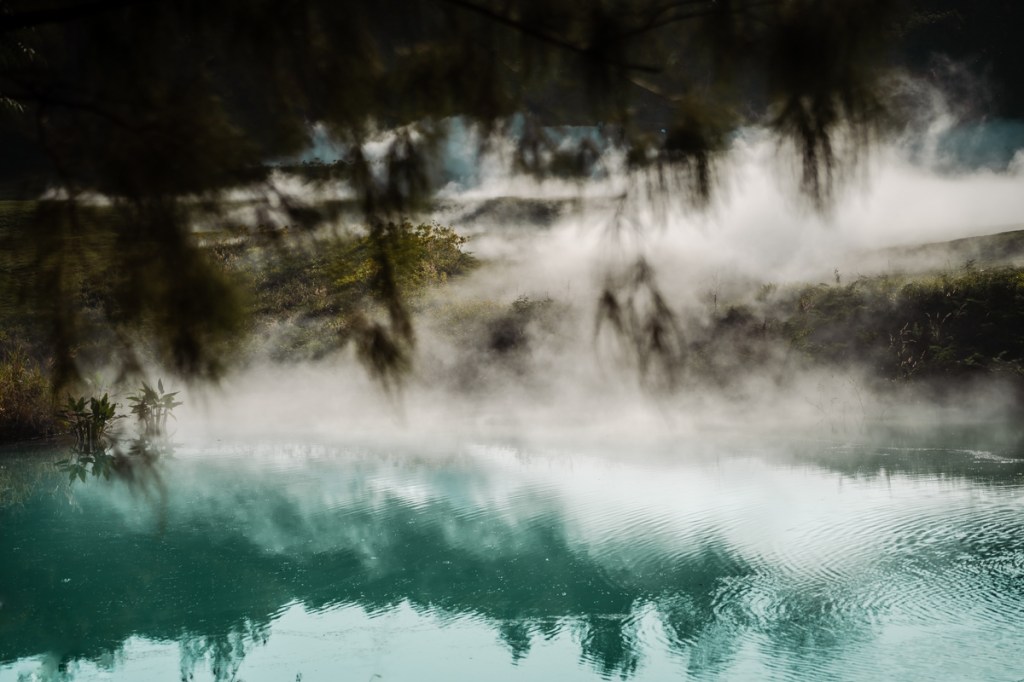
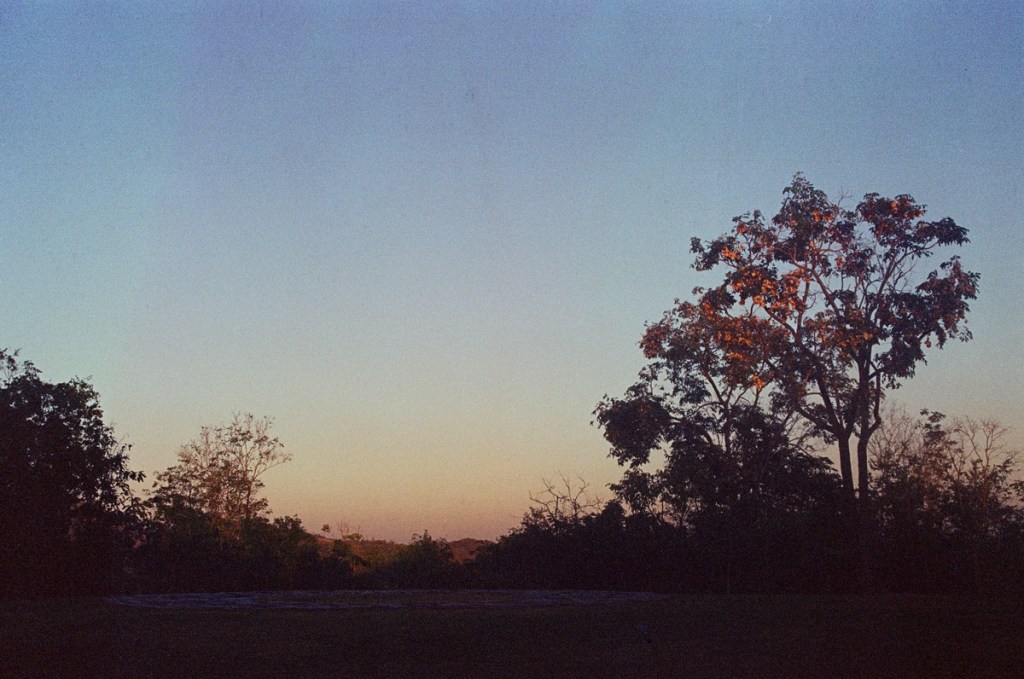
Fujiko Nakaya, Khao Yai Fog Forest, Fog Landscape #48435, 2024, Khao Yai Art Forest, Courtesy Khao Yai Art. Photo by Chittawan Limcharoen Khao Yai Art Forest, Nature, 2025, Courtesy Khao Yai Art. Photo by Ratsiree Rattanawan Khao Yai Art Forest, Nature, 2025, Courtesy Khao Yai Art. Photo by Ratsiree Rattanawan Bangkok Kunsthalle. Photo by Andrea Rossetti 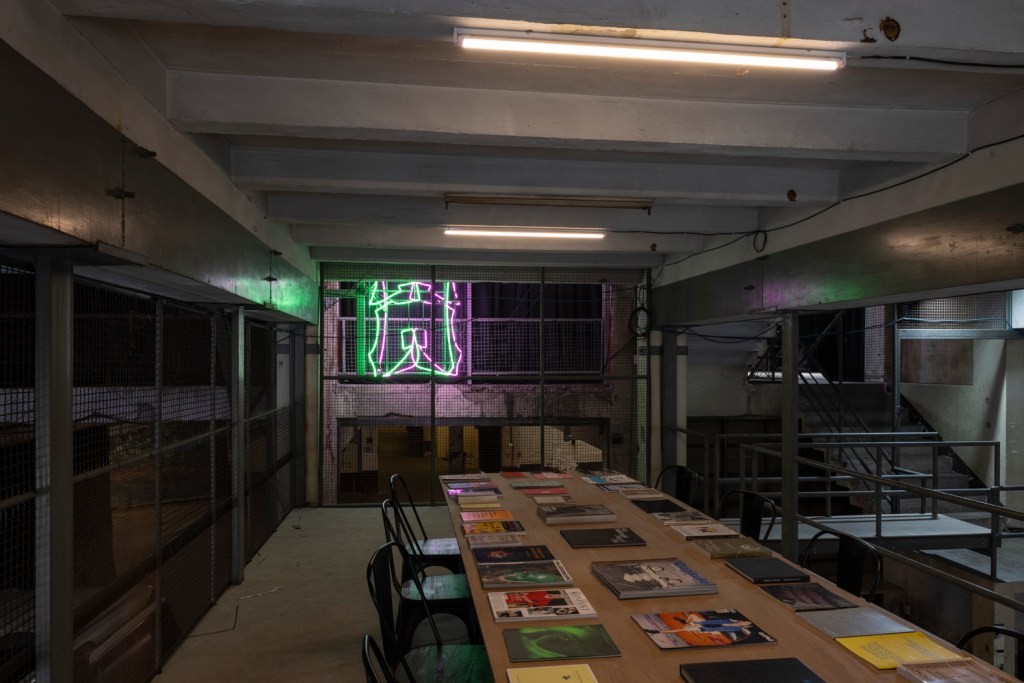
Bangkok Kunsthalle. Photo by Andrea Rossetti 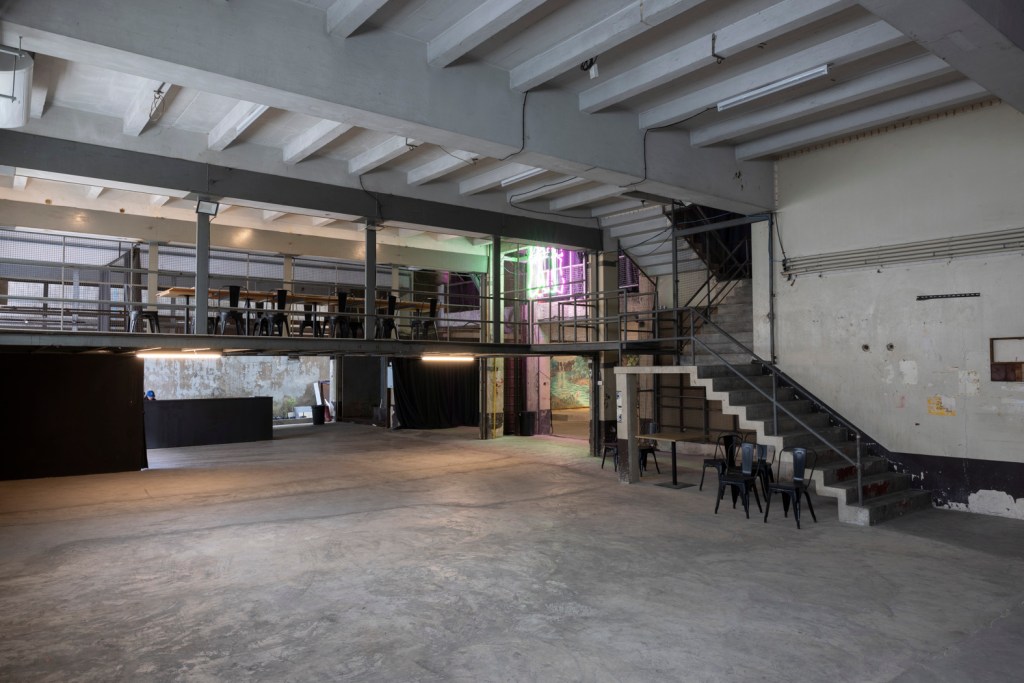
Bangkok Kunsthalle. Photo by Andrea Rossetti 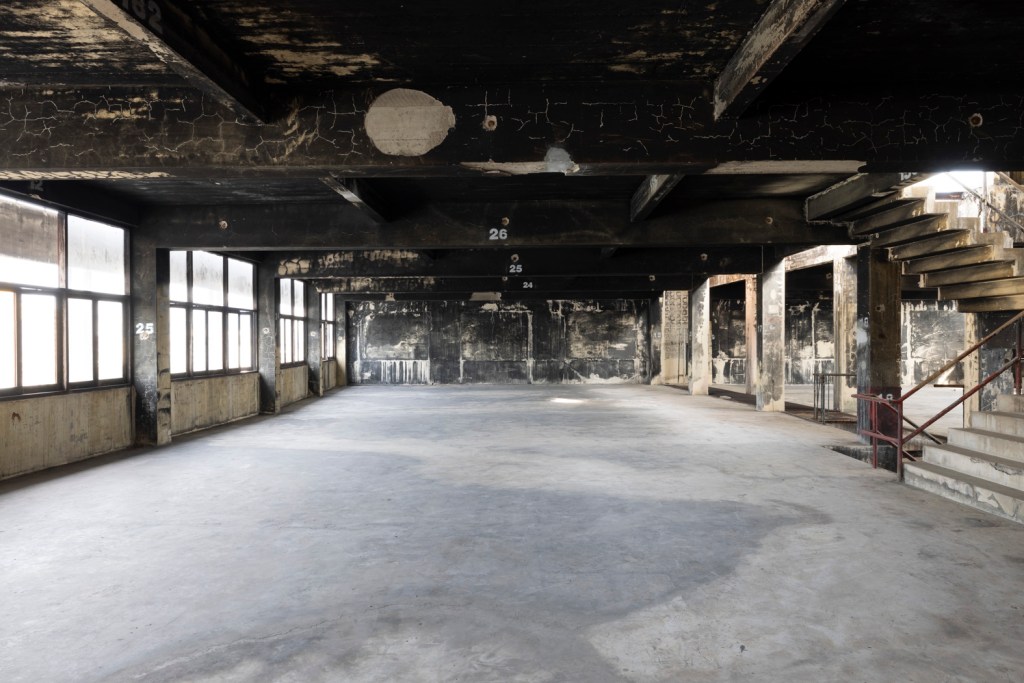
Bangkok Kunsthalle. Photo by Andrea Rossetti

