Until 22 November 2026, Palazzo Franchetti in Venice is hosting the exhibition “Vyacheslav Akhunov: Instruments of the Mind”, curated by Sara Raza and a collateral event of the 61st International Art Exhibition of La Biennale di Venezia, where the works of the Uzbek artist offer a poetic reflection on the relationship between memory, the archive and the artist’s particular condition within the context of the Soviet and post-Soviet art system.
In analysing the situation of Soviet artists excluded from the “official” art system – which was supported by and integrated into the party structure – Borys Groys (B. Groys, The Other Gaze: Russian Unofficial Art’s View of the Soviet World, pp. 55-89, in A. Erjavec (ed.), Postmodernism and the Postsocialist Condition: Politicised Art under Late Socialism, Berkeley: University of California Press, 2003) has observed that, despite the specificities of their individual trajectories, the majority of unofficial artists conceived of their practice as a means of critical reflection on complex issues, in contrast to the trivialised and profane dimension of dominant Soviet art and culture.
A similar situation appears to characterise the work of Vyacheslav Akhunov (Osh, Kyrgyzstan, 1948), whose artistic practice takes the form of a stance against the dominant Soviet ideology, to the extent that some of his works have only now been produced or presented to the public, after decades spent in his archive. The exhibition, on display until 22 November 2026 at Palazzo Franchetti in Venice and curated by Sara Raza, thus develops a reflection aimed at challenging what for years has relegated Akhunov to the margins of the art world, but does so through a rich poetic language, dense with metaphors and always intimately linked to Soviet culture.
VYACHESLAV AKHUNOV’S EXHIBITION AT PALAZZO FRANCHETTI
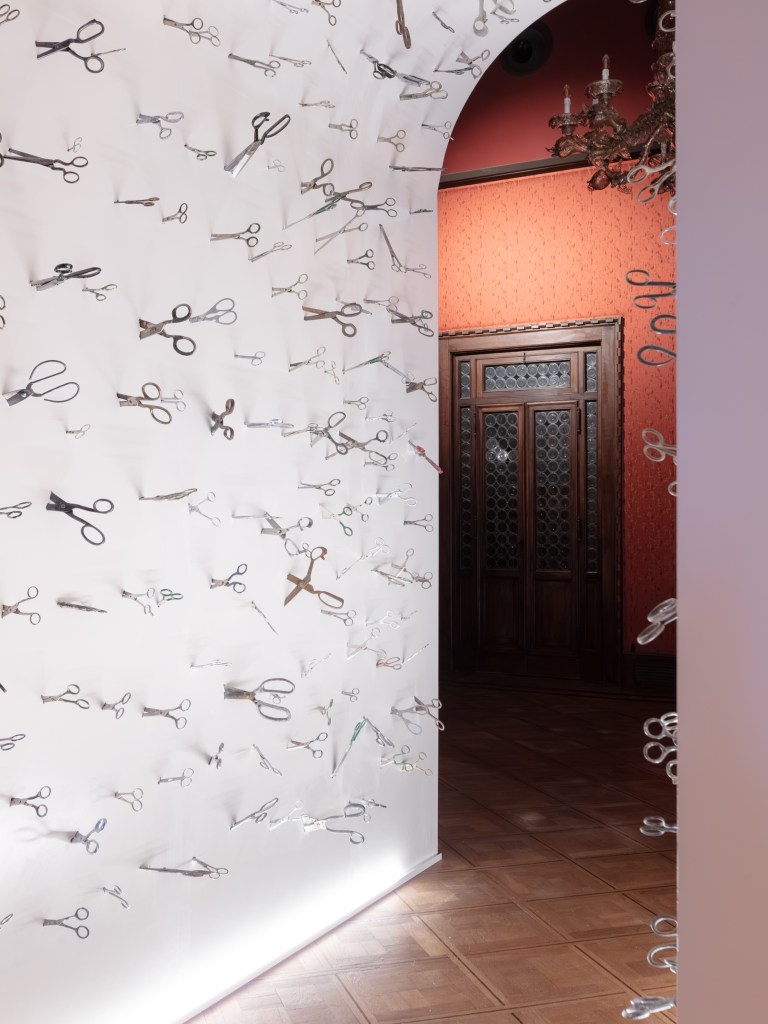
The exhibition is structured across a series of rooms, each dedicated to a different aspect of Akhunov’s artistic vision and conceptual universe. The entrance is marked by a triumphal arch covered with scissors stuck in the wall, a work that satirises solemn Soviet inauguration ceremonies and their propagandistic nature. Subsequently, the serial repetition of images and figures drawn from both institutional and popular culture becomes the strategy through which Akhunov further explores the relationship between artistic production and the power structures that shaped Soviet culture. The accumulation of repeated elements takes on the significance of a ritual gesture, a mental and creative exercise, comparable to the recitation of one of those mantras that had already interested Akhunov from the first half of the 1970s onwards. This process of re-examining the Soviet cultural heritage is particularly evident in the reinterpretation of Malevich’s Black Square, a work symbolic of Russian modernism that exerted a great influence on the Soviet artistic and cultural system, and which Akunov chose to reinterpret by creating two squares of the same dimensions as Malevich’s, but featuring a biblical quotation painted within them, thereby radically departing from his predecessor’s artistic vision and expressing, in this way, how even the modernist project had, in his eyes, exhausted all innovative energy. In response to the crisis of past models, however, Akhunov proposes a path of inner spiritual evolution, encapsulated in the final site-specific installation ROAD TO LIGHT, inspired by Sufi mysticism.
THE CURATORSHIP BY SARA RAZA
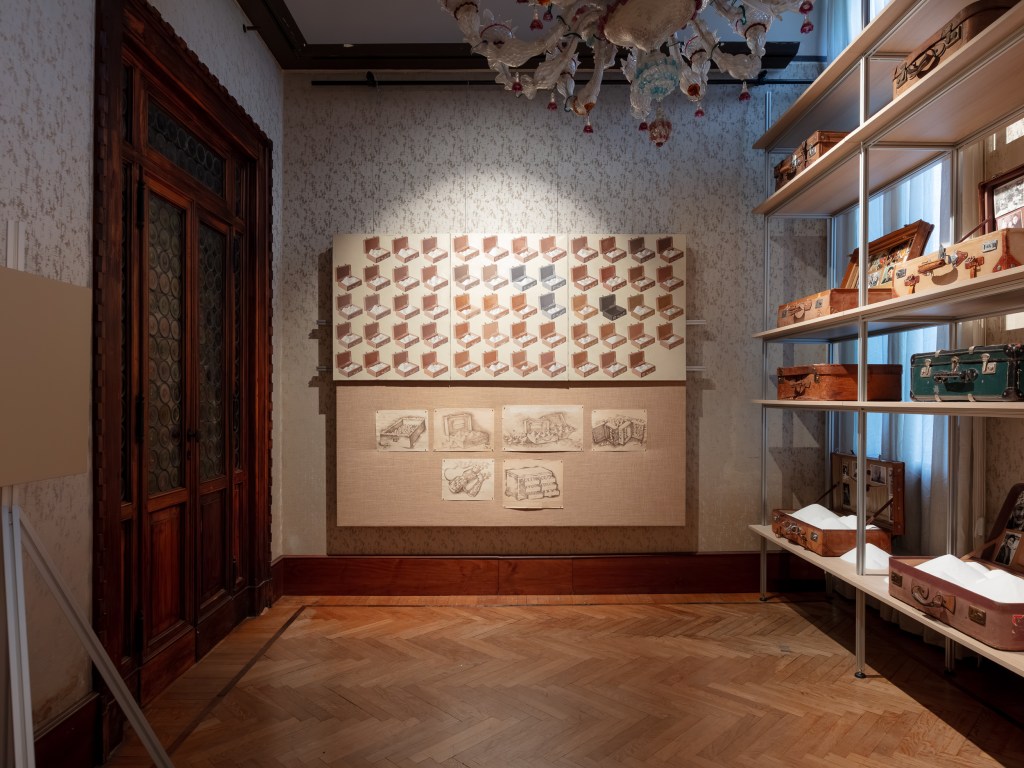
In examining the situation of an artist who remained on the fringes of the official Soviet art system, curatorial choices take on a central role, as they contribute not only to accurately reconstructing Akhunov’s artistic career, but also to recreating the cultural, social and political climate of the context in which he operated. It is within this framework that the careful selection of works takes place, aimed at reconstructing the characteristics and contradictions of the Soviet cultural context, addressing themes such as power structures, migration, the relationship with artistic tradition and, above all, the plight of those excluded and marginalised by the art system. Consequently, the artist’s archive plays a pivotal role: a repository of drafts, sketches and projects developed over the years which, due to a lack of resources stemming from his position as an outsider, remained unrealised for a long time; these are effectively represented in the installation Work in the Desk, which invites the visitor to step inside a monumental desk inspired by the table on which Akhunov collected drawings, sketches and projects for years, thereby transforming the archive itself into a work of art. Equally significant is the curatorial decision to adopt a dual dating system for many of the works on display, distinguishing between the time of their conception and that of their actual realisation, often decades later. This approach highlights the consequences of Akhunov’s exclusion from the official circuits of Soviet art, a circumstance that for a long time prevented him from accessing the resources needed to bring his projects to fruition, hampered by the lack of acceptance of his artistic language and the themes he addressed, as these were not in line with the cultural and political agenda supported by the Soviet regime.
In relation to such a body of work, curatorship thus becomes an instrument of historical memory, where the vital impulse of the archive is reinterpreted in order to evoke, on the one hand, the spirit and complexity of an era and its culture and, on the other, the recognition of a critical and artistic tension that was, for too long, relegated to the margins. Therefore, the mantras, so dear to Akhunov, become a tool for reinterpreting not only the past, but also the present.
Elia Castello
9 May – 22 November 2026
Vyacheslav Akhunov: Instruments of the Mind
curated by Sara Raza
Palazzo Franchetti
San Marco 2847, Venezia
https://www.labiennale.org/en/art/2026/collateral-events/vyacheslav-akhunov-instruments-mind
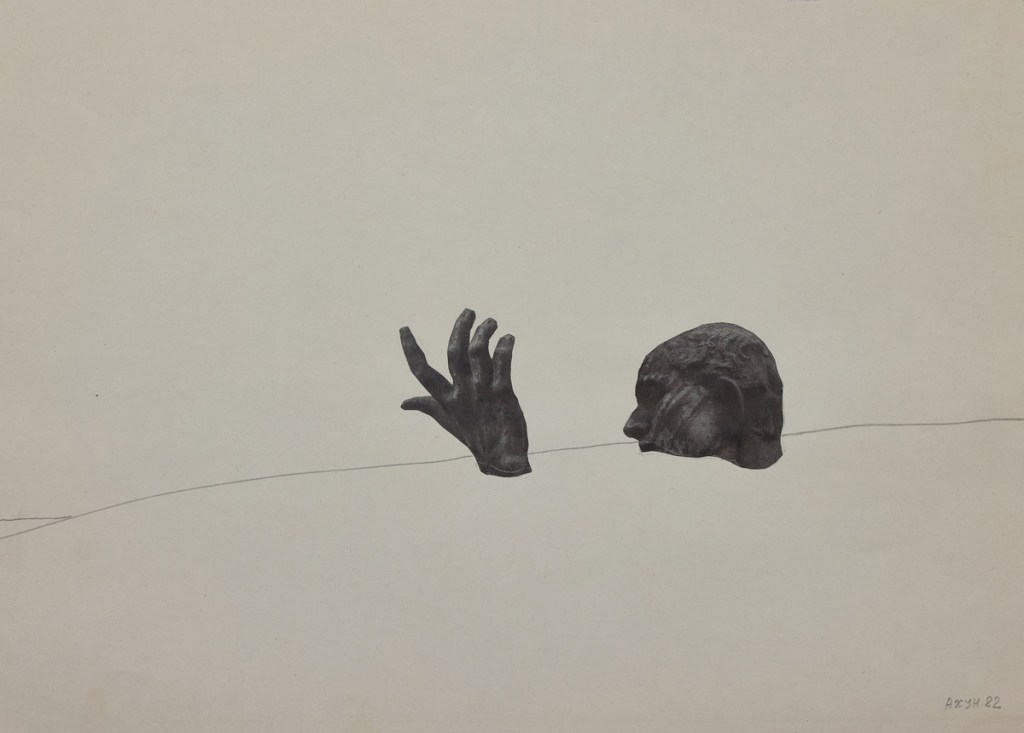
A Yearning for the Unseen, by Vyacheslav Akhunov, 1982. From the series “Lenin’s Plan of Monumental Propaganda”. Courtesy of ACDF 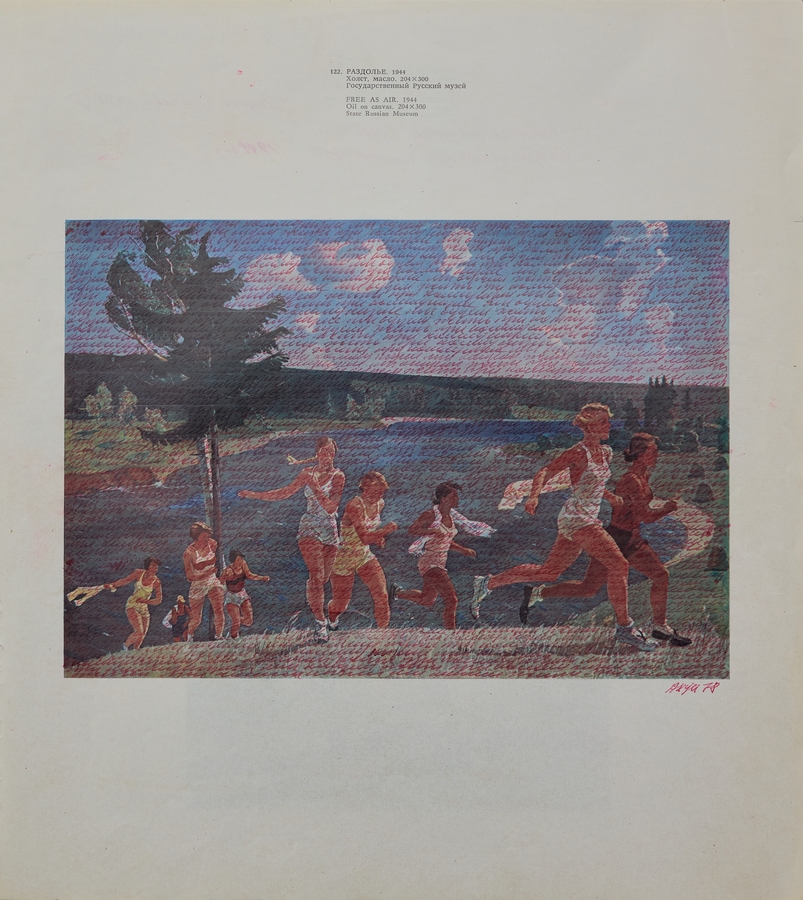
Mantra: We Will Live Under Communism, by Vyacheslav Akhunov, 1978. From the series “Mantras of the USSR.” Courtesy of ACDF 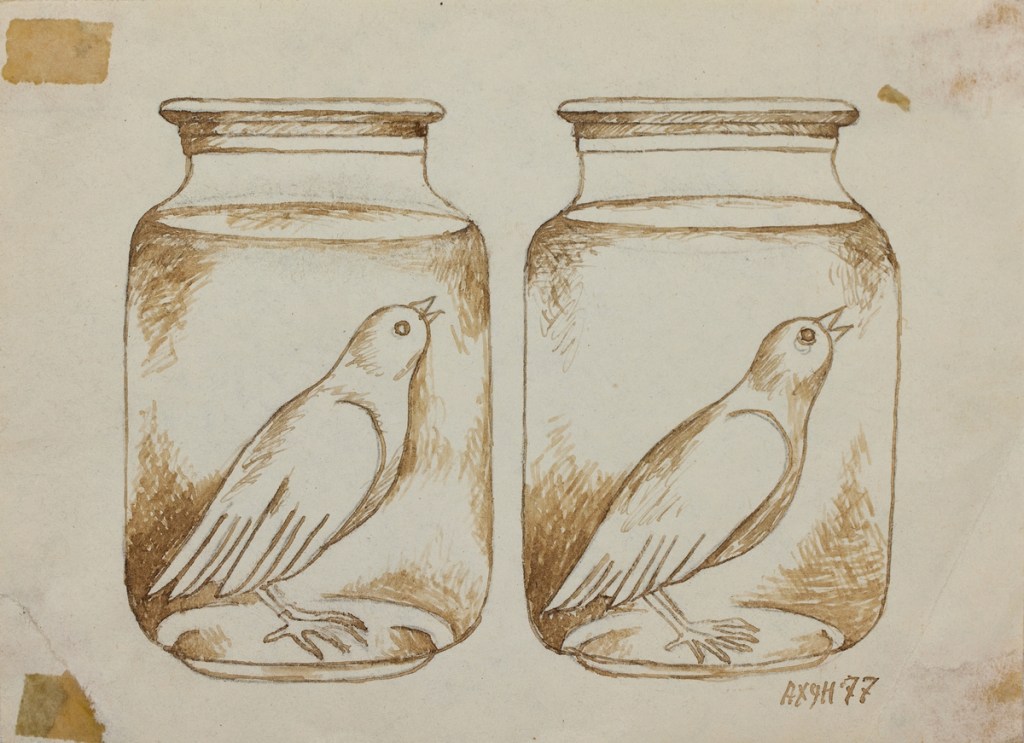
Project, Bird in a Jar, by Vyacheslav Akhunov, 1977. Courtesy of ACDF 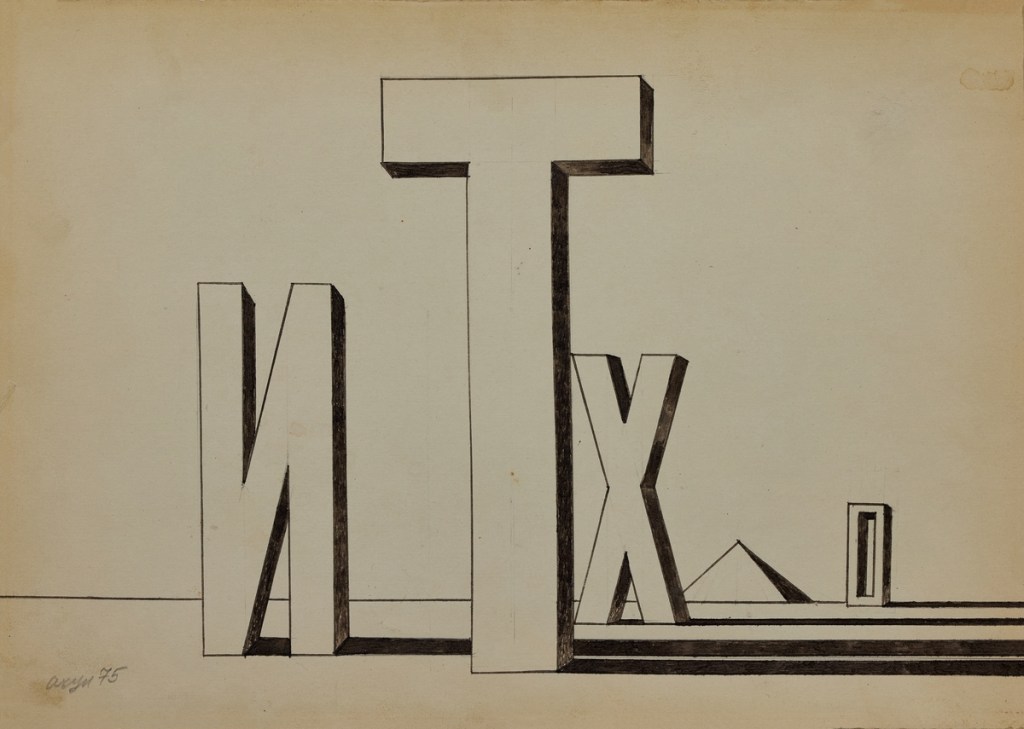
Akhunov. Quiet, by Vyacheslav Akhunov, 1975. Courtesy of ACDF 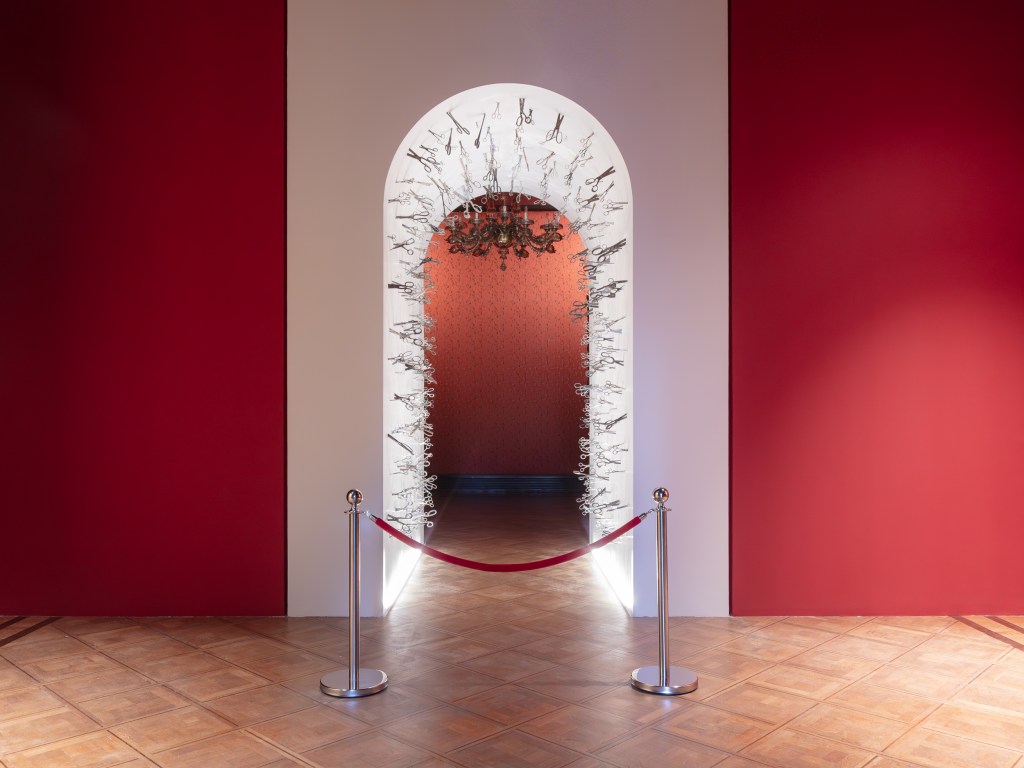
Triumphal Arch (1979/2026) by Vyacheslav Akhunov, installation view at Palazzo Franchetti. Courtesy of Uzbekistan Art and Culture Development Foundation (ACDF) 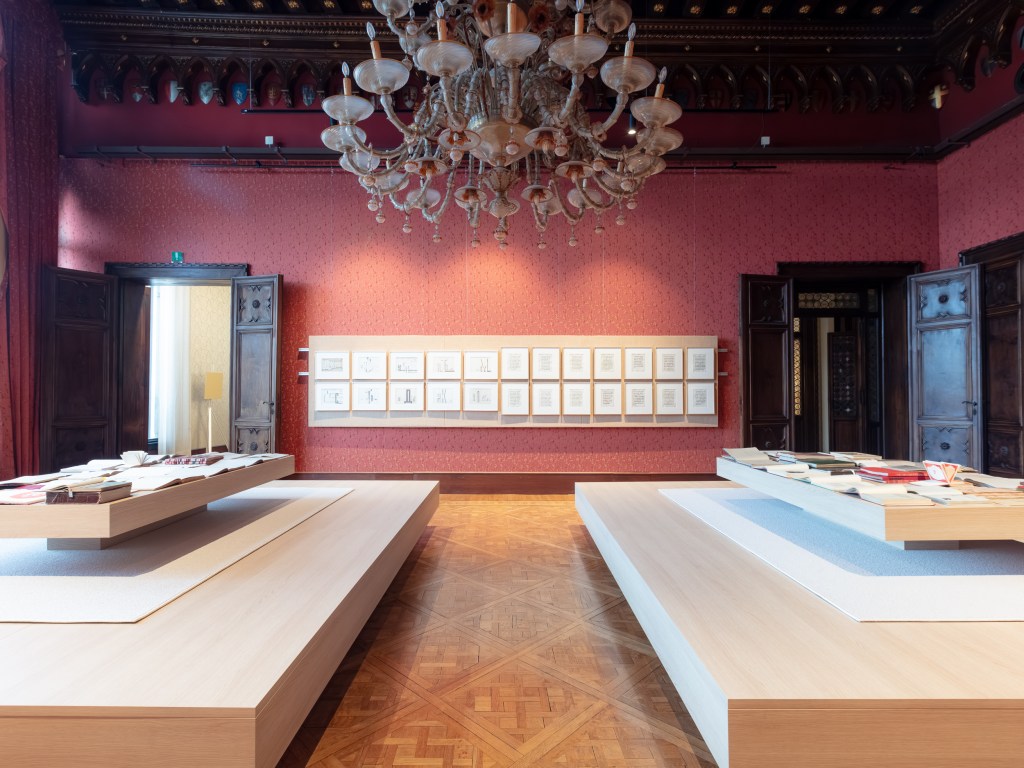
Library by Vyacheslav Akhunov. Courtesy of Uzbekistan Art and Culture Development Foundation (ACDF) (Detail) Triumphal Arch (1979/2026) by Vyacheslav Akhunov, installation view at Palazzo Franchetti. Courtesy of Uzbekistan Art and Culture Development Foundation (ACDF) 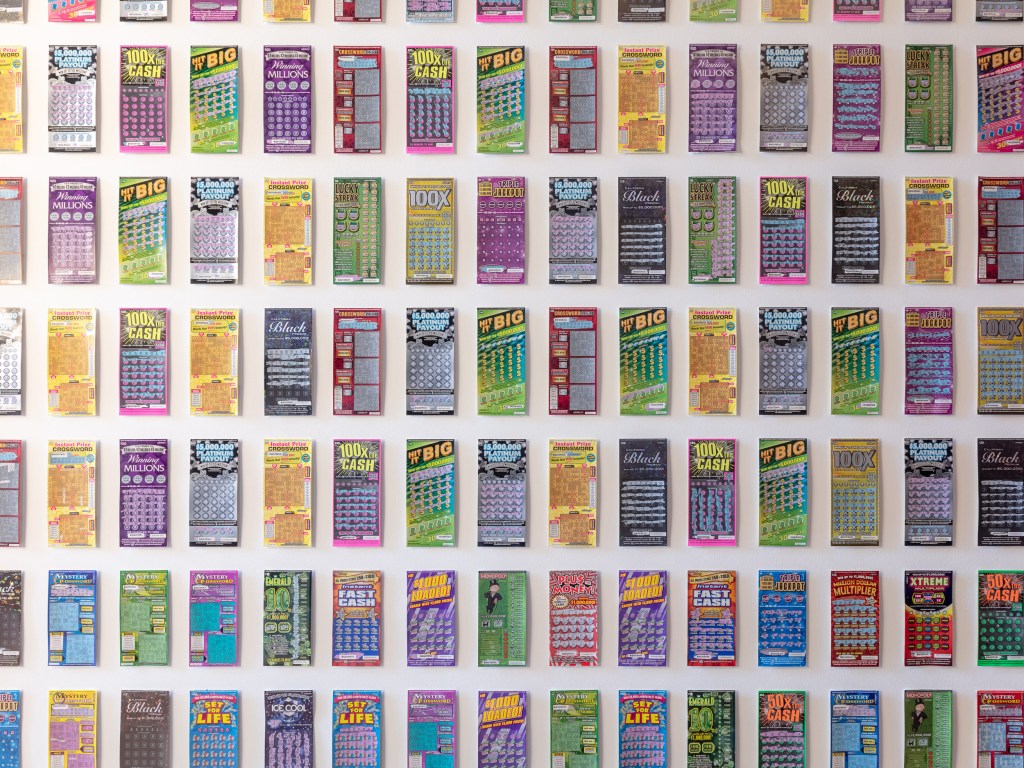
Code F63.0 Lottery Tickets (2018) by Vyacheslav Akhunov, installation view at Palazzo Franchetti. Courtesy of Uzbekistan Art and Culture Development Foundation (ACDF) Suitcases and Shifting Sands (1974/2026) and Cases Filled with Sand (1993) by Vyacheslav Akhunov, installation view at Palazzo Franchetti. Courtesy of Uzbekistan Art and Culture Development Foundation (ACDF) 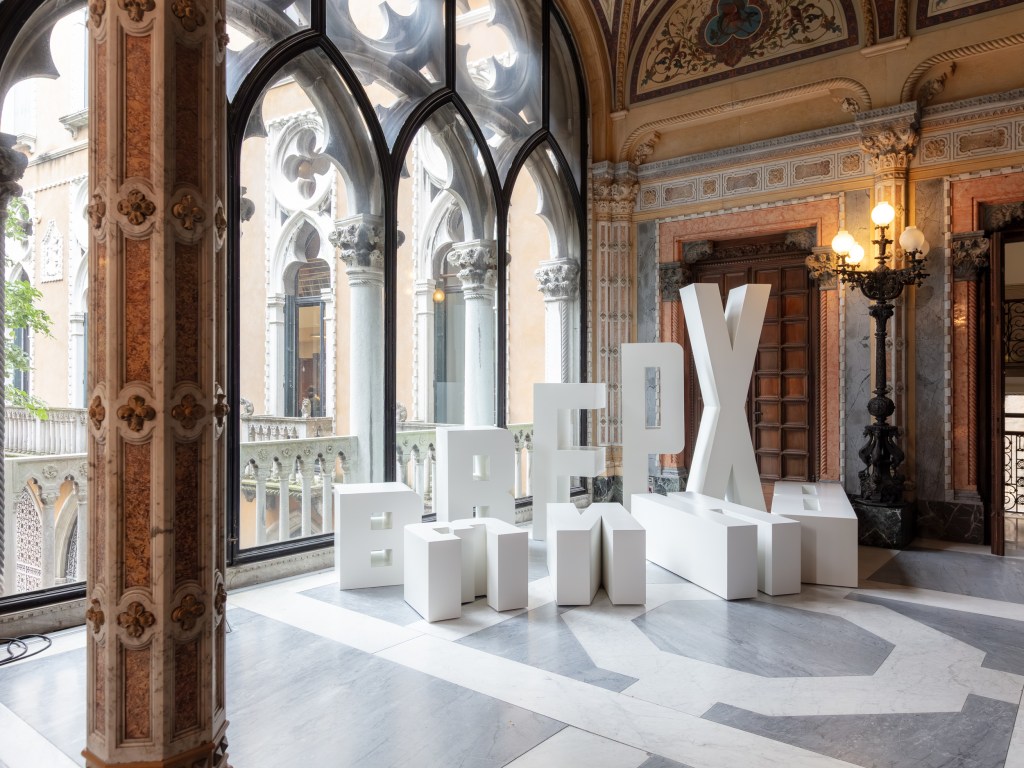
Up Down (2026) by Vyacheslav Akhunov, installation view at Palazzo Franchetti. Courtesy of Uzbekistan Art and Culture Development Foundation (ACDF) 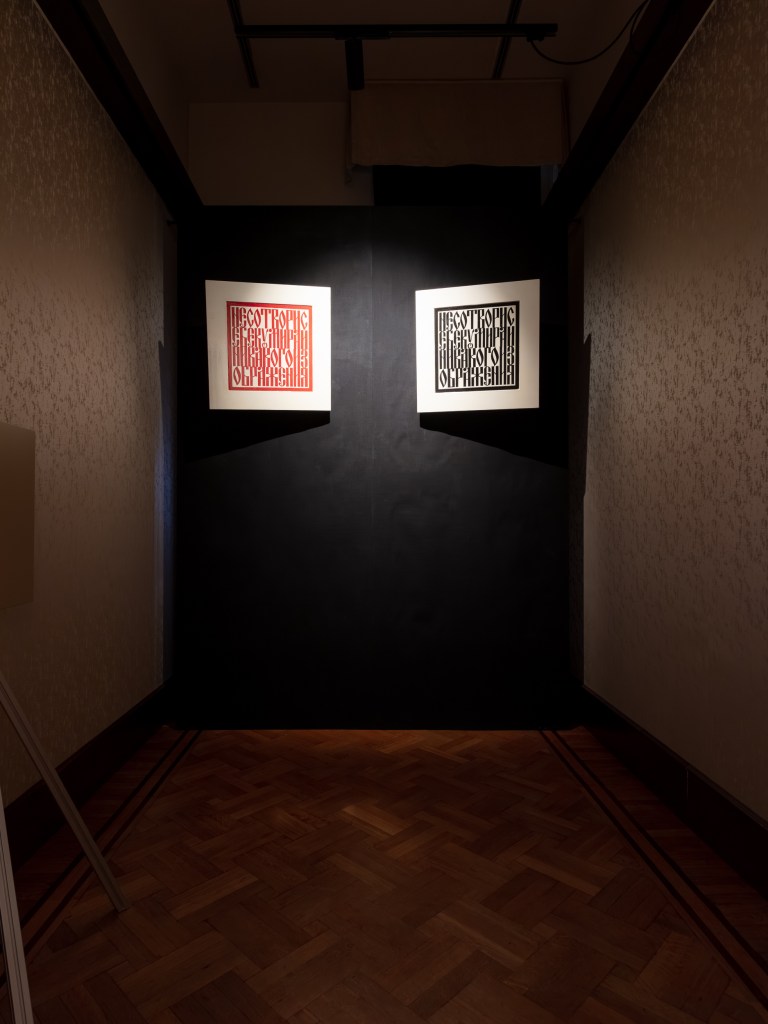
Icons by Vyacheslav Akhunov. Courtesy of Uzbekistan Art and Culture Development Foundation (ACDF)
The text has been translated in English using AI

