We met Bogdan Koshevoy during a studio visit in Venice, on the island of Giudecca. The artist welcomed us into his bright atelier, which he shares with his partner and painter Daria Dmytrenko.
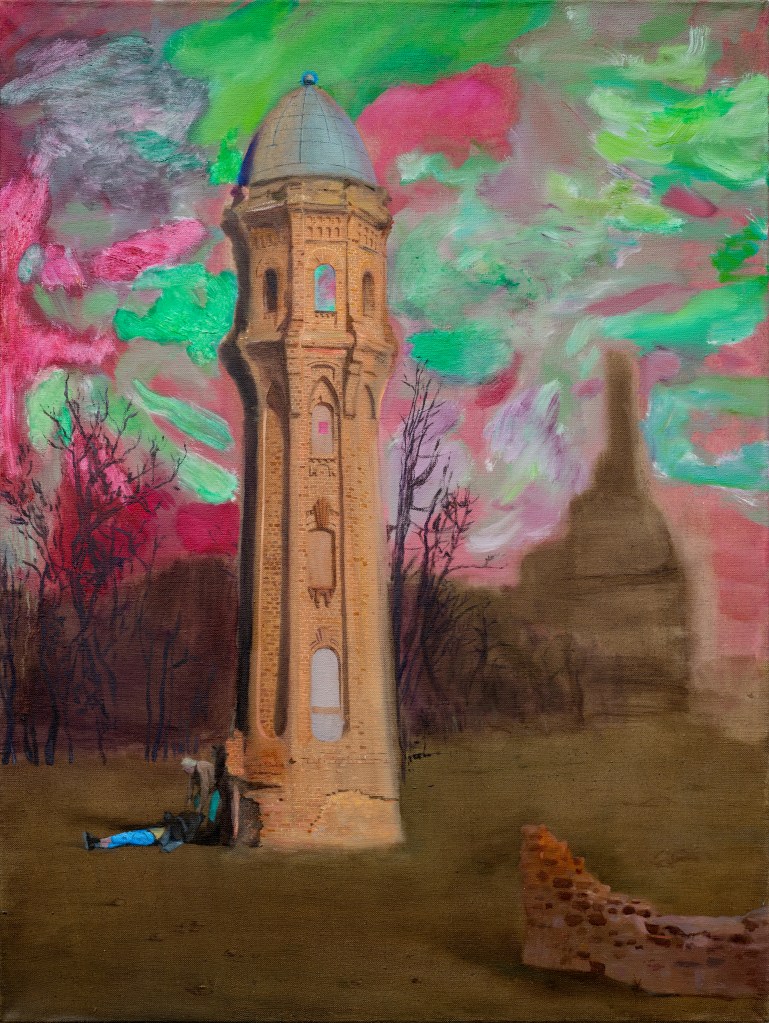
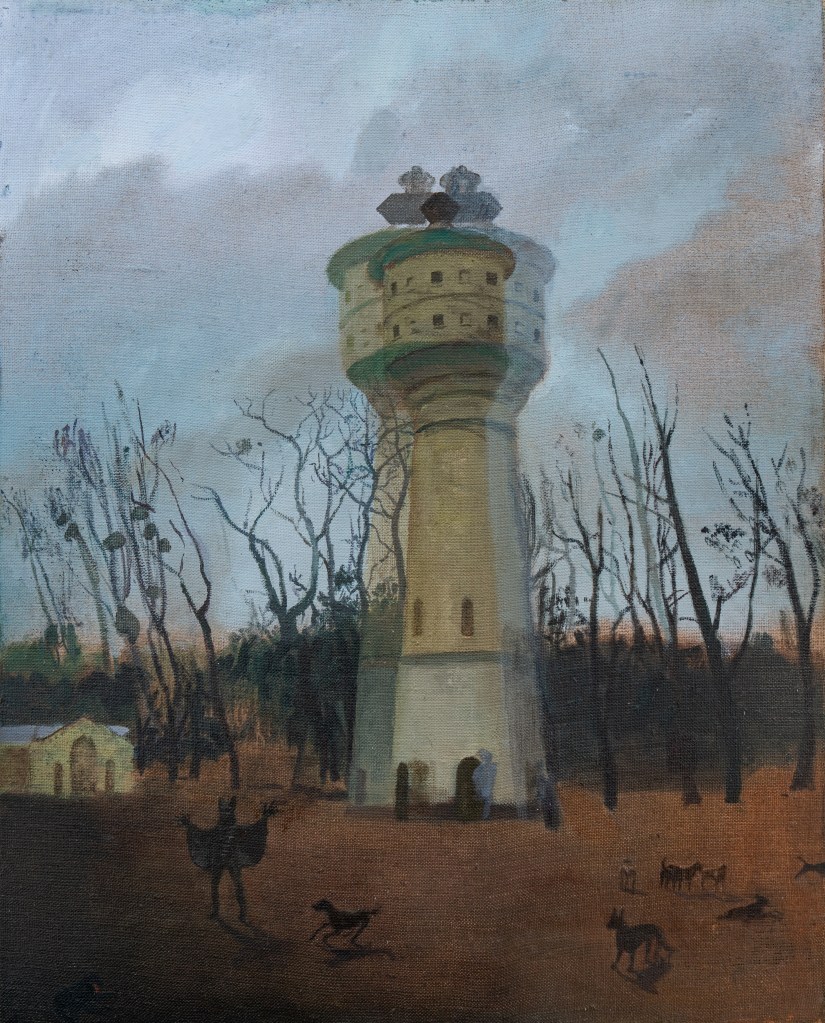
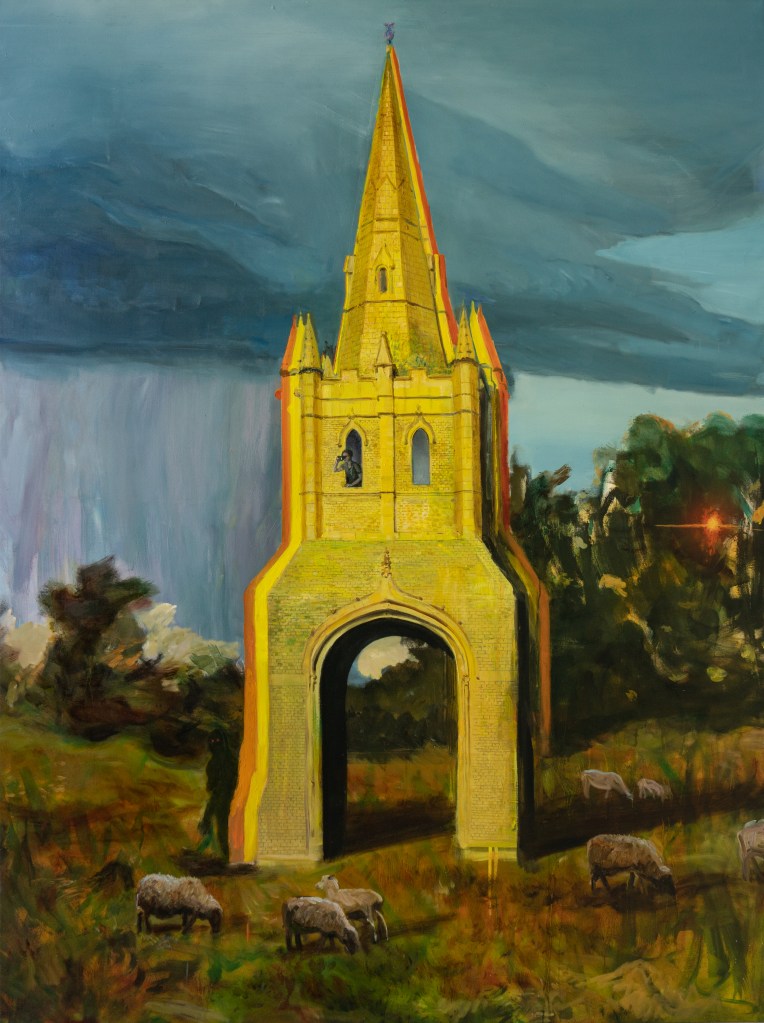
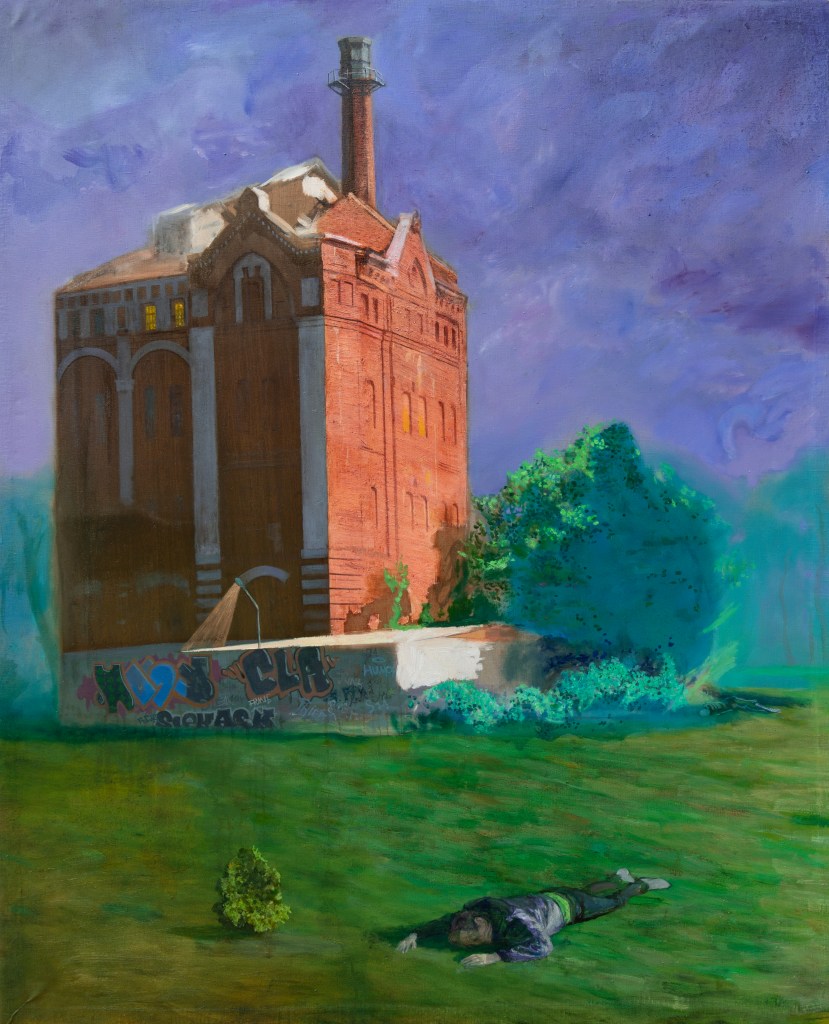
Born in 1993 in Dnipropetrovsk, Ukraine, Bogdan Koshevoy lives and works in Venice. In his paintings, the landscape ‒ characterized by romantic-gothic atmospheres ‒ hosts forgotten architectures, following visual reminiscences born from the artist’s deepest fascinations and melancholies. These are undefined places, suspended between enchantment and mystery, inhabited by silent creatures and stories told through the artist’s gesture.
THE INTERVIEW WITH BOGDAN KOSHEVOY
Many of your works’ titles often reference your homeland. What is your relationship with your roots?
When I was studying at the Academy in Venice and developing my artistic research, I tried to clarify for myself what really interested me, what attracted me even inexplicably. I realized I was particularly fascinated by late 19th-century architecture, with an industrial style, which was very present in the place where I grew up.
Is there an emotional, as well as visual, connection to this type of architecture?
It’s not just the architecture that determines the connection to my homeland, but also certain elements like the atmosphere created around them, the unique suggestions that arise from this vision. These are a series of details I know well.
The artist finds points of reference and, when in crisis or lacking new ideas, clings to something familiar, digging within themselves and focusing on the depth of already known subjects.
In your work, I haven’t found portraits or studies of the human body; instead, the landscape is the protagonist. When individuals are present, they are depicted on a smaller scale compared to the majesty of the context. Why haven’t you explored this subject more closely?
Actually, when I first arrived at the Academy in Venice, I initially made many portraits; the landscape came later. I turned to landscape because it allows me to build much more. Painting a portrait is much more psychological, whereas with landscape, there are already elements ‒like in a still life, there are various elements you can relate to each other. This allowed me to construct a dialogue within the work, and that’s what I like to do: seek a subtle balance among all these elements, both figurative and abstract, as in the case of colors. The landscape allows me to explore, to build something of my own.
THE CREATIVE PROCESS OF BOGDAN KOSHEVOY
Your works convey suspended, unsettling atmospheres, on the border between real and unreal. Are these suggestions you have personally experienced, or do they belong to your dream world?
It depends. In some cases, they are settings I imagine; other times, I take photos and use them as references. In these cases, there’s a story behind those places ‒ you can notice it by looking at my works. There are scenarios that are more convincing, more real; you can perceive my relationship with that space.
Why did you choose the tower as a central element in many of your works?
In the area where I grew up, buildings were constructed in the 18th/19th centuries; before that, it was all steppe. As a child, I noticed an abandoned medieval-style tower very close to my grandparents’ house, and I was immediately fascinated by it. It appeared as a somewhat unusual element compared to the rest. Moreover, it was closed, inaccessible. I think there are a series of nuances that connect me to the figure of the tower: isolation, defense, the possibility of seeing things from above. There are details I haven’t often focused on regarding my perception of this architecture, like the fact that it was very tall, it intimidated me and at the same time intrigued me. There is mystery even for me in what I create; in every work I make, how I feel at that moment influences it. It’s a reflection on experiences I’ve had, memories of fragments from the past.
You mainly create paintings, but over the course of your career, you have also made some sculptures. Why did you integrate this medium? Did you want to experiment with new techniques and materials?
Over the years, I have always done sculpture, but sporadically. In March 2024, on the occasion of a solo exhibition at the Barvinskyi Gallery in Vienna, during the setup phase, I realized there was a large empty space dividing the two rooms. So, I thought of introducing an immersive element, something that wasn’t painting. I was considering how to find the right balance between the spaces by inserting something that would connect the two environments.
The sculptures exhibited at the Vienna show recall the structure of a helmet. How do they relate to your paintings?
I created several helmets; I thought it would be interesting to take an element from a painting and make it three-dimensional.
What materials did you use for your sculptural works?
The prototypes were made of papier-mâché, while the works exhibited at the 2024 solo show were made of ceramic, fired and then glazed.
BOGDAN KOSHEVOY AND THE ART WORLD
What have been the most significant experiences along your artistic journey?
I have done some important and diverse things that have taught me a lot. The residency at the Bevilacqua La Masa, although it was a difficult period for me, was significant. The workshops held at Forte Marghera were meaningful; they taught me many things. It was a green space, there was a great atmosphere of exchange among artists, and it was very stimulating. The artist residency at Dolomiti Contemporanee was also a positive experience ‒ I met several artists, found myself immersed in nature, and there was a wonderful community around me.
Which figures within the art world have you felt the greatest affinity with?
First of all, other artists, but I have also worked with some curators, particularly with a young curator, Eleonora Ghedini. There was an intense dialogue between us; it was interesting to see how she reworked various concepts, even managing to clarify some things for myself.
Giada Bartolini
https://www.instagram.com/bkoshevoy/

Translated with AI


