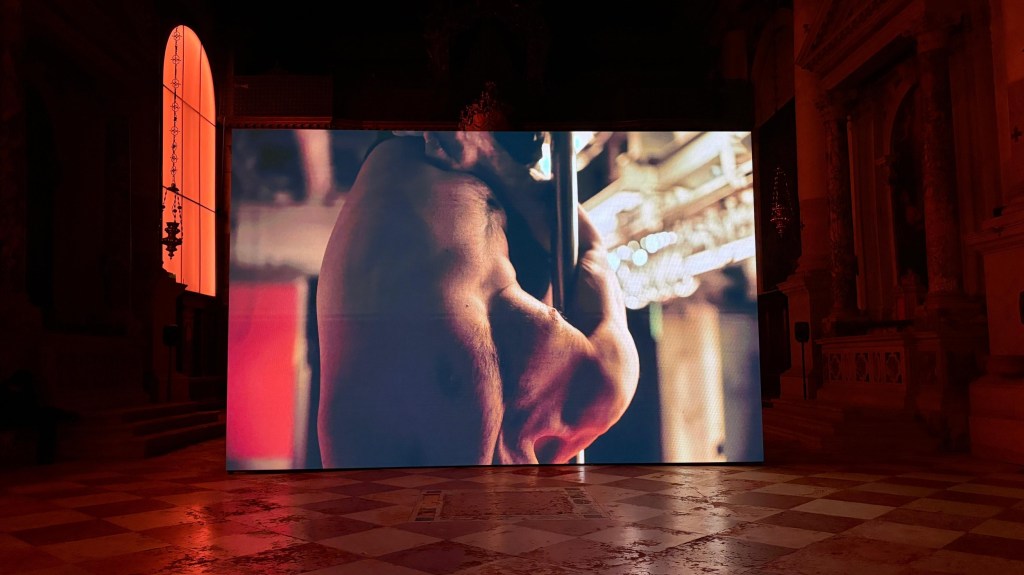
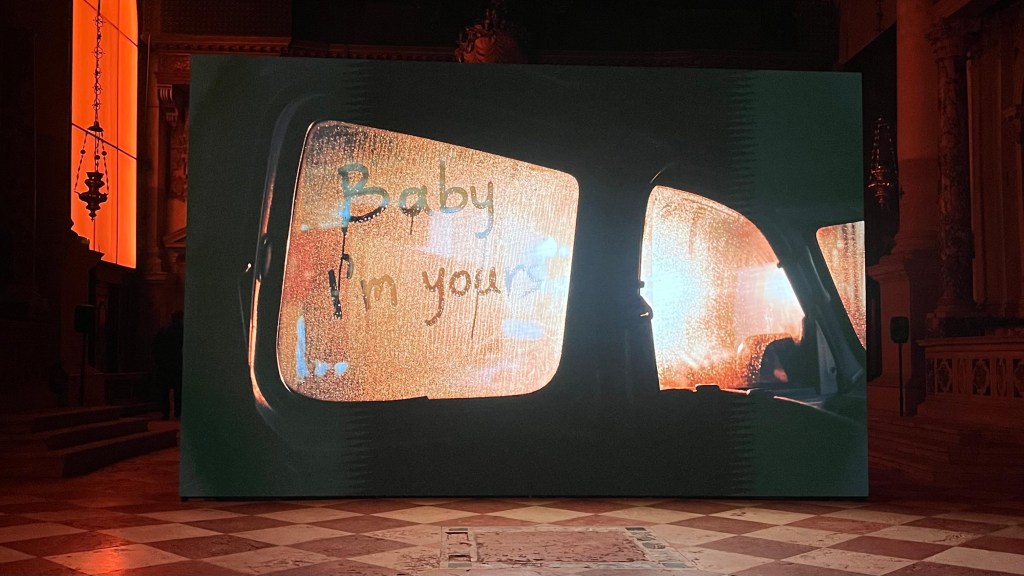
The exhibition “Canicula”, organised by the Fondazione In Between Art Film and curated by Leonardo Bigazzi and Alessandro Rabottini, is on view until 22 November 2026 at the Complesso dell’Ospedaletto in Venice. Part of the exhibition and installed within the church, “Baby I’m Yours, Forever” is an ambiguous short film, a multi-layered narrative, and a fusion of pop culture and symbolism. We spoke about this, and much more, with Janis Rafa, the video artist behind the work
The third instalment in a video-exhibition trilogy that reflects on the contradictions and ambiguities of the image within the setting of the Complesso dell’Ospedaletto in Venice, following the exhibitions Penumbra and Nebula, Canicula brings the image to its climax, on the verge of exploding. The overload of images within images becomes a metaphor for the oppressive atmosphere of the present, from both a political and climatic perspective.
We interviewed Janis Rafa (Greece, 1984), one of the participants in the exhibition, and we talked about her perspective as an artist and as a human being. From this conversation emerged reflections on the contradictions of a society founded on abuse and violence.
THE CONVERSATION WITH JANIS RAFA
How does your work relate to other works in the exhibition and to the theme of Canicula? In particular, how does it engage with the ambiguity, abuse and distortion of images?
Canicula translates into English as “Dog Days” and refers to a boiling point, a moment when things reach their extreme, whether in terms of intense heat or of being ready to explode, no longer able to sustain themselves. For me, that was one layer of reference for my work, and for the other works as well. Another important aspect was the very particular space of the exhibition: what it holds as a symbol, as an architecture of social structures, constraints, ruling systems, and cultural references.
I knew both the concept and the space before I started working. I didn’t know what the other artists would create. It was interesting to see how artists and curators, together, shaped the path, and how one work led the spectator into the next.
I was also interested in the theme of machinery, and in the exhaustion of mechanical structures. Not only architectural structures, but technology itself, especially in relation to film: for example, the evolution of the medium and the filming of moving images. The development of technology, for me, travels from pagan times to religion, from religion to technology, and then to the agricultural revolution. Those were my starting points, followed by the industrial revolution, and the industrialisation of the body, violence, consumption, and acceptance. Then there is this process of nourishing the body, which leads into the next works, where machinery becomes the industrialisation of the body. A body that turns robotic.
What do you think about Canicula?
I think it was a very physical exhibition, deeply concerned with how we conceive the body through forms of exhaustion: nourishing it and exhausting it at the same time. If it has to do with listening, or, in the case of the mammoth in Maya Watanabe’s work, with preservation – how a body is preserved and at the same time neglected – then Canicula is also about the mortal body and about death. And, of course, about the last works in the final three rooms.
This sense of progression is clear throughout the exhibition, as is its duality: pagan and sacred, technology and ascension, life and death. In your work Baby I’m Yours, Forever where can we see this duality?
I think it has to do with the way we document this duality. My work deals with the negation of language and with the negation of producing meaning through language and through forms that are easily understood by us as humans. I try to play with imagery that can narrate itself, but that also produces meaning and carries meaning on its own. So, depending on how you approach these images, and which culture you come from, you create different meanings that lead you toward broader, more general ideas of what my work stands for. For example, the sacrificed body, the violated body, or violence in its broader sense. I play with these very general concepts, which can also be translated into a performing space through images, in a way that is accessible as visual narration.
I think this duality appears in the way the work visually produces a form of meaning that is almost like a choreography or a soundtrack. I have always thought of Baby I’m Yours, Forever as a long musical narrative from beginning to end. It’s like a track, and that is how we approached it together. In the same way, the camera moves through the spaces, and that movement has neither a beginning nor an end. It is a very circular narrative.
Within that narrative, there is life and death, preservation and consumption, all at once. But there is also maternity, motherhood. The baby is produced, and at the same time there is the absence of life and of the body – even if it is the son or daughter of others. Of course, these are highly symbolic concepts and images, but they are also very literal, even if it is a fictional work.
There are actual spaces that, in one way or another, you can recognise. And the objects you see there, the machinery, or even the dead bodies in those spaces, are actual bodies that had once existed. So, the work moves between fiction and reality. I think it is very fictional, but it also tries to linger in reality in many ways.
About this tension between fiction and reality: were the pieces of meat and bodies real in the work?
Yes. In the work, I try to rely as much as possible on the actual – on making what you see as real as possible, rather than using VFX. For the last fifteen years, I have been making works that use a lot of cinematic language. I work with a crew, and I like to explore the processes used in cinema. So, I resist, as much as possible, transforming reality into something fictionalised, even if that sometimes makes things more complicated.
I am especially interested, when it comes to a human or animal body, in preserving what it stands for. When I include an animal, either dead or alive, and the same often applies to humans, it is to represent what it really is: a killed animal, a consumed body, a sacrificed baby for the pleasure of others. For me, it is also a way of paying tribute to these ungrieved bodies and making them visible.
JANIS RAFA IN VENICE
The locations in the short film are portrayed as non-places. How do you choose the settings for your videos?
That same logic of paying tribute also applies to spaces. I choose to expose spaces that are quite difficult to access, and even more difficult to film inside them. For me, it is a research process: a way of accessing places that are impenetrable and unseen. VFX or props are things I reject, because then I feel I could reproduce something that I ultimately want to honour. And the best way to pay tribute is to look at it directly and expose it to the viewer.
Thinking about this idea of tribute and the space of Canicula: your work is exhibited in a church, a space where sacred and fictional collide. Was it a difficult space to work with?
The inspiration came from the space itself, and that is often the case. I am very interested in the architecture of the space where the work is shown. The space of the church has to do with heavy notions such as mortality, fear, spirituality. The body is both an open wound and a sacred ideal. Fear, loss, and the rituals of mourning and paying tribute are formed through and for a human-centred understanding. The question is how the presence of the lifeless animal, the corpses of those non-humans can be read outside a symbolic and hence anthropocentric meaning.
The work’s concept came from the notion of sacrifice ‒ sacrifice as pagan ritual. The ritual of sacrificing the body, usually the animal body, to pay tribute to something, to symbolise human glory or fear. From paganism into the religious structures that later emerged within structured religious formats, that obliged us to follow particular rules, taboos and sociocultural norms. Within this logic of what is allowed and what is not, what is holy and what is a sin within the social acceptable is where we can also find the production of the meat industry. Or, if we take it more symbolically, this is how social and political hierarchies are formed: by sacrificing some bodies so that other bodies may progress.
VIOLENCE AND SACRIFICE ACCORDING TO JANIS RAFA
Sacrifice and violence emerge in your practice not only on a symbolic level, but also on an aesthetic one. In Lacerate – a 2020 short film shown at the Venice Biennale, curated by Cecilia Alemani – you revisited Still life in an allegorical way, from both a conceptual and an aesthetic perspective. How important is the pictorial language in your artistic practice? And what is your stance on the use of references?
Lacerate engages specifically with 16th and 17th century still life paintings, including hunting still lifes. These references are closely tied to the idea of the male figure as hunter. I will now refer to Derrida’s text I Animal Therefore I Am, which considers how humans, or men, or this colonial practice of the man venturing into nature as the hunter, are never themselves hunted. He always follows, but he is never followed.
Why did you choose to convey this kind of violence through Still life? Why use a visceral perspective in which violence is not shown directly, but in negative, through the absence of the subject?
Again, as a way of understanding humanity in its broader form, a figure of someone able to enter the unknown, and therefore protected from ever being followed. I think Still life can really encompass that notion of life and death, of something laid out on the table to be observed and understood, always as prey for humanity, as something available to become a symbol through which we can understand mortality, or contemplate our own prevailing. This is itself quite problematic, because when we look at the meat industry, the concept is different: there, we do not even contemplate these figures. The contemplation is not even there.
What interests me is how the meat industry quickly becomes an archetype of hunter, prey, predator, concepts that are often associated with the male figure, with masculinity, and with the way bodies are violated and nourished at the same time.
There is also a contradiction in the place maternity occupies within this whole framework. Maternity becomes a device for producing and reproducing beings whose fate is already decided, because their birth is basically their death. It is almost like the prey in still life paintings. For me, it is an earthy stage, one that helps me read the later, more industrialised version of the same logic.
About this perspective of the hunter: in Baby I’m yours, Forever the human presence is more prominent than in your other works and less passive. In fact, there are a lot of men, whereas in Lacerate or in other films there are not so many.
In my work, and perhaps especially in the later works, the male body is, I think, the only body that appears. Lacerate is the only work in which there is a woman, but in the previous twelve works there is always a man in the foreground. I think this is both a conscious and an unconscious decision, but there is a very specific reason for it: for me, it serves a very basic purpose, to show a male-dominated structure performing on its own.
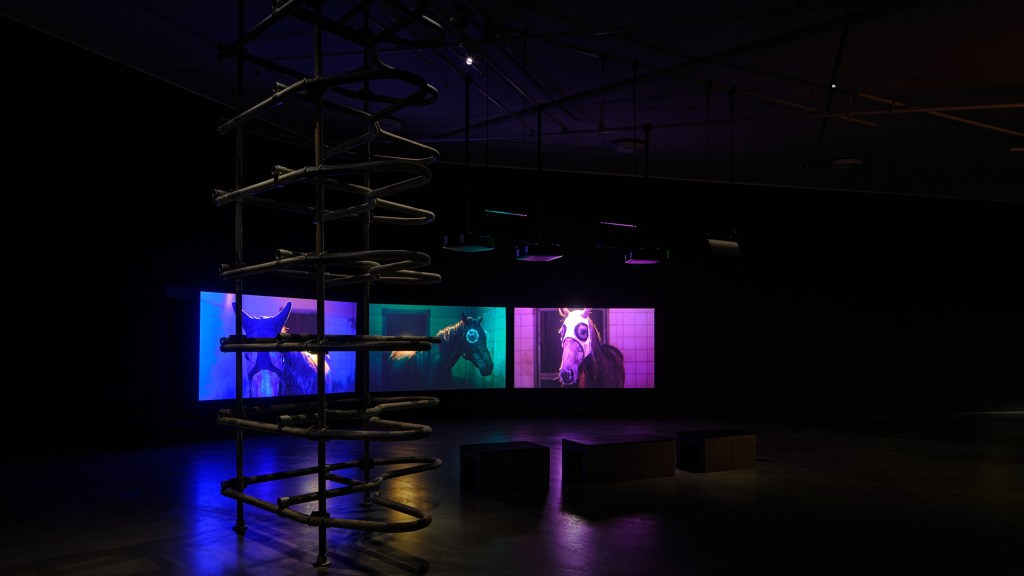
As in Baby I’m Yours, Forever and The Space Between Your Tongue and Teeth, we again see a group of naked men washing a racing horse inside a stable, in a closed space under artificial light. In that work, and in Baby I’m Yours, Forever, which are more similar, I think it was important for me to hold on to that body that refers more directly to the male figure.
Not necessarily to masculinity, but to desire and pleasure. To the need to please ourselves and to constantly claim desire and pleasure through the bodies of others, exhausting other bodies to satisfy some form of need. To please the body, our body, specifically the male or masculine body. The body that is there, ready to consume and to take advantage of any form of pleasure.
At the end of the day, this has to do with our mouths, our bodies, and the endless, exhausting desire to consume the body of others without consent. Of course, this can be very specific and literal, referring to dead animal bodies that we consume without much thought. But it also has to work on a more metaphorical level, showing how we desire bodies without necessarily passing through a consensual notion of desire.
JANIS RAFA’S APPROACH TO ART
Precisely because of their intersectional nature, your works are characterized by multiple layers of interpretation, drawing on animal studies and feminism.
My work has many layers. It also has a layer of popness: a contemporary element that comes through music, and that also evokes the religious choruses of these layers of voices. But we played a lot, and this is something I want to continue doing, with this pop element that emerges through music, sound, or colour. There is a lightness, and almost an irony, in the phrase “Baby I’m Yours” or in another line such as “Lay All Your Love on Me”. On one hand, these are easily consumable, familiar texts; on the other, when they come out of the mouth of an animal, for instance – or of a female or queer body – they completely transform the logic of consensual desire.
Another layer you mentioned is that the female body is present in this work, and I now understand that more clearly after seeing it several times. The female body appears in the work through machinery. There is a womb and a wound at the same time, which is what this space – the church, the industry, and the industrial structure – represents. The camera turns: we have this hollow space with a chain that usually lifts huge body parts up to the second floor; an image that somehow makes the space resonate more with a female body, with something that is both leaking and wounded, but also fertile and ready to reproduce and carry life. And that comes through the architecture and the cinematography very clearly.
Do you think that this layering of meaning might, because it is intersectional and multi-layered, be better understood by the public?
I always keep the audience in mind. Also when I make a work for the cinema, I know the work is made for a particular audience. I know there are things that can be grasped and read easily and things that require more processing, and that, depending on someone’s culture and background, may or may not be unlocked.
But I also love misunderstanding. I love misreading. In Baby I’m Yours, Forever the point can be missed easily. You can say that it uses the animal body in a highly critical way, for example in terms of animal politics, and so it could be attacked in that sense. It is about how the animal body becomes a symbol in the work rather than what it actually is. I am aware of that, and I think I am ready to play with the audience and push the limits a little: the limits of the church, of curatorial practice, of what is allowed, of how much can or cannot be said. How daring something can be, but also how seductive it can be.
JANIS RAFA AND THE CURATORSHIP
How do you describe the collaboration with the curators Alessandro Rabottini and Leonardo Bigazzi? How was it, from a personal and professional point of view, to work with them on a new project?
The Fondazione In Between Art Film has a very particular way of working and commissioning works, because they are also, in a sense, producers of the work. I mean that they are involved from the outset, before the work reaches the exhibition space. They are deeply engaged in the concept, the initial proposal, the visuals, and the development of the work. With Leonardo and Alessandro, I have worked several times before, including on Lacerate, so I already knew that they are very involved in the making of the work. It is not always like that, but for me it was interesting because each of them, brings something different. One may read things in a more theoretical and symbolic way, while the other is more practical, especially in relation to cinematic language and the practical side of film. That dynamic works for some artists, I suppose, but not for all. You need to be at a stage and moment in your practice where you are ready to listen, not feel that you must protect the work, but allow it to develop through more collaborative practices.
So, do you see curatorship as a collaborative process between the curator and the artist?
At its best, yes. At its worst, no.
Was it always like that in your experience?
No, I think it really depends on the curators and on the commission. It is not something I would describe as the recipe for every exhibition. For example, when it comes to involving curators fully in shooting, I usually do not give too much information, or too much detail about what will actually happen during the shoot, beyond the general concept and some storyboard material. I tend to protect my work depending on the exhibition.
It really depends, but in the context of Canicula and the Fondazione In Between Art Film, there are people who are highly experienced with the medium, precisely with moving image practices. They understand the medium, and they have the intellectual and practical resources to support it. In that sense, they are both producers and commissioners. It works differently, in a much more cinematic way.
What are your future projects? Are you working on something right now?
I have a major project in cinema, but not in the art world. I have a feature film called The Future Is an Elder Cow, which I have been developing for many years, and which is now at a good point to enter production. It is a fiction film, for the cinema. It is kind of post-apocalyptic, but recognisable reality; it deals instead with human relationships, mysteries, and taboos. It speaks of a future in which humans are retaliated by animals, because women can no longer give birth to humans, but to mammals. What does it mean to carry a life that is not similar to you? What it means to gain rights depending on the womb that gave birth to you. Here, the female body emerges as a fertile body, the body that brings life, and again it is a very important source for me in thinking about how to produce meaning.
I think animals are in the worst condition in the world. There are people of A series, B series, and so on; animals may be productive animals or even performative animals, but they are violated in the same way. And in all these categories, female bodies –female animal bodies – they are in the worst condition of all.
I think it is important to understand and see female bodies from a feminist perspective of the body, rather than from a human-centred perspective. How can you talk about feminism if you cannot look at animal consumption or animal politics, for example? There is a profound violation of bodies; the meat industry is based on violence. That opens a whole other conversation about how we understand queerness, feminism, leftist ideology, and respect for the body.
Rebecca Canavesi
6 May – 22 November 2026
Canicula
featuring Lawrence Abu Hamdan, Massimo D’Anolfi and Martina Parenti, Roman Khimei and Yarema Malashchuk, Janis Rafa, P. Staff, Wang Tuo, Yuyan Wang and Maya Watanabe
curated by Alessandro Rabottini and Leonardo Bigazzi
Complesso dell’Ospedaletto
Barbaria de le Tole, 6691 – Venezia
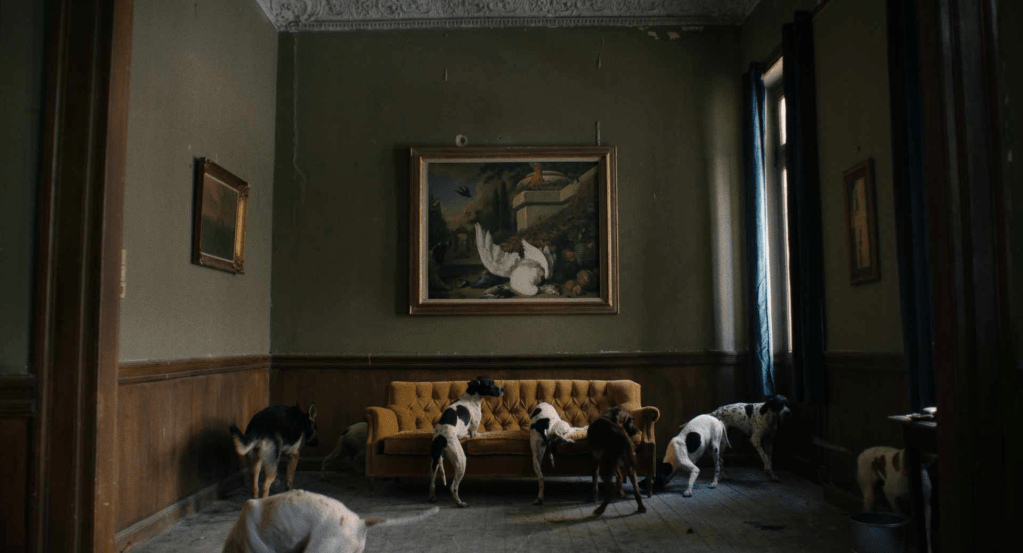
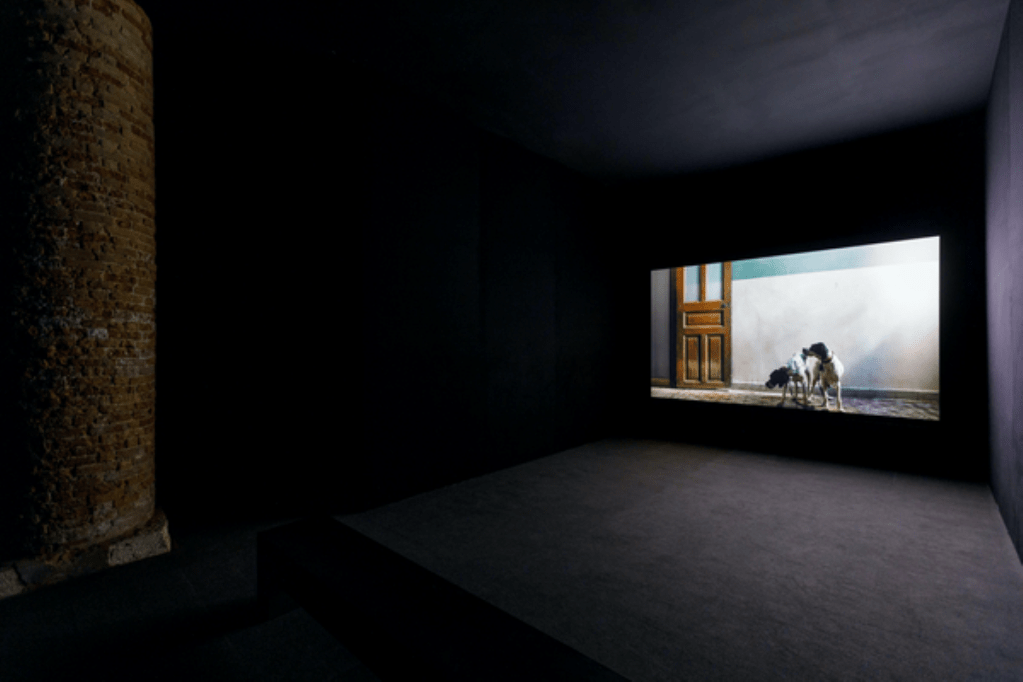
Janis Rafa, Lacerate (2020), Video Still. Courtesy of the artist Janis Rafa, Lacerate (2020), Installation View. 59. Mostra Internazionale d’Arte La Biennale di Venezia (2022). Courtesy of the artist Janis Rafa, Feed Me Cheat Me Eat Me, Eye Filmmuseum Amsterdam, 2023, © Studio Hans Wilschut 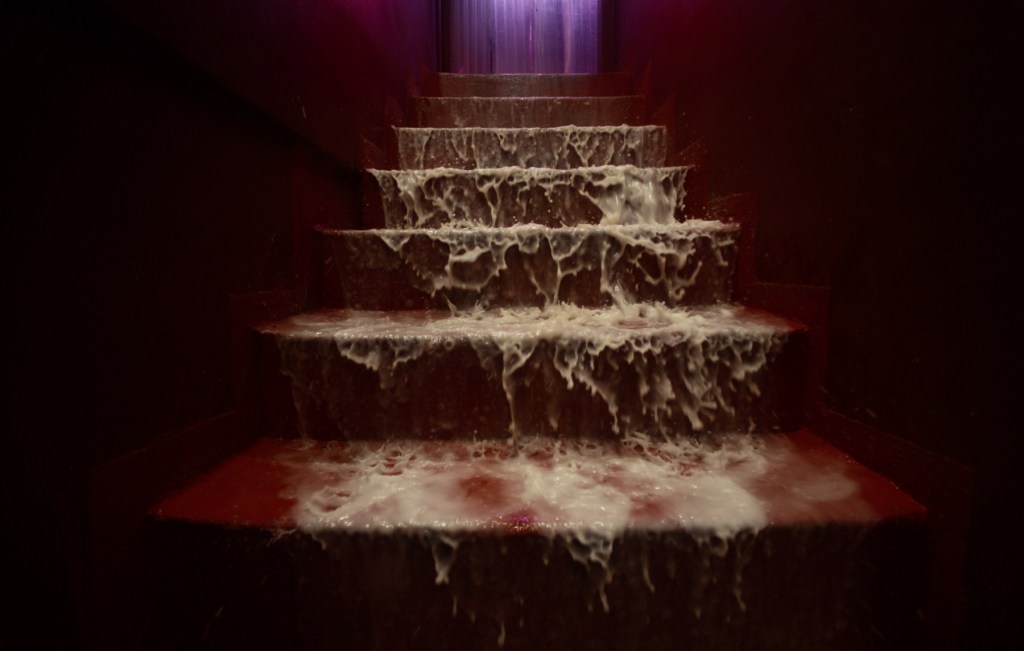
Janis Rafa, Baby I’m Yours, Forever, 2026 in “Canicula,” Fondazione In Between Art Film at Complesso dell’Ospedaletto, Venice, 2026.Courtesy of the artist and Fondazione In Between ArtFilm. Photo © Marco Cappelletti and Giuseppe Miotto / Marco Cappelletti Studio 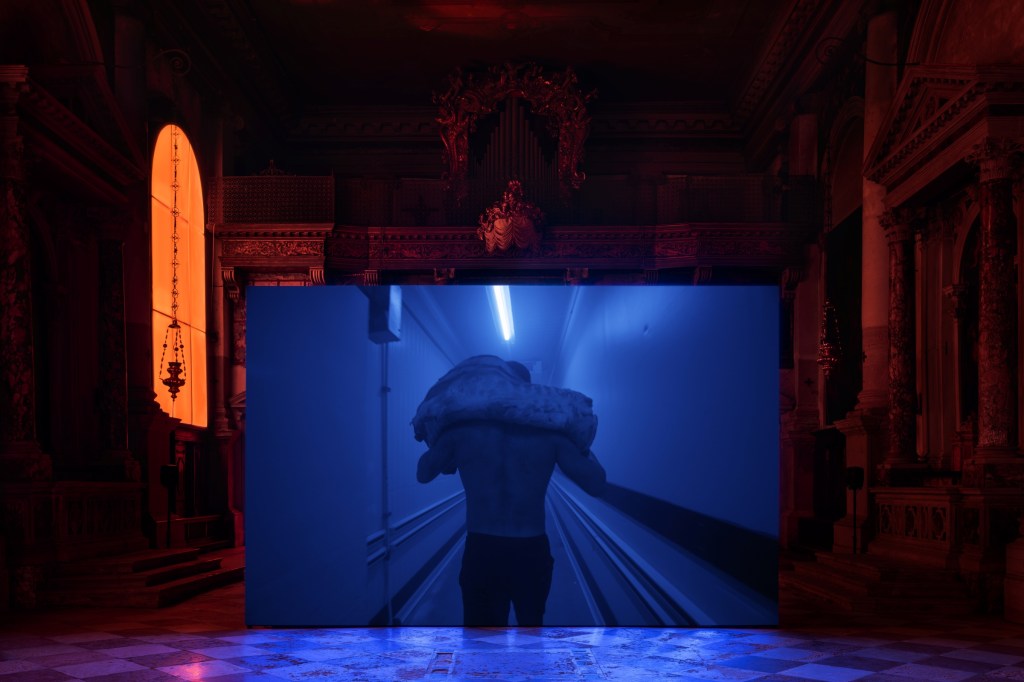
Janis Rafa, Baby I’m Yours, Forever, 2026 in “Canicula,” Fondazione In Between Art Film at Complesso dell’Ospedaletto, Venice, 2026.Courtesy of the artist and Fondazione In Between ArtFilm. Photo © Marco Cappelletti and Giuseppe Miotto / Marco Cappelletti Studio 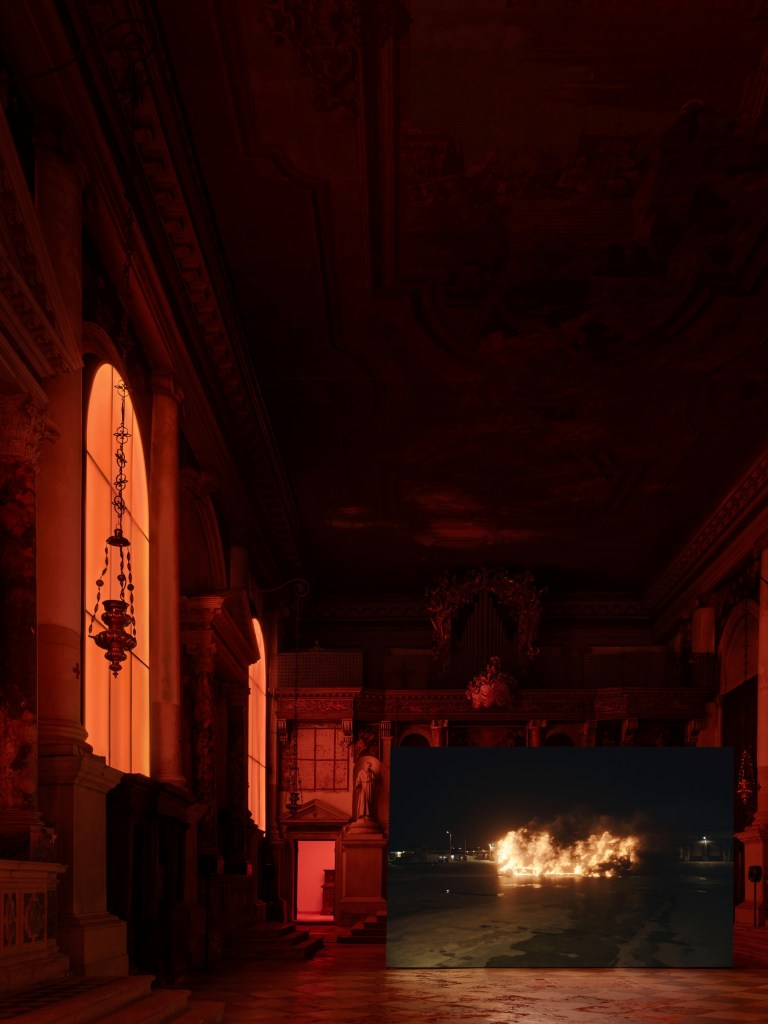
Janis Rafa, Baby I’m Yours, Forever, 2026 in “Canicula,” Fondazione In Between Art Film at Complesso dell’Ospedaletto, Venice, 2026.Courtesy of the artist and Fondazione In Between ArtFilm. Photo © Marco Cappelletti and Giuseppe Miotto / Marco Cappelletti Studio 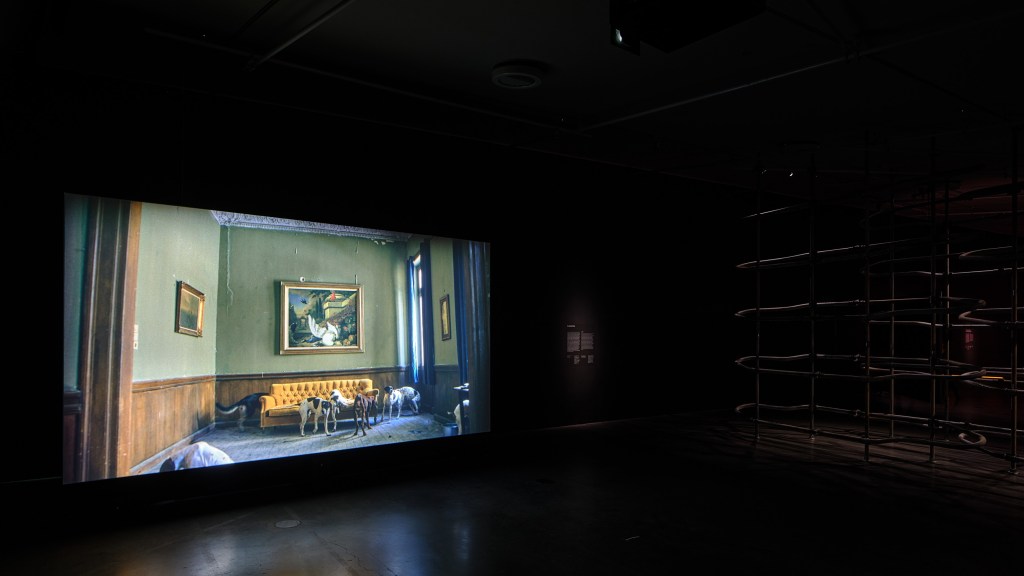
Janis Rafa, Feed Me Cheat Me Eat Me, Eye Filmmuseum Amsterdam, 2023, © Studio Hans Wilschut 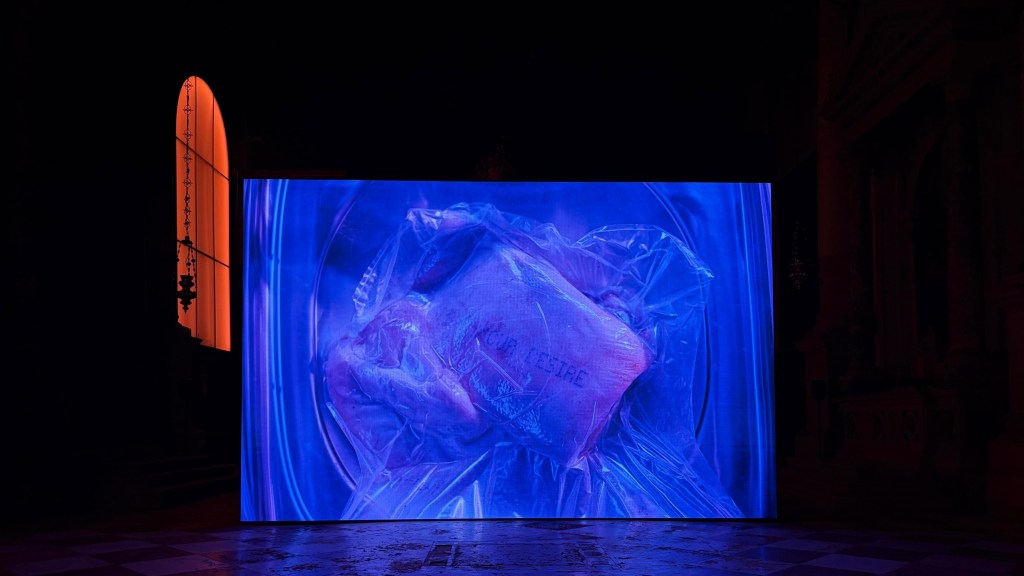
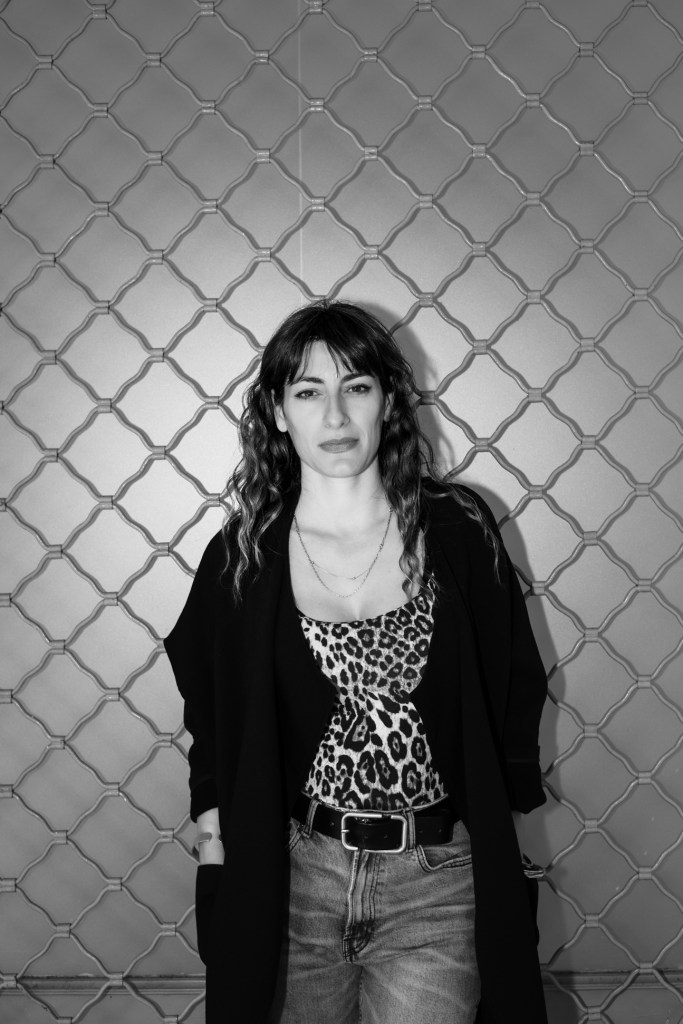
Janis Rafa, Baby I’m Yours, Forever, 2026 in “Canicula,” Fondazione In Between Art Film at Complesso dell’Ospedaletto, Venice, 2026. Photo Adriana Pizzo Janis Rafa, Baby I’m Yours, Forever, 2026 in “Canicula,” Fondazione In Between Art Film at Complesso dell’Ospedaletto, Venice, 2026. Photo Adriana Pizzo Janis Rafa, Baby I’m Yours, Forever, 2026 in “Canicula,” Fondazione In Between Art Film at Complesso dell’Ospedaletto, Venice, 2026. Photo Adriana Pizzo Janis Rafa. Photo by PINELOPI GERASIMOU, ONASSIS STEGI

