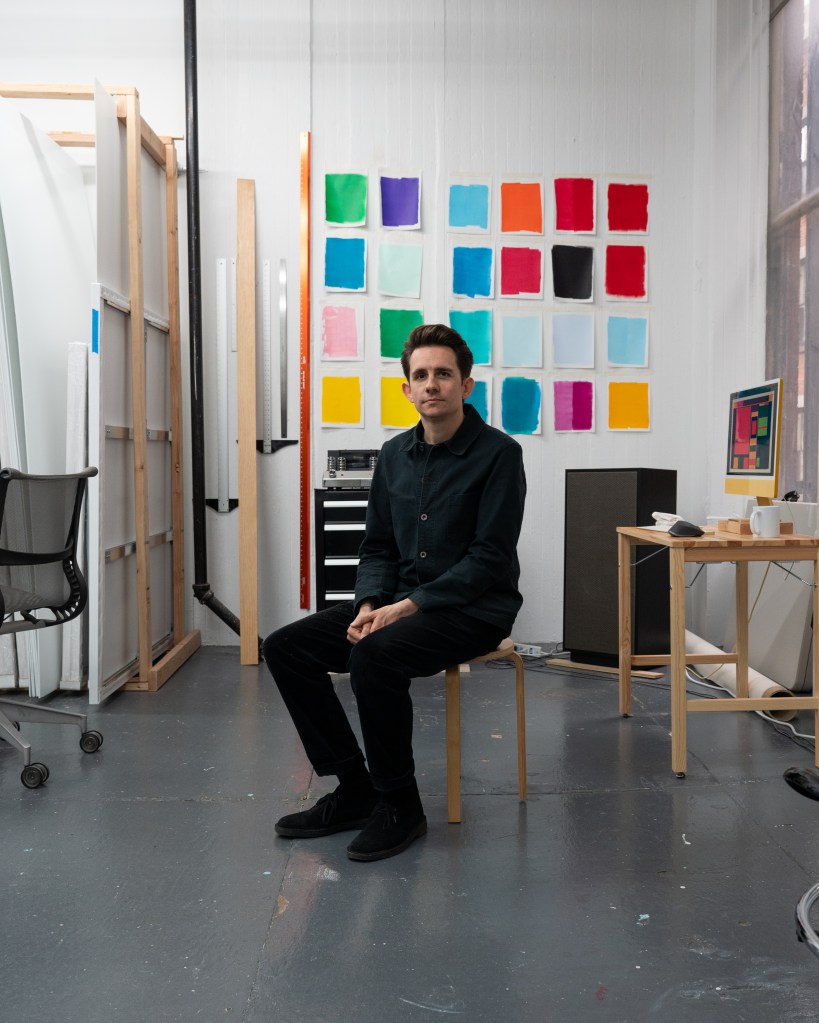
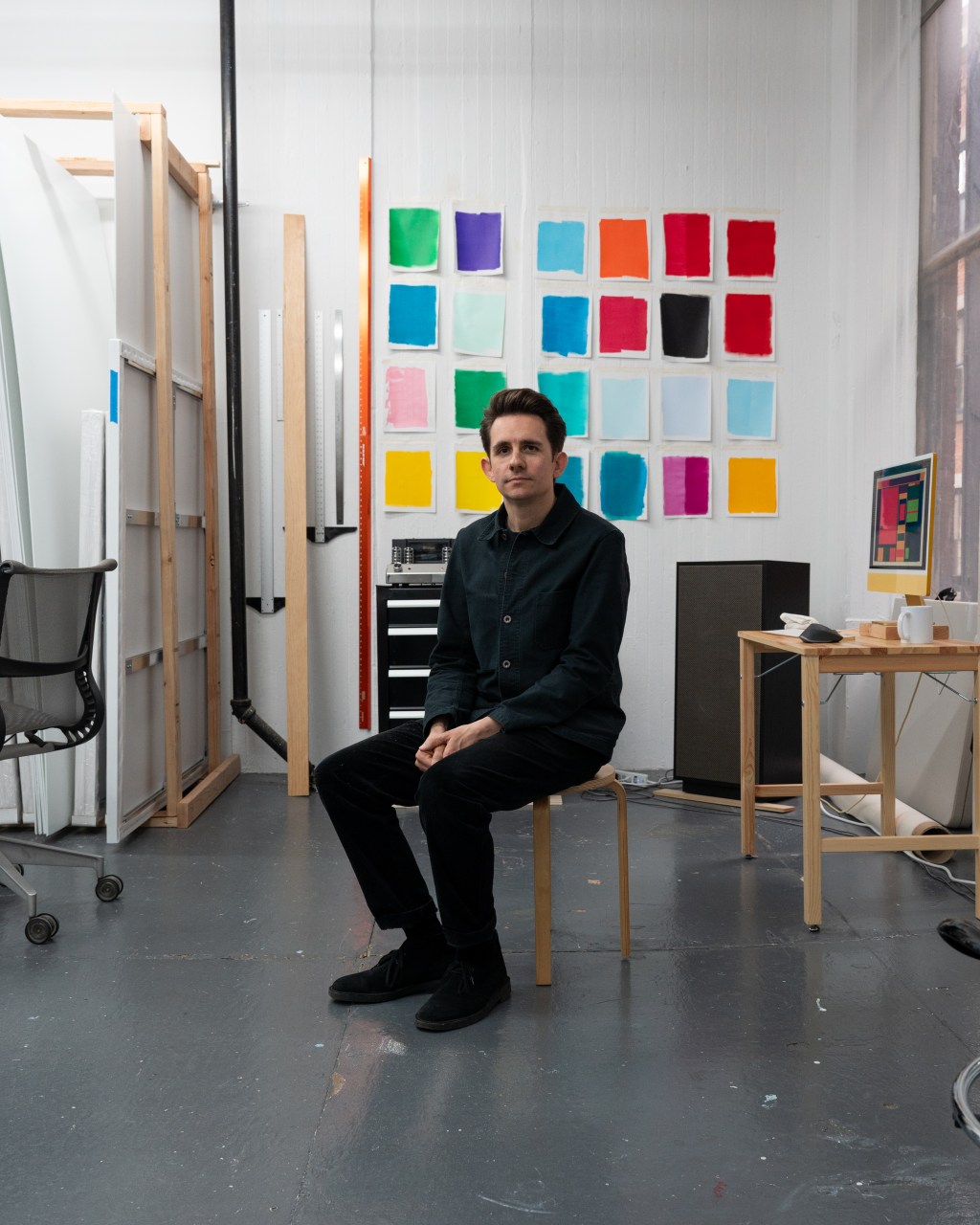
We met Rafaël Rozendaal in his studio in New York, where we talked about his introduction to the internet, his family, and his recent venture in acrylic painting.
The internet plays a distinctive role in the creative practice of Rafaël Rozendaal, the Dutch-Brazilian artist born in 1980 and based in New York. He began to look into art when he was eighteen, wanting to explore the internet on his own terms. His work examines the boundaries between visual and material culture, often creating moving images. Rozendaal’s first works were typically humorous, figurative, and then they became digital. Currently, the artist investigates the constraints of space in his acrylic painting on canvas, where he continues to build his practice. Recently on show at MoMA in New York, we met him to discuss the evolution of his journey as an artist.
Was there a specific moment when you knew you wanted to become an artist? A digital artist?
I think actually, growing up, I was very interested in cartoons, and animation, and anything moving. I wasn’t sure when I was young, I thought maybe I wanted to be a music video director. I was always aware of art history. Around 18 or 19, I was more like, I want to be an artist, because all the other options seem to have a lot of compromise, and a lot of collaboration, and structures. But even in the beginning with the internet, I thought the art world system was antiquated. So I did say it’s art, but I wanted to do it on my terms.
What do you mean by “it’s art”?
There’s an importance of saying something is art. And it’s a little bit tricky, because art is also a compliment. So you’re giving yourself a compliment by saying I’m an artist. Just like saying I’m poetic; you could say that chef is so exquisite, he or she is an artist. There’s a weird barrier there to say that. But there’s also just a statement of saying, “I don’t want to listen to anyone when I make my work, and I want to make it on my own terms”. And you can make a movie, or a book, or music on your own terms. But with visuals, very quickly, you go towards collaborative practice, like making visuals for a musician, maybe. When you think of computational images, they’re often structured in a commercial setting, or in a music festival, or all these things. When you’re young, you think, oh, the art world is antiquated, it’s for old people. The one thing I found weird about art was the decision makers. When you start out, you’re 17, 18. And the people on the boards of museums are in their 60s. And when you make music, you play for people your own age. It would be weird if you’re a musician, and the people in front of you, weren’t your age. I guess with classical music, that’s the way it is.
So maybe there wasn’t a specific moment, but there was you watching cartoons, you kind of having this context of the world, and you were like, OK, I’m going to be a part of it.
Yeah, actually, when I was really young, when I was five, I thought I wanted to be a carpenter. Because my dad would build his own paintings. He painted on wood. I liked hammering and sawing. I liked the smell of wood, and things like that. Then at some point, I was 10, and I said, “oh, I want to design furniture”. And then a friend of my dad’s was like, “really, why?” And once I had to answer why, I didn’t have an answer. Oh, I guess I don’t.
But you were ten!
But definitely the reason I brought up my dad as an artist. My mom studied ‒ not exactly architecture, something interior design, I was just at a household where culture was always at the forefront. Any chance we got. A not very money focused family but a very culture focused family. In the digital art space now there’s a lot of people who came from a background of computers or computer science and I come more from a background of art. That’s the best way I can explain it.
RAFAËL ROZENDAAL’S ARTISTIC PRACTICE
How has your practice changed from your first works, specifically works from the early 2000s, to now?
I would say the first works were overtly humorous. One of my first works was fart jokes. And that wasn’t so much of trying to make a funny work. But it was. I was interested in there being a taboo in art to introduce crass humor. And taboos are interesting. It was totally not a taboo to introduce violence, or shock value, melancholy or I couldn’t think of anything that wasn’t allowed at a museum. And somehow fart jokes weren’t allowed. There was an angle there that there was an introduction of different kinds of dada, ridiculousness. Manzoni with canned feces, things like that. I thought, what can you do in a new medium that you couldn’t do before, things like sound? I was just very interested in that age gap of when you’re 16 with your friends, that’s your life, and somehow that wasn’t allowed. All of a sudden, when people go to the museum, they become very serious. There’s this weird, what some people call the gentrification of the mind, where all of a sudden, you start behaving differently because you think that will give you access to that structure. Over time, my work at first was very figurative, and then maybe became more abstract. The first twelve years were purely digital.
And then?
At some point, I started exploring physical works. The element of the exhibition was throughout, from the beginning. I was projecting works and showing them on screens and showing them in public space. So there was always a thread that was present. The paintings came about two years ago, but they’re kind of an extension of all the experiments and physical work that I did before.
Some artists, when they have an idea or a concept for a piece, have to create it immediately. Do you find yourself in a similar position, or do you think rest or boredom is important?
If I see a good idea for a title or a thing to photograph, I’ll definitely stop and write something down. I really like this quote of Picasso, that “you have to think with the brush”, and whatever your medium is, of course. It can be a piano, it can be a spoon, or whatever your medium is. There’s something that I cannot do in conversation. I cannot, in conversation, discuss something and come up with an idea for a composition. It’s really a different part of the brain. The computer is very language-based, you know that feeling when you have an idea for a title of an exhibition. You wanna write it down, you open your phone, and there’s three notifications of different things, and you forget the title. It really is the world’s smartest people who are all working to get your attention in some way with software. The only resistance I’ve found, or the only strategy, is the sketchbook.
Why?
What’s interesting is the sketchbook, for sketching, it always comes with fear, because not every time you sit down, you have a great idea. It’s a little bit like going to the gym. You don’t really wanna go, but afterwards, you feel good. I would compare it to that. I do have the luck that I get pretty bored by entertainment, and television, and streaming, and YouTube, but I still have to actively shut it off ever since I was young. I always joke, or describe growing up, one room had MTV, and Cartoon Network, and things like that, and one room was my dad painting abstract geometry, and I’m somewhere in between. I’ve always been in between the distraction machine and the stillness.
You are lucky for that. It’s interesting that you mentioned composition for your paintings, because previously, maybe you said, “oh, I’m really good at color, but composition may not be my strength”.
That’s what one of my teachers told me.
Do you still feel that way?
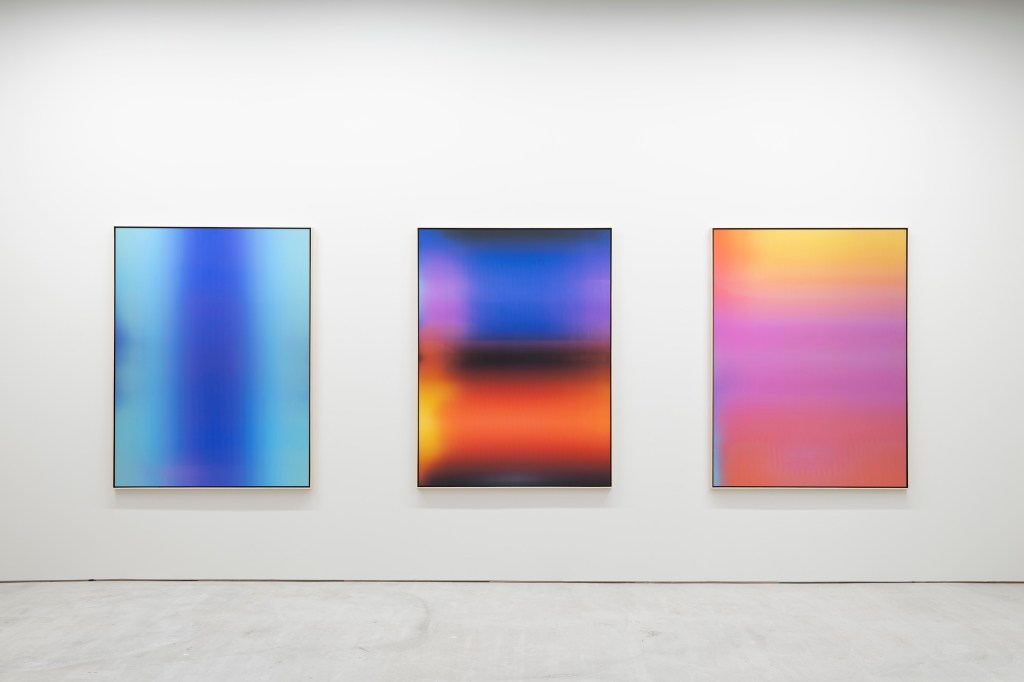
No, yeah, no, but it was a thing where on the computer and with websites, you can add an aspect of randomness, and you can also add the aspect of interactivity. The final composition can be up to a different thing than you. So, I thought that was an interesting solution to that problem. Maybe I’m not the decider of the composition, and so either the user or the algorithm decides the final outcome. That was an interesting thread, and it still is. The thing with my paintings is I’m going towards figuration, and the paintings I like the most are where the composition can’t be any other way.
It just has to be that way. That feeling, like an envelope, that’s the envelope. There’s no other envelope possible, so I think that’s why I’m interested in the area between figuration and abstraction: the figuration dictates the composition, but the figuration’s so reduced that there’s still a lot of room for the tension between the colors. There’s so many ways to build the composition or the layers that if you see three of them, one is more interesting than the other two.
No longer kind of using the negative space, this is an envelope, this is the space.
There’s definitely an element of going towards pure abstraction. I’ve read a lot of interviews with artists, even Mondrian, it wasn’t purely just moving squares around the canvas. Everyone has a premise or a starting point, and maybe Mondrian’s premise was to dissolve any illusion of three-dimensionality, or maybe someone like Frank Stella was very interested in how the energy of the painting guides the movement of the eyes. He was thinking about energy, and maybe Mondrian was thinking about the collapse of three-dimensionality. You have this game or a prompt or a motivation, and for me, the motivation’s the tension between readability and abstraction.
EXHIBITING ACCORDING TO RAFAËL ROZENDAAL
Does color theory play into it, or does it influence your work?
I’m very practical with color that I iterate. That’s my approach to color. Let’s say you’re painting your house. Even there, there’s all these subjective choices. Do I want it slightly pink or slightly blue? When you’re painting and you’re experimenting with colors, it’s a theoretical endeavor. There’s nothing practical about it. It’s an intellectual endeavor of seeing what happens, but you can’t put it into words. We often think of theory as something verbal and practice, as something that you do with your hands.
My thesis is that what you do with your hands is theoretical and practical. It’s just a different language. But as far as colors, it’s dictated by the subject, but sometimes you go to the store and you see a pigment or a bottle, and you’re very curious about that color, and then the figuration will be an excuse to use it. I found some really good purples, and then I asked myself: “Should I make a really big eggplant painting?” Sometimes a painting is just an excuse to use a color.
Do you think viewing your work online is similar to viewing it in person?
I see that as very similar to music, where you can experience the same song at a festival or at a wedding or in the shower or on the subway. Just to make the example simpler, let’s say it’s electronic music. Let’s say something that was made electronically and not performed live because of course a symphony is better live than in a recording. Let’s say electronic music. Of course, it might be the most epic version when you’re 17 years old with all your friends at the right moment at a festival or in an underground show. But it’s cumulative. Every experience, maybe knowing that song for five years before you go to that event, builds up the experience.
I see websites very similar where someone goes to an exhibition and sees it full size. That might enhance the home viewing experience or the home viewing experience might enhance the museum experience. It’s interesting that with physical work, we’re used to taking a catalog home and then the catalog is a reduced version. When you go home with digital works, the work is available online and it’s smaller, but also you’re closer to the screen, you’re more intimate, and you’re less distracted by the people around you. I see each new experience as a full experience.
If you are sharing your work in an exhibition, do you have an order you’re looking to achieve or does the curator usually take autonomy?
I have a practice of when it’s time to do a show, it’s just a matter of putting a computer in the room with the projector and just trying a bunch of them and seeing what’s right for that space. It’s very interesting that it can be counterintuitive, that I think a work is great and then it just doesn’t work in the space, and then a work I didn’t care about tends to be perfect for that space. That’s also very similar to music where a song at home might not be the best one for the concert and the other way around. I try to be very open, I think each space has a different character, so it’s hard to predict. The beauty of digital work is that you can just pull up and there’s no shipping. You can change it any second. As far as the sequence of works, I often randomize things. The show at MoMA was a selection of twenty-five works, but the order was randomized. I wanted it to be unpredictable.
Was there a specific emotion, or feeling that you wanted viewers to take away from the show at MoMA you’re talking about?
It’s cheesy, but the journey from being 18 years old and thinking, I felt like the museum was two generations removed from me. This was before social media, so if you wanted to meet anyone, you just had to go to openings and talk to people. And then you would meet people that are like, “I’m an artist, what do you do?” I make websites. Then they’re like, “oh, could you make my website?” I’m like, “no, that’s not what I mean.” It was that whole trajectory of saying what you see on the screen is not documentation, it’s an artwork, and this was the last step on that journey. Maybe not the last step, but it felt like that was what I was trying to show people, and now it’s very visible.
You have done exhibitions around the world, Rome, Japan, Amsterdam, New York, where your work was displayed in Times Square, in windows, in mirrors. Did any of these exhibits or spaces really transformed your work?
I would say each space just demands; it turns out a different work turns out to be the best one for that space. In Times Square, I chose the kissing animation because it’s very figurative. I thought if it’s an abstract animation, it might feel like a pre-roll for an advertisement or something like that. It wouldn’t survive, that context is so busy, you needed something very solid. One of the things we noticed there is if all the screens are using the same colors, you get this color wash over an entire block of a city. That was very interesting. A different installation, like in Venice, it’s a much more intimate room at A plus A gallery, so you can have more subtle colors. Yeah, I really just enjoyed it. I’ve been making red sauce for pasta since I was 10 years old.
Homemade?
Yeah, and it’s just different every time. That’s the funny thing. When you travel, you have different ingredients. You can do the same thing over and over. It’s just different every time. I feel the same, I’m very interested in exhibition making and just interested in creating a moment of focus and a moment of getting to know the people. That’s very joyful for me. I try not to think hierarchically. I try not to say, oh, this was the best one. Because you can’t reproduce it. There’s no sense in creating a hierarchy. Sometimes a really small show is interesting, sometimes a big show. Of course, something like MoMA is very helpful. The best way I feel about it is that art and artworks should create energy with the visitors or the artist or the curator, that there’s a next step after. That’s the best outcome for me. You saw that work in Venice, at A plus A gallery, and now we’re talking here. One thing leads to another.
There is one exhibit that sticks out to me, the On And On exhibition at Kostyál Stockholm in 2015. Would you ever display your work like that again?
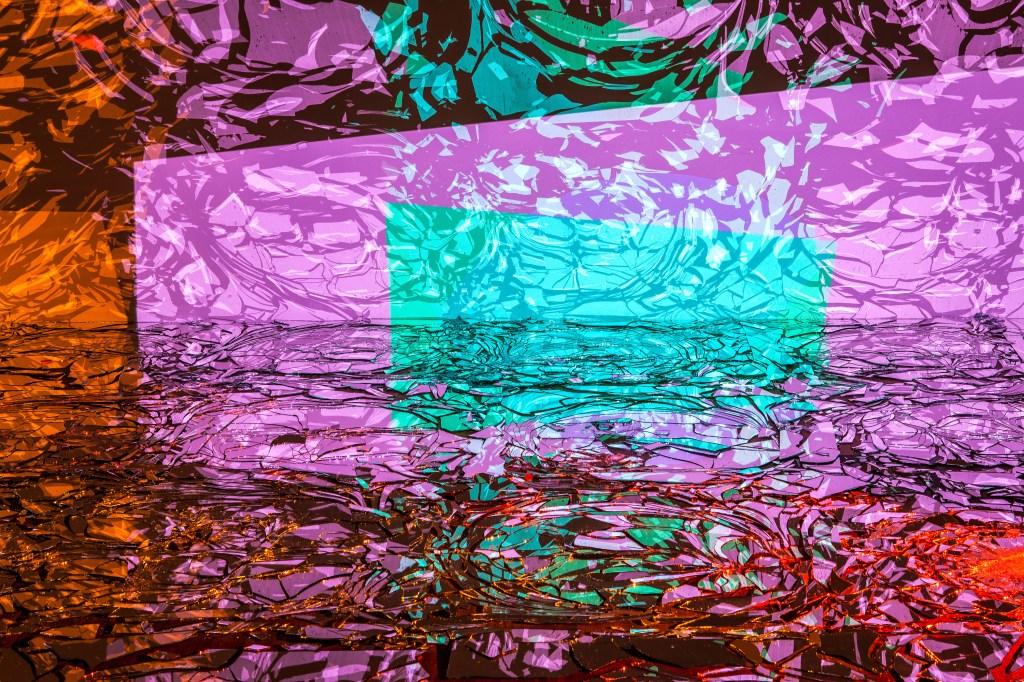
The first show I did was in the Netherlands. A lot of the shows, I didn’t have access to a perfect white cube, and I didn’t have powerful enough projectors. A lot of this was solving the problem with the means that I had. At first, I thought, oh, if we cover the floor with mirrors, then you kind of double the space, and because my medium is light, you’re expanding the light. The first show that I did in the Netherlands was just finding mirrors from thrift stores to fill up the space, creating sort of a puzzle of different size mirrors. The next show in Stockholm, one of them fell, and it was interesting. We broke all of them. But I did that maybe ten times in different cities, and I’m lucky I never cut myself, but it’s really quite violent, the smashing, and it’s something I have to do. If I tell other people to do it, it comes out different, but I’m a little nervous about hurting myself. There should be a good reason to do it.
TECHNOLOGY AND CURATORSHIP
What role does technology play in all this?
The technology also moves. One of the interesting aspects of making digital art is that traditional mediums lose intensity over time. Pigments fade, or maybe a sculpture, the surface, or an arm breaks, or a nose breaks of a sculpture. Digital works improve over time because the displays improve. When I started, maybe a projector was 800 by 600 pixels. Now it’s eight times that, and in the future it’s a million times that. Every two years you do a show, there’s a reconsideration of the work. And these giant LED walls were not possible before, so now you can have a moving image that can compete with daylight. That was not possible ten years ago. Maybe in ten years I can have a show where I have ten of those screens in a room, so it almost feels like a painting exhibition with each work having its own screen. As time goes on, there’s new possibilities. What’s funny about talking is if we talk about all this, digital art makes so much sense, and I should have never made any physical objects. I really struggled with that in the beginning.
And artists, even musicians, are always changing. Their sound, their work.
Well, there’s a good example of musicians. Maybe a good example is Lil Wayne wanting to learn guitar just because he was so good at rapping. And then nobody likes the guitar songs.
No one likes it. But also, after you release Carter V, you can’t really top that.
No. Or maybe you can. I do think it’s different. That’s one of the benefits of visual art versus music, or pop music particularly. It seems when you picture the Beatles, and you close your eyes, you see the young Beatles. When you picture Picasso, you imagine an old Picasso. So there’s something about art being more of a lifetime thing and not like, oh, you’re gonna peak at 29. I’m happy that that’s a positive of the visual arts. I’m not afraid that I’ve peaked. I can see if you’re a pop celebrity, that would be difficult. Similar to being an athlete.
You also curated Sleepmode: The Art of the Screensaver, in 2017, yourself. What was that process like?
I think that was something where it was particular to the Netherlands. In the Netherlands, the commercial gallery system is smaller, and there’s more state-funded exhibition centers. And I also did a show somewhere, and there’s a museum that’s called the Architecture Institute in Rotterdam. The Ministry of Culture decided they had to merge, and so they became a museum of architecture, fashion, design, and screen culture. But they’re traditionally in architecture, so they didn’t really know what to do with digital art. And they saw one of my exhibitions with broken mirrors, and they said, “oh, we really like how you expand the digital into installation. It’s not just a small TV on the wall. But we’re not an art institution, so are you interested in doing something with us, but not as an artist?” I just had this idea in the back of my head of screensavers as such an interesting form of digital culture that’s very exhibition-ready.
This wasn’t technically a solo show, but I felt the power of having an institution work with you, and all of a sudden, there’s all these people who thought about which computer to use, which software to run the old screensavers, how to hang them, what to do with the floor. There was a whole team of exhibition designers and technical people, and it’s like having the wind in your back. It was just a curiosity for me. Everything on the screen is always one after another, and in an exhibition, you can see things next to each other. And I thought, that’s an interesting, different experience.
I don’t want to say it was a niche experience…
Let’s say you do a show about photography in the 80s. And people are like, “oh, we’re canonizing the medium of photography,” and once you do software from a certain era, everybody said, “oh, this show is so nostalgic, and I remember seeing this when I was young, et cetera”. It was interesting that this is such a part of mainstream life experience that the word nostalgia comes up. But if you do a show about painting in the 90s, or in the 70s, or in the 30s, that word doesn’t come up. Somehow, it’s separate from regular life.
That’s like digital painting.
Yeah, but screensavers; it was even hard to trace who made them. They were packaged as part of the operating system, or made by a company, so we didn’t know the individual authors, and we couldn’t. We tried reaching out, and we couldn’t, it was part of Windows 95. We found some of them, but let’s say two-thirds we didn’t know, and it felt like someone who was building PowerPoint, or the Microsoft Windows system on a Friday afternoon. They were like, “hey, Bob, do you wanna make a screensaver?” And it’s like, sure!
Through all these exhibitions, would you say that curating is very integral to your practice?
It’s a thing that I noticed. When you’re young, especially in the Netherlands, the galleries were not so important. It was more about the curators at the artist centers. Let’s say every town in the Netherlands, there’s maybe twenty of them, or thirty centers, and the people who decide who gets to show are the curators. You think about that, and you’re like, why do they get to make the decisions? One thing I noticed was also that a lot of curators are always stressed, and they’re kind of overworked. I started this thing called BYOB, Bring Your Own Beamer. We call it a projector beamer in the Netherlands and Germany.
I thought, if all the artists bring their own gear, then it takes away all the stress from the organization to come up with all the funds to realize that. I wanted to create a more spontaneous way of curating. The screensaver show was very ahistorical. I wasn’t trying to explain anything. It was just showing thirty screensavers. I do it my way. It was also just any chance I could get to create an installation or to do something in space. I’m just excited to do that, because I can’t do that on my own. The screensaver space was basically a hallway for directions that forms a square, but the square in the middle is closed off. That’s a very unique walking experience. BYOB, we did it in many spaces so you could see how the community and moving image respond to it. The first BYOB was almost in an abandoned subway tunnel, or it could be on a giant wall outside. If you work with installation, it’s interesting to react to many different spaces.
I also like Color, Code, Communication (2023). That was a cool exhibition.
That was really wonderful, it kind of came out of the moment of NFTs becoming such a big topic. Everyone talked about what an NFT is. What should institutions do with that? And I think Folkwang Museum had a tradition of collecting photography early on. They have a big impressionist collection, but in the 70s, they started collecting photography and there was the Düsseldorf School and a lot of interesting photography came out of Germany. They were early to deal with that because it’s a different way of collecting, a different way of exhibiting and conservation. Now there was this moment for digital art. Of course, there was a lot of digital art before that, but there was just this moment of attention. They decided, let’s not just dip our toes, but let’s just do a very focused solo show with one artist.
I thought it was interesting with the curator to think about, what does it mean to show things that are a serial work, a work that’s owned by many people. What is the work? The center of the exhibition was 81 Horizons. Basically, I made a drawing of a landscape. The most reduced way to create a landscape is just two colors, like a line in the middle. It’s very figurative. This is grass, this is the night sky. Then I wanted all the colors to be distinctive enough that you could say, oh, I own this one, I own that one. Each is a different work. You could imagine I could have made 1,000 with different tones, but you wouldn’t be able to discern. I see the digital as raw material.
RAFAËL ROZENDAAL’S PAINTING
You just started painting in 2024, and it kind of marked a shift for your career.
Yeah, it’s a shift. I would almost say it’s becoming more American, because I came from Europe, and I came from the Netherlands where vacation is almost a national religion. It’s kind of hard to explain because I have a lot of friends here who come from a humble background and vacation was just not an option. In the Netherlands, it doesn’t matter your income, you go on vacation. You just go in the car and you stay somewhere, you eat canned food, but you will go on vacation. Just to give the context, it’s not a luxury.
It’s hard to explain, but I always felt like I’m very interested in work and we would go on these long vacations and I would just be bored, but society almost teaches you that it’s better. I feel like also the American dream has shifted from hard work to now winning the crypto lottery, never having to work again. That seems to be the dream. The dream is not to have a house and mow your own lawn, it’s to pay someone to mow the lawn. For me, going to America is actually finding the joy in the work itself. Before I moved to New York, in 2012, I worked so little because I worked with a programmer. I would work one or two hours a day and then I’d go to the movies. This all sounds like I’m very wealthy, but that’s not the point. It really is more, growing up in Europe, it’s more of a Duchampian attitude of, I’m more of an editor than a creator. I’m not a laborer. Coming from conceptual art, even if you work, I was working all the time, but you pretend not to work.
BYOB is maybe an example where I created an exhibition form and then many other people execute that form. It’s an instruction. And there’s been 600 editions around the world without me having to do anything. Coming here, it’s actually figuring out, you can have an idea for a painting, but that’s nothing. You have to make a thousand of them and iterate and try and try and try. Then it really becomes something. And so I think I came more from the background of, oh, I just found a toilet bowl and I’m putting it in the gallery. That was my context. And now it’s more through hard work and iteration, the work, it can’t come up with, it’s not a mental exercise. It’s a physical exercise. So that’s maybe a shift, but that might’ve also always been present in my websites because I was always producing a lot of them. Fundamentally, there’s this funny thing with things you say that they become reality. So I used to say I only work two hours a day. It’s probably not true. But I work, I had this studio visit here with some fancy New York collectors, let’s say. And they were like, “what’s your day like?” “Well, I try to be here at 6.30 and I leave at 6.30, so like 12 hours a day”. And they just thought that was totally normal. And in the Netherlands, they’d be like, “oh, are you okay? You need more life balance, blah, blah, blah”.
So what do you really want?
There’s something about if you love your work, then there’s no need for vacation. All this is, it’s difficult to explain the difference in attitude, but it was because of crypto that I had made a large amount of money all of a sudden that I’d never had before. My whole trajectory was to make digital art to be free, to not have a studio. That was always the idea. My mom’s from Brazil and I thought I could do the winter in Brazil, I could do the summer in the Netherlands and the spring in New York, and I just had my laptop, it was a perfect life.
Then the crypto money came and it would have been like, oh, I could buy a condo in Miami or whatever and just do my work on the beach. It turns out that walking through the cold in the morning and working is what I want. That’s the weird thing. I literally had the choice. A lot of what we’re learning is there’s things that are out of reach and that kind of enslaves people. It’s like, oh, if you just keep working, one day you’ll retire and then you’ll get to live life the way you want.
I’ve always had this opportunity somehow to do exactly what I want and then I lived with very minimal means, but then at some point, because of blockchain, I literally had the choice. You can live in Hawaii or whatever and it turns out that’s not what I want. That was a funny realization.
Where do you get passion from?
I always had a sense of knowing what I wanted, whether it was at some point I really wanted to make comic books and then I would recreate music videos with friends. We just had a VHS camera and we would go around the neighborhood filming each other. I always wanted to make things and I always enjoyed that more than watching things. Not sure where it comes from, but I’m sure it has a lot to do with my family and them being encouraging.
A lot of the titles of your exhibits are either phrases, adjectives, or something related to time, do you decide the titles? Do you think of them as precursors to the viewing experience?
There are many titles that I chose myself. Especially gallery exhibitions, I came up with the title. The show at Folkwang Museum, I wanted to call it Almost Nothing because the horizons are such a small act, just a line, but they were worried that it sounded too nihilistic and that they wanted to communicate this new frontier of the museum. The show was 100% mine, the title was theirs and I had to give them a little something. I was a little disappointed.
Color Code Communication was more descriptive to help the audience understand it.
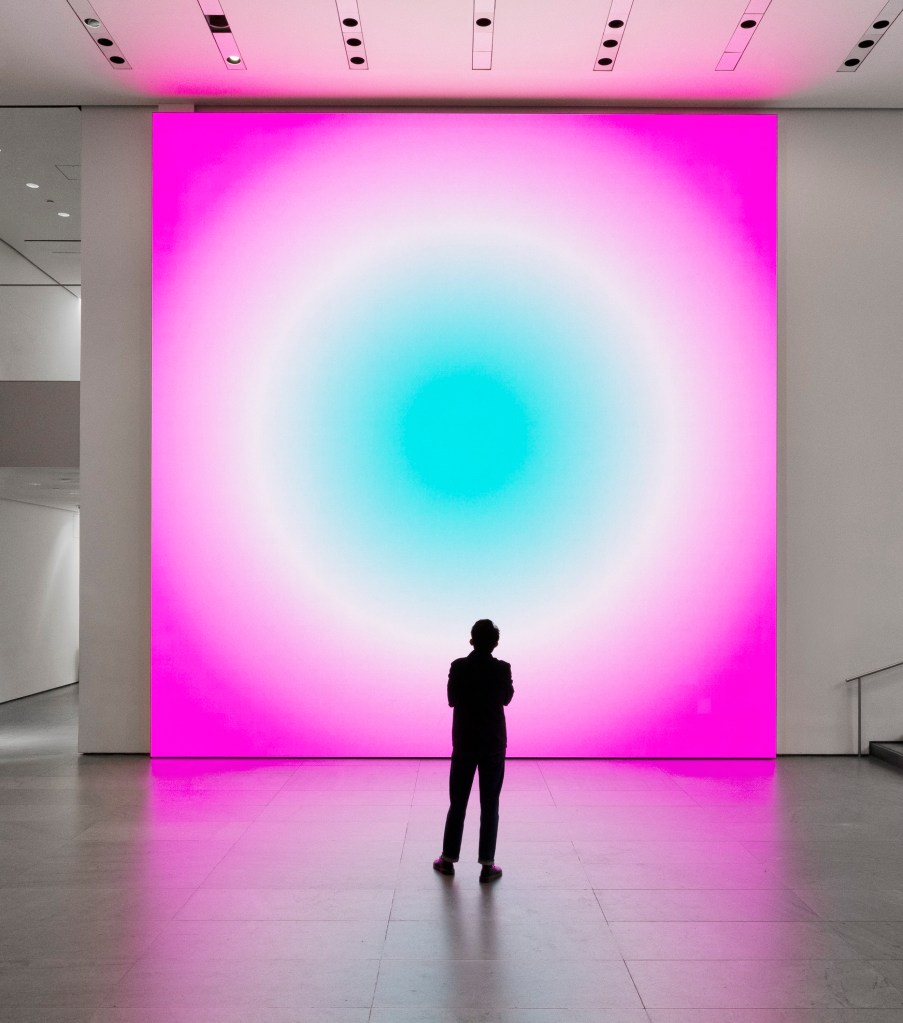
Everything else in the show was very hardcore, like we’re not explaining anything. The show at MoMA was called Light. That was Paula, the curator’s idea. I had written down maybe ten possible titles. One title was easy, a lot of them were joy or words like that and she came up with the word light and I thought, oh, that’s perfect.
That’s all very intuitive. It’s a funny question of inspiration or energy and there was a lot of positive encouragement from the internet, so the internet was very small when I started. I made a few things and immediately I would get in touch with other people making things on the internet. I had done all kinds of things before, like let’s say, cutting stone or silkscreen or oil paint and I was always bouncing against giants and it’s like, oh, that looks too much like this, that looks too much like that. Once I moved to the computer, it was this area where I would do something and it would look new and a lot of people would say, oh, I’ve never seen that. So that’s very exciting.
I think abstract expressionists in the ‘60s also sometimes did titles as a hint to what it could be but then otherwise, they just titled a piece orange because it was orange.
Well, the paintings, I just titled them with the date, the day that the painting was finished. At first, I would say like 25 or 9, 10, like 2025 and then parentheses, whatever, postcard, envelope, but then I decided not to put that word. I’d want to leave it up to the viewer. The websites and the digital works, I do give them titles. The domain names were a whole thing so that was a way to find the works and there was a whole game of finding a title that’s still available. Now with NFTs, I’m free to have a short title and yeah, but it’s very intuitive. There’s nothing pre-planned.
Moe’Neyah Holland
Rafaël Rozendaal, 2024. Photo by Naeem Douglas Rafaël Rozendaal, On And On, Carl Kostyál, Isbrytaren, Stockholm, 2015, exhibition view. Photo by Karl Henrik 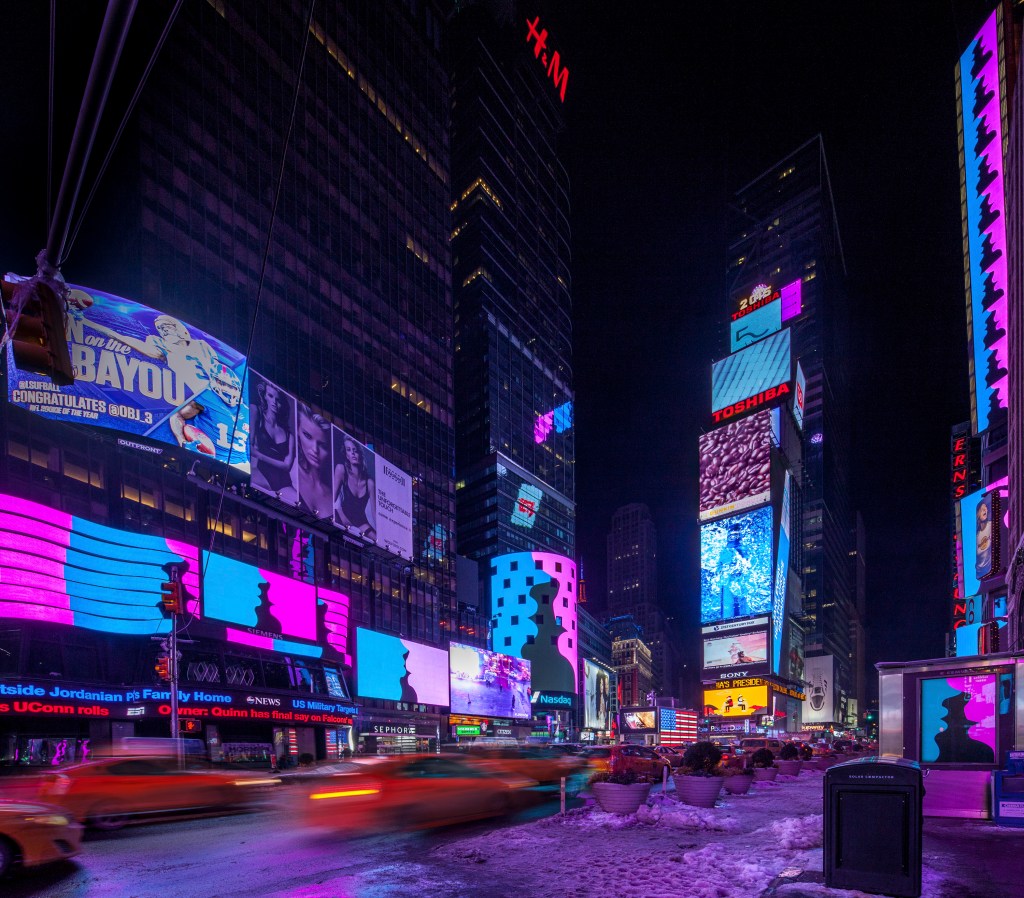
Rafaël Rozendaal, Times Square Midnight Moment, New York, 2015, installation view. Photo by Michael Wells 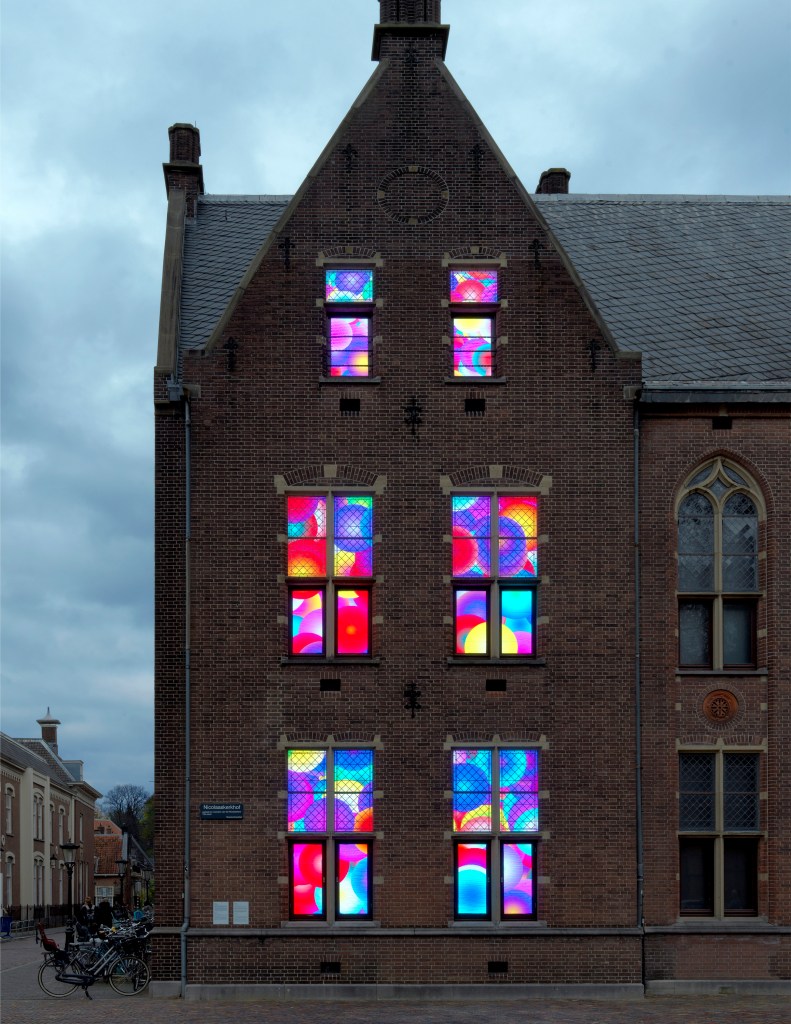
Rafaël Rozendaal, Double Pressure, Centraal Museum, Utrecht, 2019, installation view. Photo by Gertjan Vanrooij Rafaël Rozendaal, Light, Museum of Modern Art, New York, 2024, installation view. Photo by Jonathan Dorado 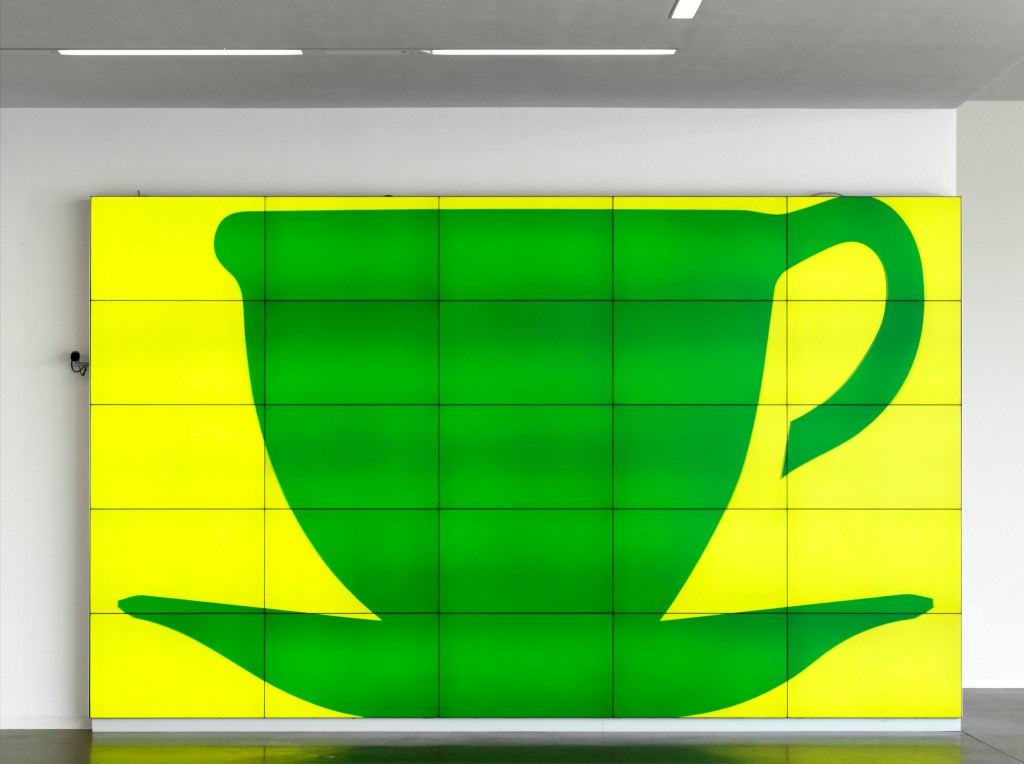
Rafaël Rozendaal, Color, Code, Communication, Museum Folkwang, Essen, 2023, exhibition view. Photo by Gertjan Vanrooij Rafaël Rozendaal, Screen Time, TSCA, Tokyo, 2022, exhibition view. Photo by Shu Nakagawa 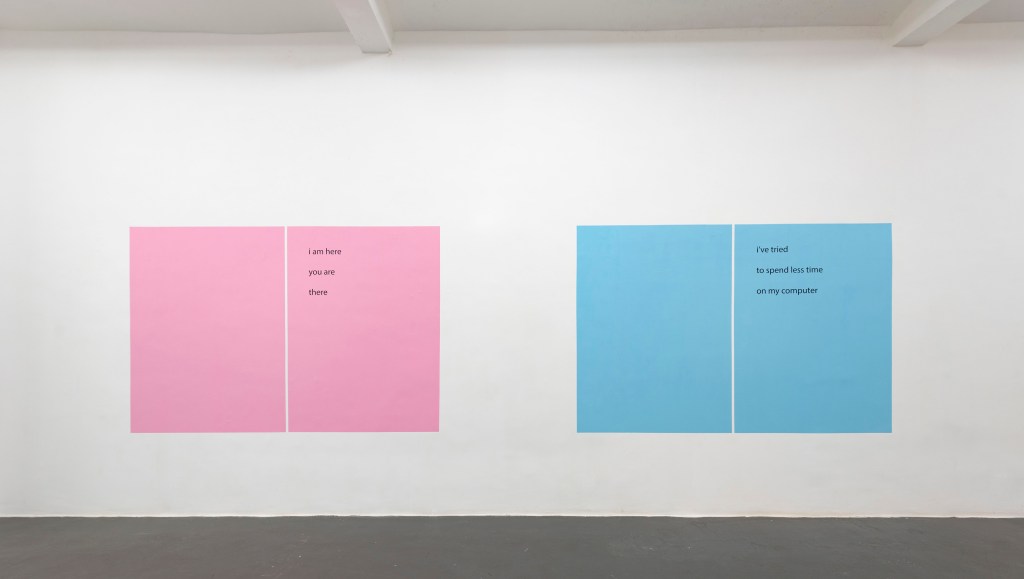
Rafaël Rozendaal, Nervous, Postmasters, Rome, 2019, exhibition view. Photo by Giorgio Benni 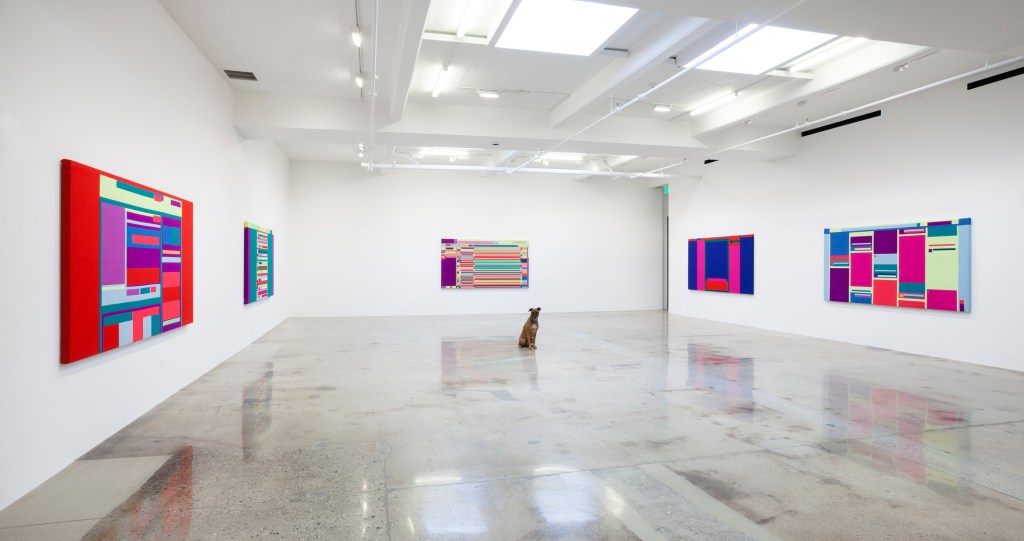
Rafaël Rozendaal, Abstract Browsing, Steve Turner, Los Angeles, 2016, exhibition view. Photo by Don Lewis 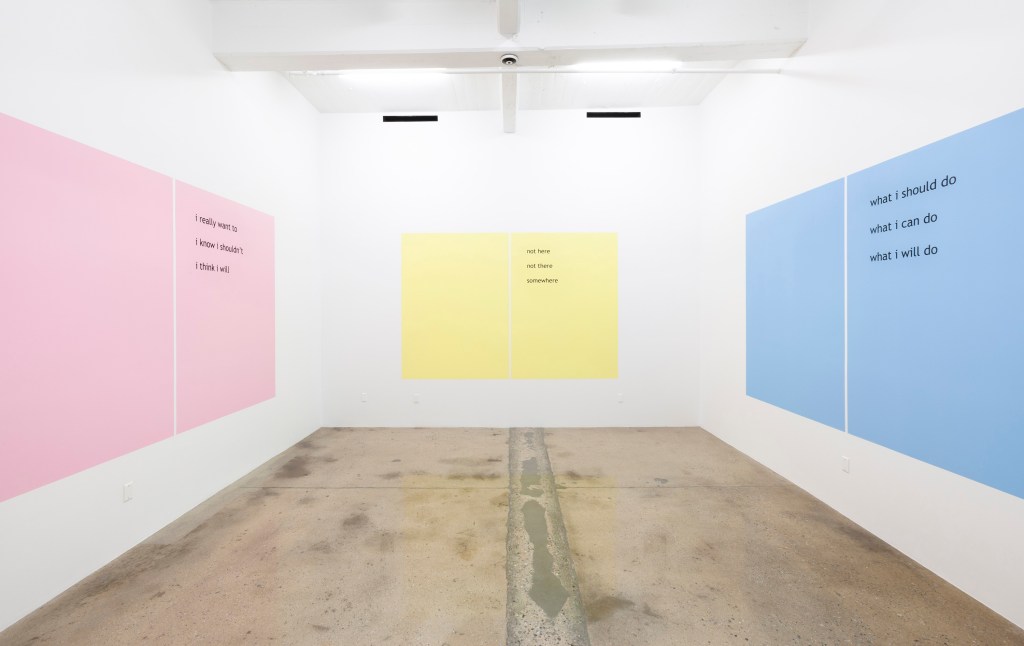
Rafaël Rozendaal, Haiku, Postmasters, New York, 2015, exhibition view. Photo by Don Lewis 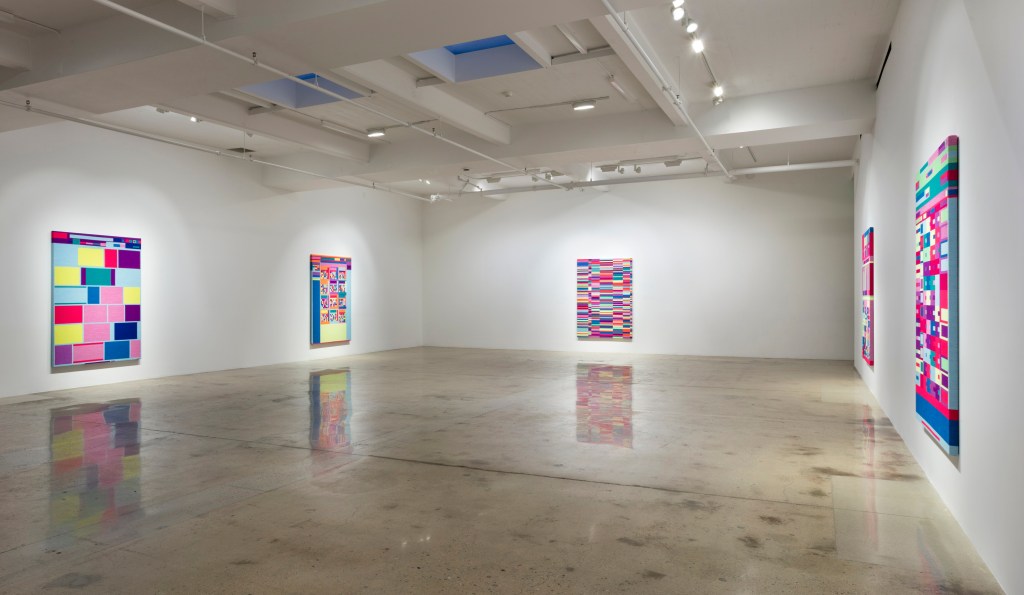
Rafaël Rozendaal, Portraits, Steve Turner, Los Angeles, 2018, exhibition view. Photo by Don Lewis 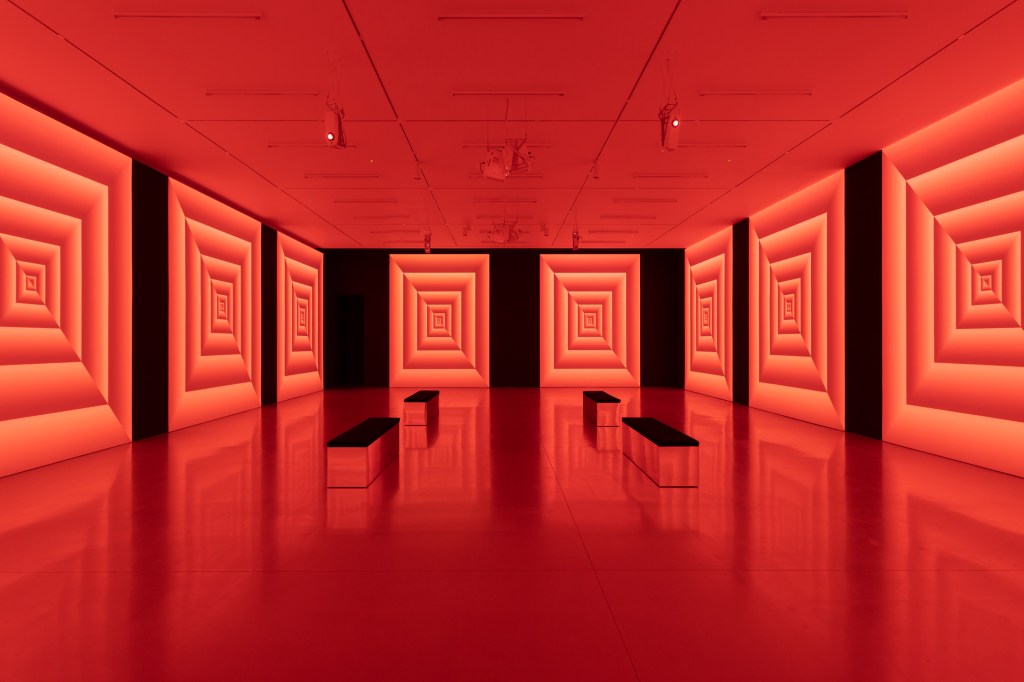
Rafaël Rozendaal, Permanent Distraction, Site Gallery, Sheffield (UK), 2021, exhibition view. Photo by Jules Lister
 c plus c