In this conversation, Charlotte Laubard explores her interest in self-taught art and her critique of the myth of the artist as genius, proposing a vision of art as a collective and socially situated practice. Laubard highlights the transformative potential of art and recognizes curating as playing a fundamental role in co-creation and facilitation.
Born in 1974, Charlotte Laubard was director (2006-2023) of the CAPC ‒ Musée d’art contemporain in Bordeaux and is currently professor of Art History and Theory at HEAD in Geneva, where she also served as director of the Department of Visual Arts (2017-2023).
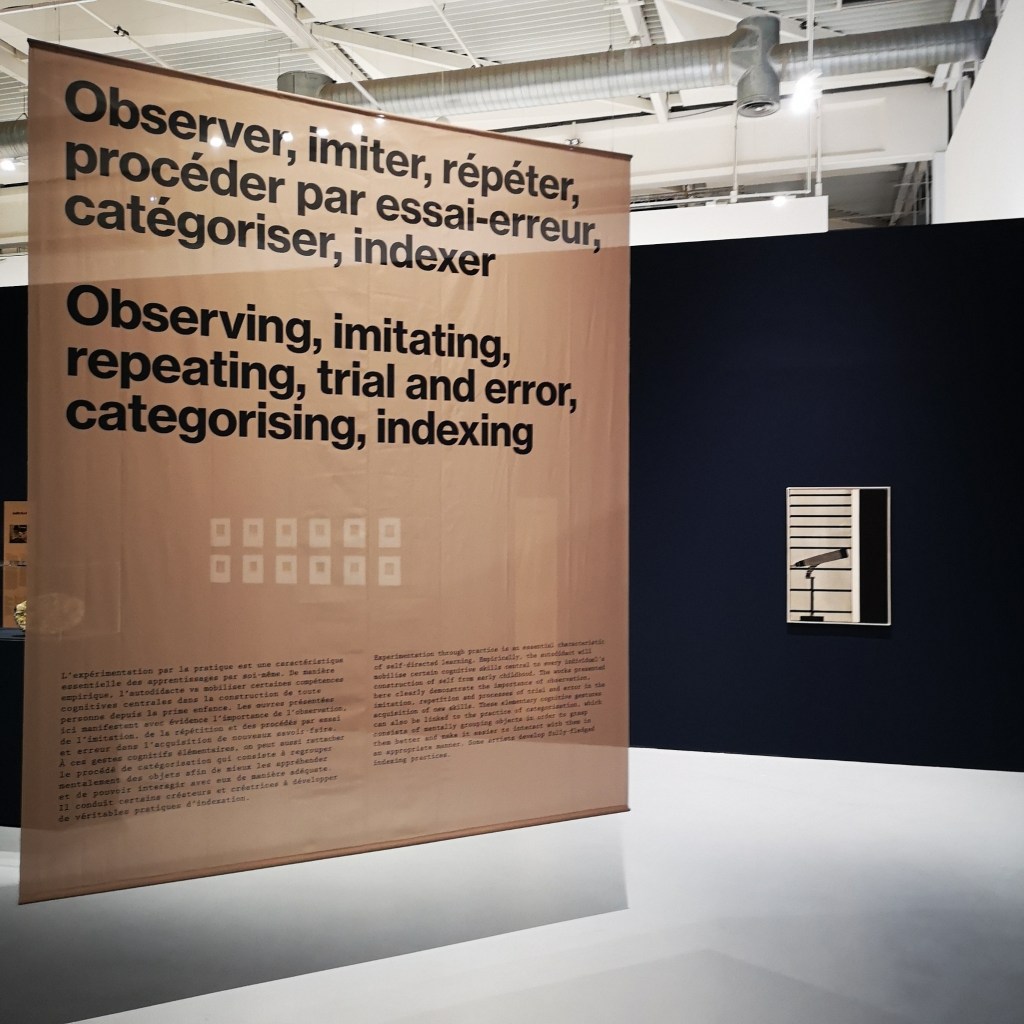
She has worked in New York, Turin, and Kiev in international institutions dedicated to contemporary artistic creation and has curated numerous exhibitions, including the Swiss Pavilion at the 2019 Venice Biennale with artists Pauline Boudry and Renate Lorenz, and the group exhibition L’énigme autodidacte at the MAMC+ in Saint-Etienne in 2021-2022.
She is an art historian and independent curator, as well as co-founder of the Société suisse des Nouveaux commanditaires. This interview was an opportunity to explore some of the research topics that characterize her academic and curatorial career.
SELF-TAUGHT ART AND CURATING
In your work, you have explored the issue of autodidactism in art, questioning the institutional processes at stake for its legitimacy. Many great pioneers of curating ‒ from Harald Szeemann to Pontus Hultén ‒ did not have a formal academic background, because curating as a discipline did not yet exist. Today, however, the figure of the curator is becoming institutionalized, with the risk of standardization. In this context, what space remains for a self-taught and innovative dimension of curating?
The risk for any curator today is to think in keywords ‒ to approach the complexity of reality through a categorical reading that is reductive. The major flaw in much of today’s artistic and curatorial practice can be summed up in a single word, in my view: the aboutness. To avoid this pitfall, I often encourage my art students to approach reality through a detail that escapes attention, that resists understanding, and that unfolds a whole series of questions ‒ sometimes of an abyssal nature.
Your research focuses on the digital dimension not only as a technological innovation but as a structural factor of cultural change. In this scenario, do you think there is a risk that self-taught artists, instead of inventing alternative paths, will increasingly rely on models and archives generated by AI and self-learning algorithms?
There is one thing I know from having studied self-taught practices, as well as the practices of unlearning that were so prevalent in modern and contemporary art ‒ and from spending time with art students: anything that can facilitate learning and expression is worth embracing. History shows this time and again: whenever a technology has been designed to be used with almost no technical knowledge, it enables a broader public to seize it and express themselves. Of course, this also generates a great deal of normativity. Those who manage to stand out tend to use such tools in deviant, non-conforming ways ‒ whether consciously or not ‒ which often proves far more conducive to creative accidents and unexpected discoveries.
ART AGENCY AND COLLECTIVE PRACTISES
You invite us to move away from the idea of the isolated artist-genius, to recover a collective practice in the production of art, and a role for art that is not only contemplative but operational. How could this perspective redefine not only the criteria for artistic legitimacy, but also the very function of the institutions that preserve and display artworks?
In the past ‒ and still today ‒ too much importance has been placed on the artist’s intentions. This burden confers both enormous responsibility and a certain fragility: the artist must constantly meet the imperative to say something original, endlessly reinvented, while also managing the anxiety that arises when their work fails to connect, when their intentions are not understood. Yet the reality is that everyone who experiences an artwork projects their own intentions onto it ‒ intentions that may diverge considerably. The very existence of the work, and the social legitimacy it gradually acquires, depend on this process of co-construction and co-creation. We would have much to gain by letting go of the myth of genius and our attachment to authorship, in order to focus instead on the effects and experiences that artworks produce.
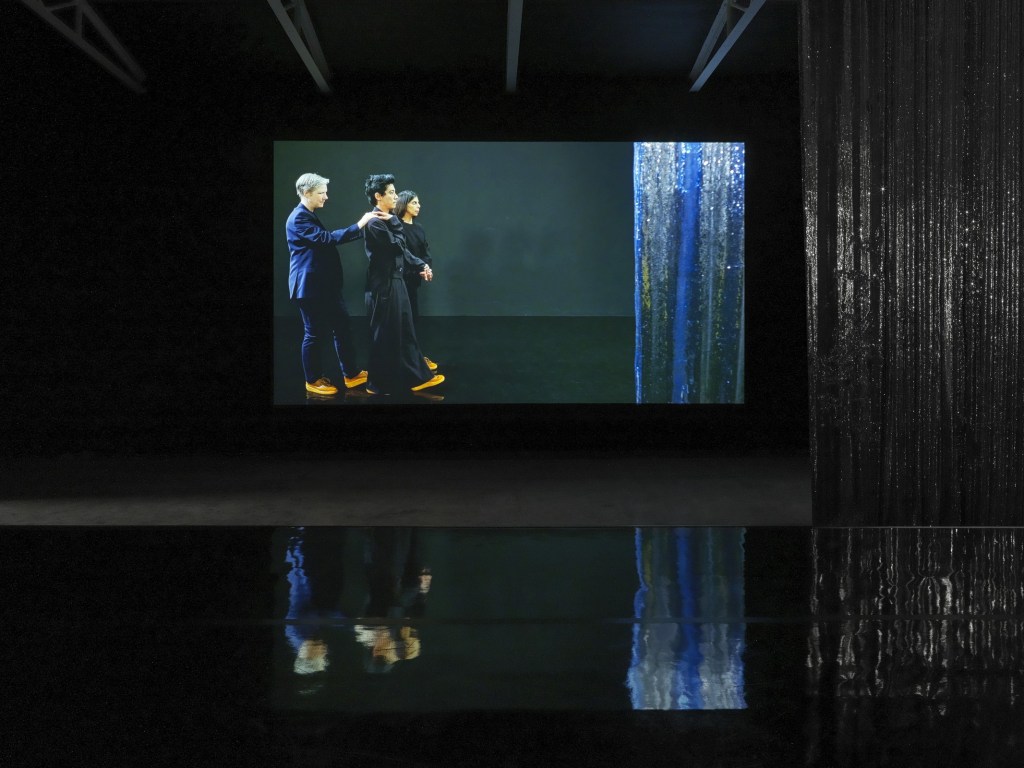
In the letter to visitors written on the occasion of Moving Backwards, the Swiss Pavilion you curated at the 2019 Venice Biennale, you invited people to move beyond the modernist and Western reading of art as formal or conceptual advancement, in order to restore its active role in society. What kind of agency can we recognise in art today, in a fragmented and globalised society?
Art not only heightens sensitivity, strengthens critical judgment, and broadens the field of consciousness ‒ it can also protect, heal, grant access to invisible entities, influence the course of existence, resolve situations, affirm shared values, commemorate, bring people together, and celebrate… It seems to me that by embracing all these roles of art, we can restore social legitimacy to creative practices and make the art world genuinely more inclusive. This means, quite concretely, that aesthetic contemplation is only one among many possible ways of relating to creation.
ART AND CO-CREATION
You are the co-founder and mediator of the Société suisse des Nouveaux commanditaires, an initiative that allows anyone ‒ regardless of age, origin or profession ‒ to collaborate with an artist or mediator to commission a work. From your experience, what are the issues that most mobilise citizens today?
The Nouveaux commanditaires (“New Patrons”) initiative enables groups of citizens to commission an artist to respond to a collective issue ‒ for instance, to strengthen social bonds, give visibility to a cause, revalue a place, or share a memory. The Nouveaux commanditaires make artistic creation a tool of democratic action, accessible to all, producing works that emerge in response to real needs and social concerns meaningful to the communities in which they take root. What continues to amaze me most about this approach is how the commissioners gradually become open to the most contemporary and radical forms of art, even though they often begin with rather clichéd or simplistic notions of what art is. The explanation is, in fact, quite simple: the work responds to their need. It offers them an “imaginary leap” that often helps resolve or transcend ‒ on a symbolic level ‒ situations that may be complex.
You have often insisted that creation is collective by nature, and that the work lives in its relationship with its audiences. In this sense, curating is no longer just mediation, but becomes co-creation. How do you imagine a curatorial practice capable of giving shape to these collective energies without being reduced to simple social facilitation?
I think it’s perfectly fine to be a facilitator. With the Nouveaux commanditaires, my role is to help people and artists work together, in mutual respect for each other’s skills. My ambition in this context is to produce works that are legitimate both socially and artistically. Ultimately, it’s about transforming the roles of all the actors in the art world: the artist, the curator, and those who experience art. In short, it’s about changing the very way the history of art is conceived and written. Quite an ambition ‒ one that surely restores a sense of dignity to the role of facilitator, doesn’t it?

If curating has a political task, not just an aesthetic one, what do you think is its most urgent function today: to create common sense, to encourage dissent or to imagine new forms of coexistence?
Common sense and dissent are both at stake in our current era, one deeply marked by populism. At a time when antagonism is so pervasive, I believe we should think of art and curating as practices of agonism ‒ to borrow a concept from philosopher Chantal Mouffe. The most effective artistic practices are those capable of welcoming diverse perceptions and interpretations. Their polysemy ‒ their resistance to unilateral meaning ‒ is their true strength.
Alice Longo

Charlotte Laubard. Photo Keystone / Gaetan Bally 
The Self-taught Enigma, catalog of the exhibition curated by Charlotte Laubard, MAMC+, Saint-Étienne, France, 2021 The Self-taught Enigma, curated by Charlotte Laubard, exhibition view, MAMC+, Saint-Étienne, France, 2021 Moving Backwards: Pauline Boudry / Renate Lorenz, curated by Charlotte Laubard, exhibition view, Swiss Pavilion, Biennale di Venezia, 2019. Photo Annick Wetter Nouveaux commanditaires, work by the Frères Chapuisat, commission mediated by Charlotte Laubard, Nyon, Switzerland, 2021. Photo Michel Giesbrecht 
Nouveaux commanditaires (New Patrons), artwork by Lili Reynaud-Dewar, commission mediated by Charlotte Laubard, Fribourg, Switzerland, 2022. Photo Guillaume Python 
Nouveaux commanditaires (New Patrons), artwork by Invernomuto, commission mediated by Charlotte Laubard, Geneva, Switzerland, 2024 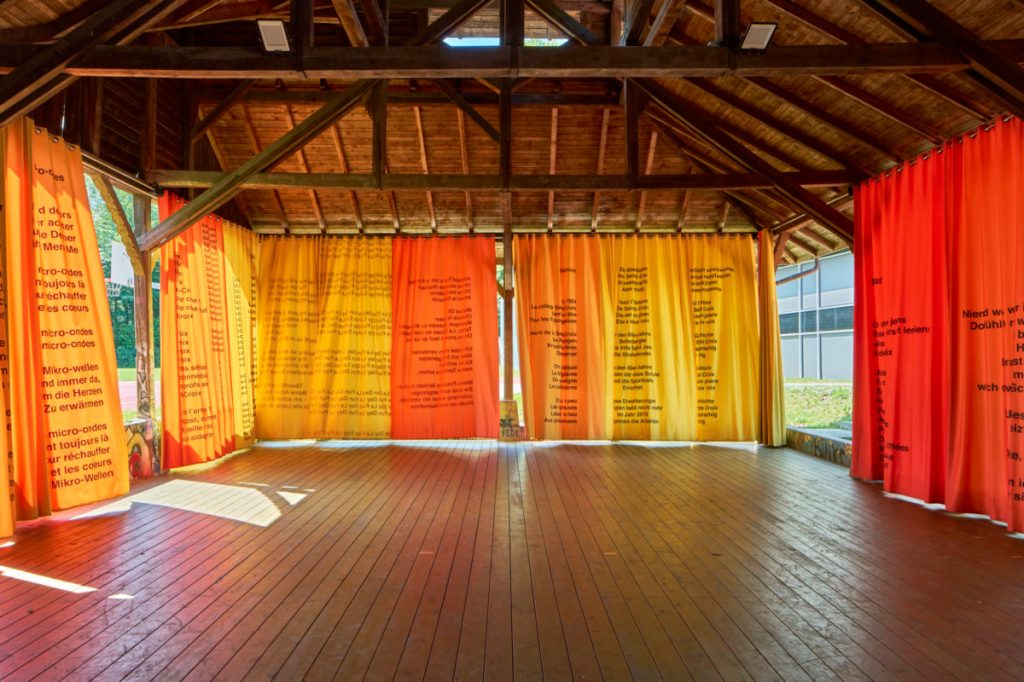
Nouveaux commanditaires (New Patrons), artwork by Invernomuto, commission mediated by Charlotte Laubard, Geneva, Switzerland, 2024 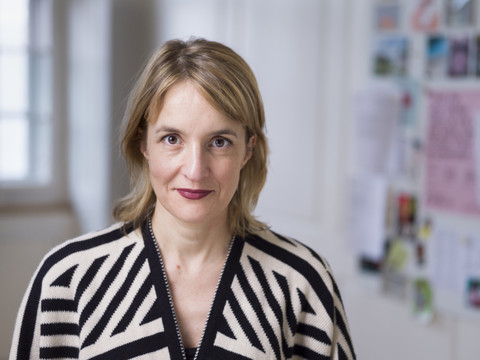
Charlotte Laubard. Photo Keystone / Gaetan Bally
The text has been translated in English using AI

 c plus c