Palazzo Grassi, the Venetian venue of the Pinault Collection, is hosting, until 10 January 2027, the works by Michael Armitage and Amar Kanwar exploring conflict, human memory and sensitive socio-cultural and political issues. A narrative centred on the violent implications of power, expressed through a universal perspective that becomes a collective voice.
Michael Armitage was born in Nairobi in 1984, whilst Amar Kanwar was born in New Delhi twenty years earlier. These two artists, working in different media – the former in painting and the latter in video – depict their contemporary reality with profound expressive sensitivity. Both narratives blend recollections, memories and episodes from human history, bringing together the individual and collective dimensions.
MICHAEL ARMITAGE AT PALAZZO GRASSI
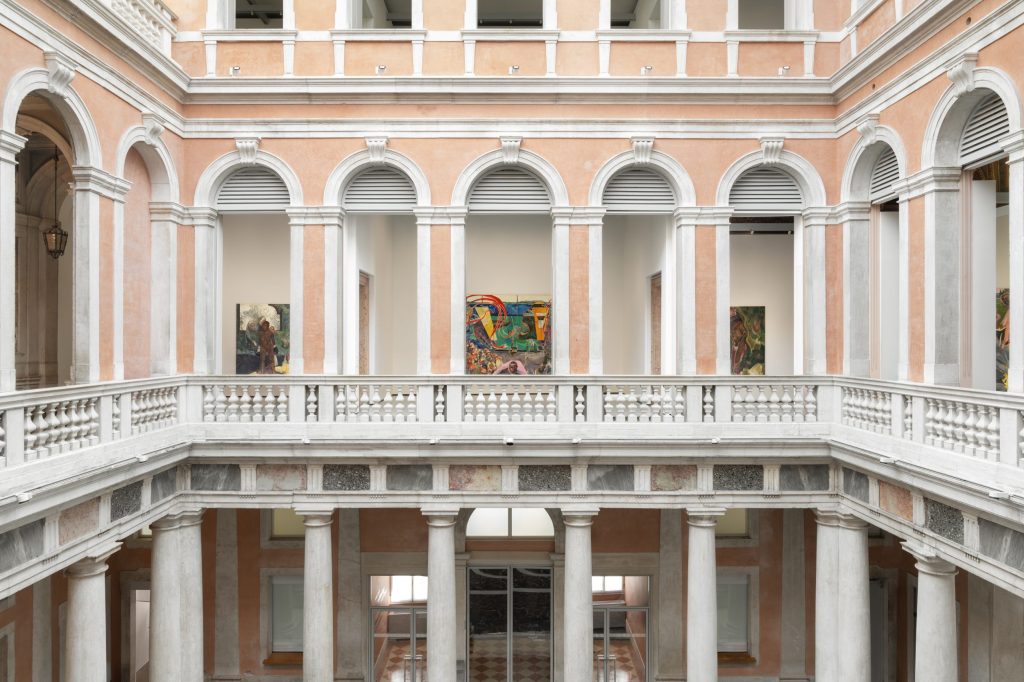
Michael Armitage. The Promise of Change, curated by Jean-Marie Gallais, in collaboration with Hans Ulrich Obrist on the catalogue, Caroline Bourgeois and Michelle Mlati, features forty-five paintings, each of which depicts a daily reality experienced by many and (probably) unknown to those who have never encountered it. Armitage paints on large lubugo canvases made from tree bark, following an artistic practice widespread in Uganda. Lubugo cloth is characterised by holes and tears, an ambivalence between fragility and resilience that echoes in the themes addressed by Armitage. The holes, described by Obrist as “scars on a body” in the interview published in the exhibition catalogue, become, in the artist’s own words, “my attempts at sewing or the stitches I put into the cloth. […] I want to make work that has a relationship to a cultural history. […] It’s just a way of making that part of the work so I can talk about other things”.
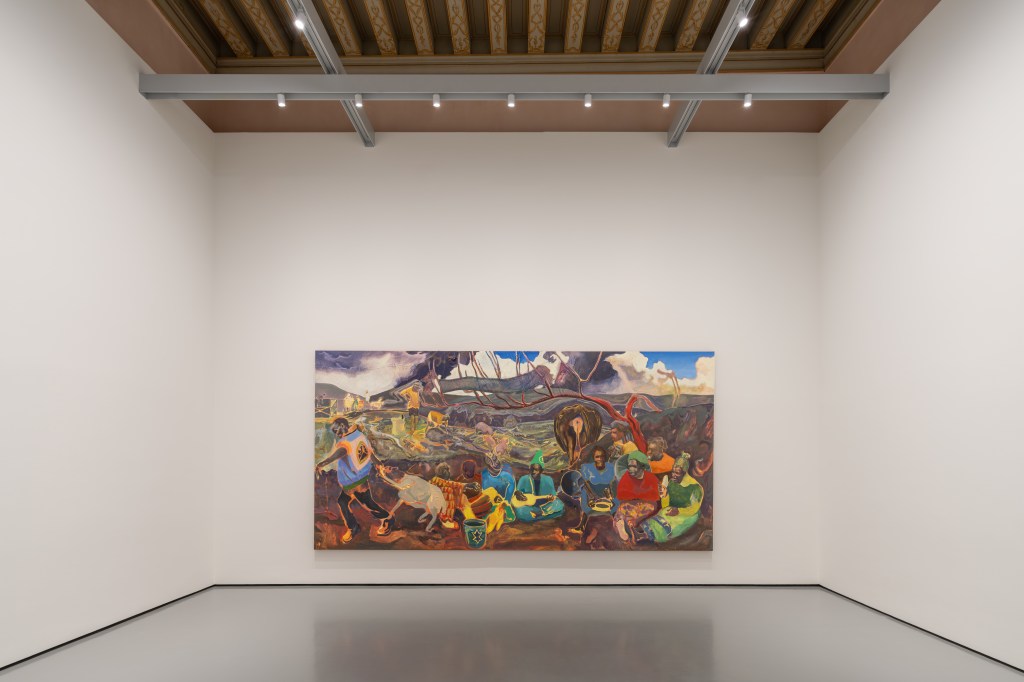
The cultural history of Africa, particularly East Africa, is central to Michael Armitage’s artistic output, both in terms of imagery and content. His works are inspired by fragments of current events: in Curfew (Likoni March 27 2020) from 2022, it is the violent police crackdown on passengers waiting for a ferry; in Nyali Beach Boys from 2016, it is the scourge of sex tourism; in Mkokoteni from 2019, meaning “cart” in Swahili, it is a means of transporting goods widely used in Kenya. Violence, both in expression and content, is the central theme of Armitage’s work, taking shape in almost abstract colours, with clear references to the paintings of Goya and the Fauves. The tragic events of the present range from clashes during political demonstrations to public summary executions, to the hardships faced by migrants, the use of glue as a narcotic, and even gang rape. Armitage draws on a story he knows, one he has lived through, and which echoes in his memory, to speak to the world about issues that are universal and which, universally, must be addressed. This story, “unknown” to the West, is shared by the artist, but also rewritten and decolonised through references to the filmmaker Ousmane Sembène. Thus, issues emerge that cannot fail to concern anyone who has the courage to acknowledge them and not look the other way. Anyone, because in #mydressmychoice (2015) the violence suffered by the protagonist was there for all to see – not only by those who caused it, but also by those who shared it online. The exhibition is heart-wrenching because it succeeds in sharing the pain and fostering a sense of community. However successful and powerful it may be, it would require a trigger warning at the outset.
The exhibition is spread over two floors and is organised into thematic sections. The selection of forty-five works provides a comprehensive overview of Armitage’s oeuvre. It is worth spending some time in the room dedicated to preparatory drawings and in the one featuring a series of in-depth studies on lubugo cloth. Here, the videos focus on the material, whilst the bibliographical references are connected to the exhibition. A valuable selection of texts, including the exhibition catalogue edited by Hans Ulrich Obrist, proves to be an effective tool for understanding the artist’s perspective.
THE AMAR KANWAR EXHIBITION
On the second floor of Palazzo Grassi are the two multimedia installations The Torn First Pages (2004–08) and The Peacock’s Graveyard (2023), the centrepieces of the exhibition Amar Kanwar. Co-travellers, curated by Jean-Marie Gallais. The Torn First Pages, a nineteen-channel video, is displayed on metal frames running along three rooms and is accompanied by a book – a symbol of the visual storytelling. The video installation combines printed materials and archive footage – footage of demonstrations filmed by activists – with the aim of paying homage to the story of Ko Than Htay. The title of the work derives precisely from the bookseller’s act of protest, in which he tore out the first page of every book he sold: the page which, as required by law, listed the regime’s political objectives. The video installation bears witness to Kanwar’s commitment to supporting the democratic movements active in Myanmar, documenting the complexity of the struggle and the atrocities of the dictatorship.
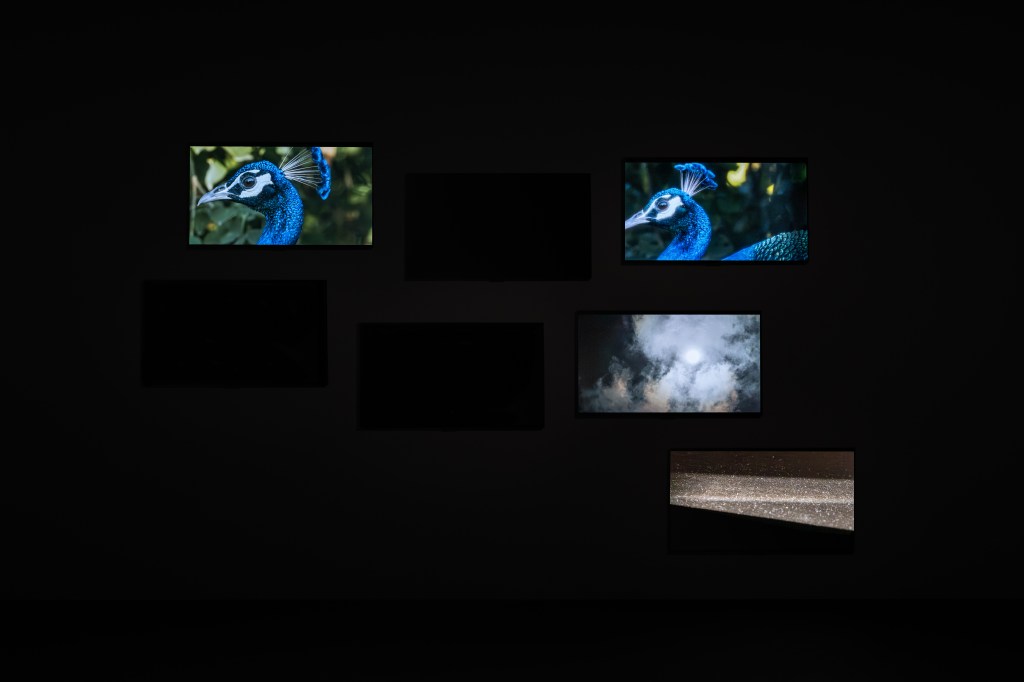
In a separate room, in a more intimate setting, The Peacock’s Graveyard explores the theme of memory through a reflection on death: the result is a timeless narrative comprising five stories written by the artist. A contemporary fairy tale rendered in the video through a juxtaposition of texts and metaphorical images, accompanied by the sound of a raga (an Indian melody), which heightens the narrative’s poetic power, inducing a trance-like sensation. Kanwar’s are “timeless fairy tales”, to quote François Pinault’s words in the catalogue regarding the work The Peacock’s Graveyard, which has recently joined his collection.
A COLLECTIVE ISSUE
The two exhibitions at Palazzo Grassi shed light on themes that have been obscured or ignored by Western history, told through the works of Michael Armitage and Amar Kanwar who, though distant in style and geography, raise common questions about violence, abuse and contemporary tragedies. The common thread is certainly violence in its various forms, but also, and above all, an awareness of how necessary it is to listen and respond collectively. The sense of a shared community – as human beings – arises from an awareness of the present and is evoked by Armitage’s works, as well as by the images in The Torn First Pages and the universally valid morals of The Peacock’s Graveyard.
To echo the thoughts of Elias Canetti in Crowds and Power (1960): “All the distances that men have created around themselves are dictated by the fear of being touched”. If the experience of the crowd is a profound human experience that allows us to experience a moment of primordial equality, then the only way to be equal is to be touched by the same problems, to be confronted with the same violence.
Rebecca Canavesi
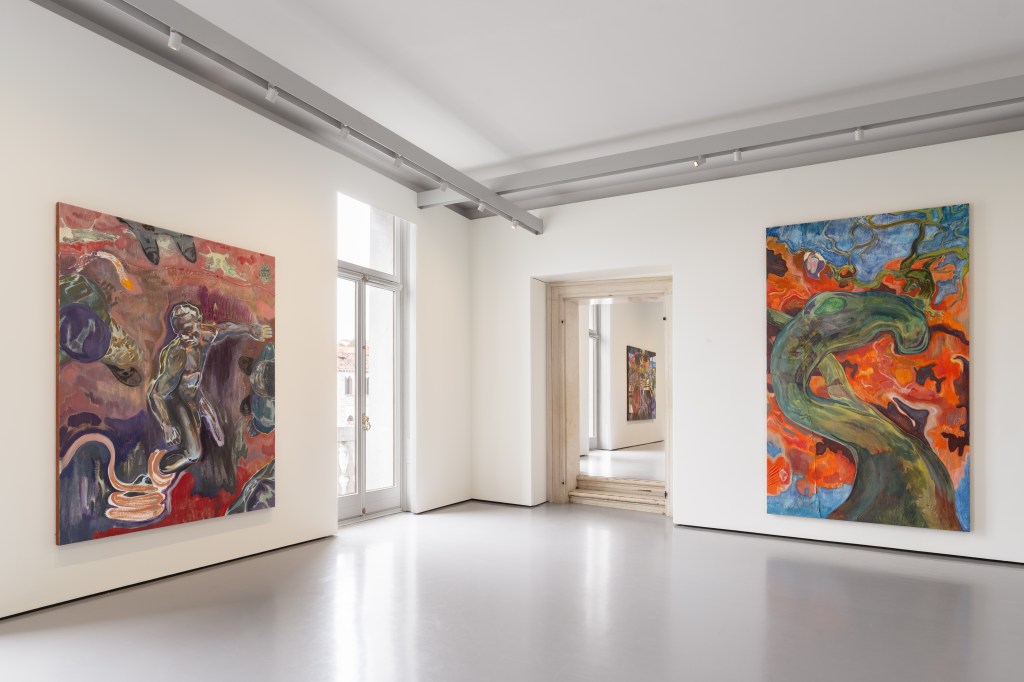
(from left to right) Michael Armitage, Nyayo, 2017, Private Collection; Strange Fruit, 2016, Private Collection. Installation view Marco Cappelletti Studio 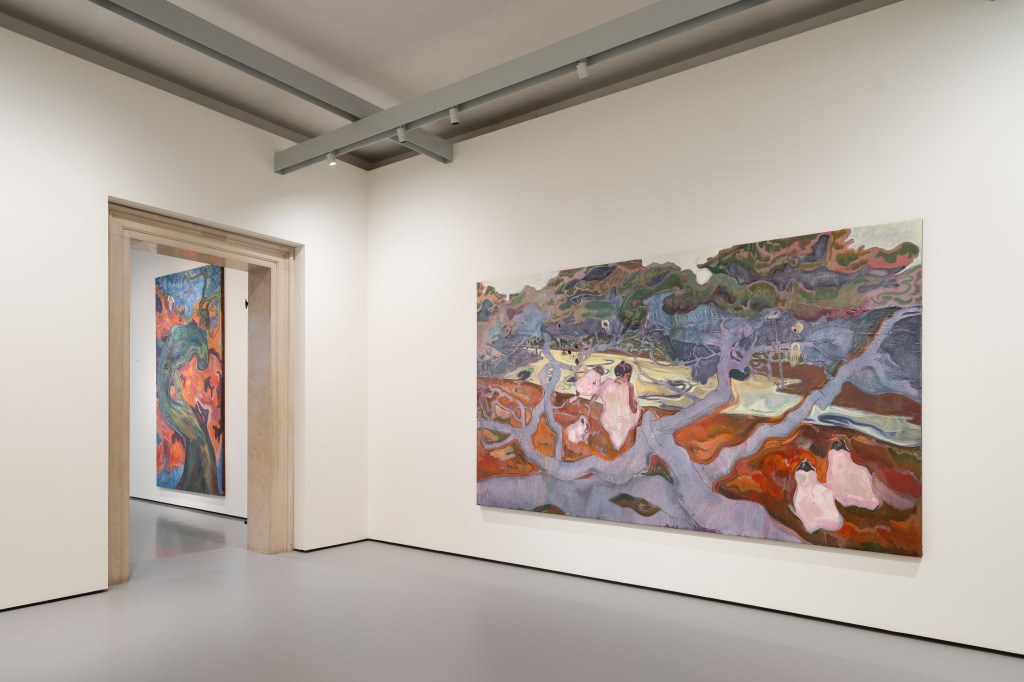
(from left to right) Michael Armitage, Strange Fruit, 2016, Private Collection; Baikoko at the mouth of the Mwachema River, 2016, Private Collection. Installation view Marco Cappelletti Studio Michael Armitage, Dandora (Xala, Musicians), 2022, Pinault Collection. Installation view Marco Cappelletti Studio 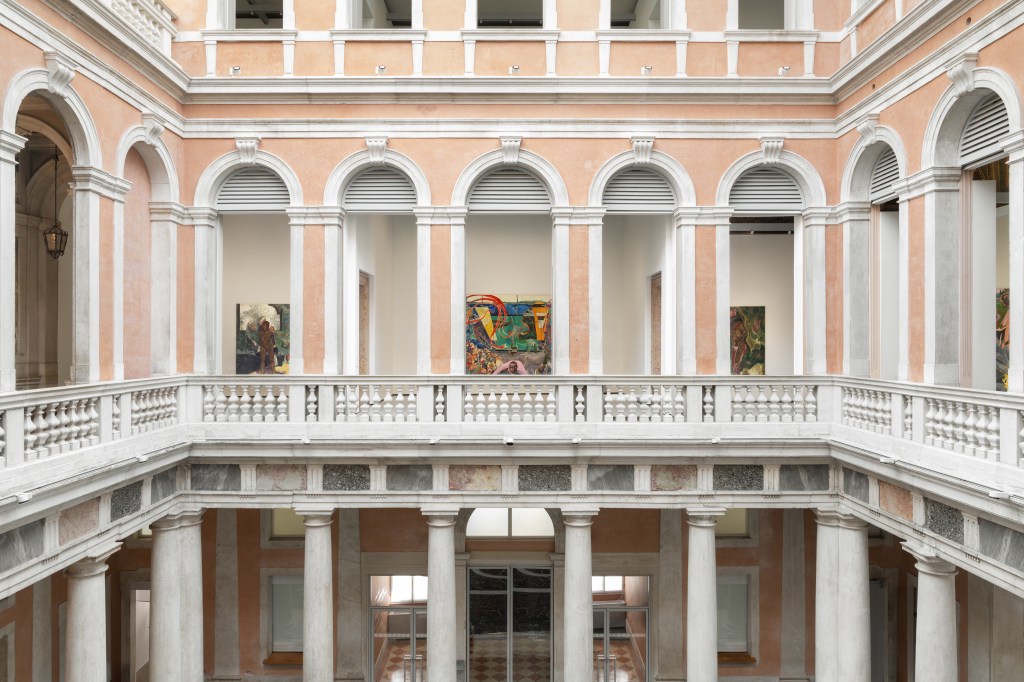
(from left to right) Michael Armitage, Conjestina, 2017, San Francisco Museum of Modern Art, Accessions Committee Fund purchase; Curfew, (Likoni March 27 2020), 2022, Museum of Modern Art (MoMA), Gift of Ronnie Heyman in honor of Ann Temkin. Acc. no.: 768.2022; Necklacing, 2016, The Metropolitan Museum of Art, Purchase, Bequest of Gioconda King, by exchange, 2018 (2018.937). Installation view Marco Cappelletti Studio 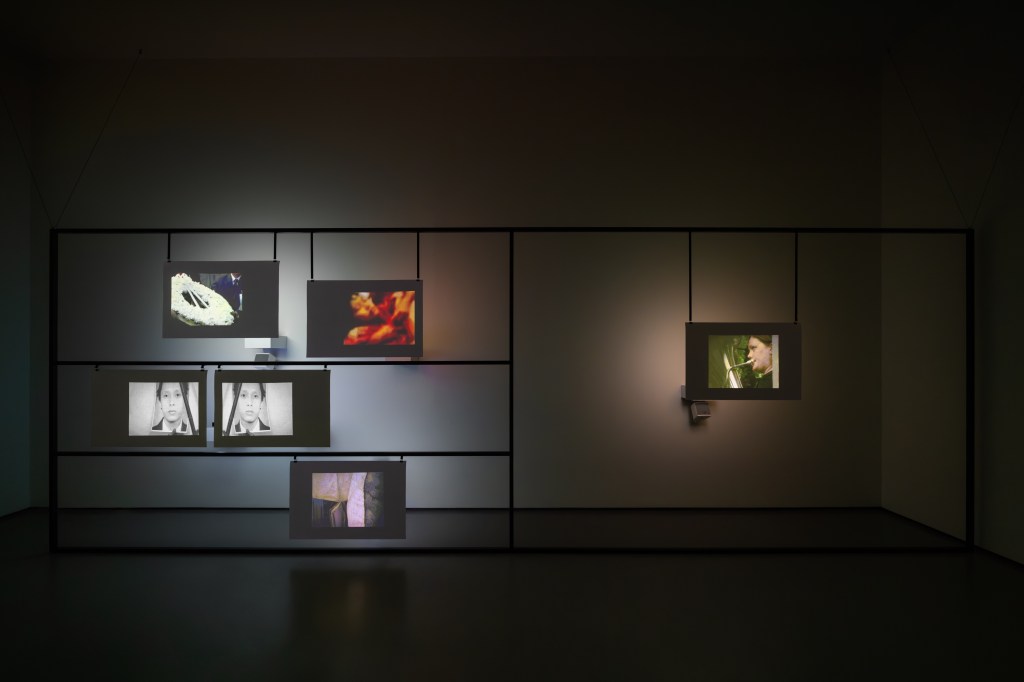
Amar Kanwar, The Torn First Pages, 2004-2008, Collection of the artist. Installation view Amar Kanwar. Co-travellers, 2026. Photo Marco Cappelletti Studio © Palazzo Grassi, Pinault Collection Amar Kanwar, The Peacock’s Graveyard, 2023, Pinault Collection. Installation view Amar Kanwar. Co-travellers, 2026. Photo Marco Cappelletti Studio © Palazzo Grassi, Pinault Collection 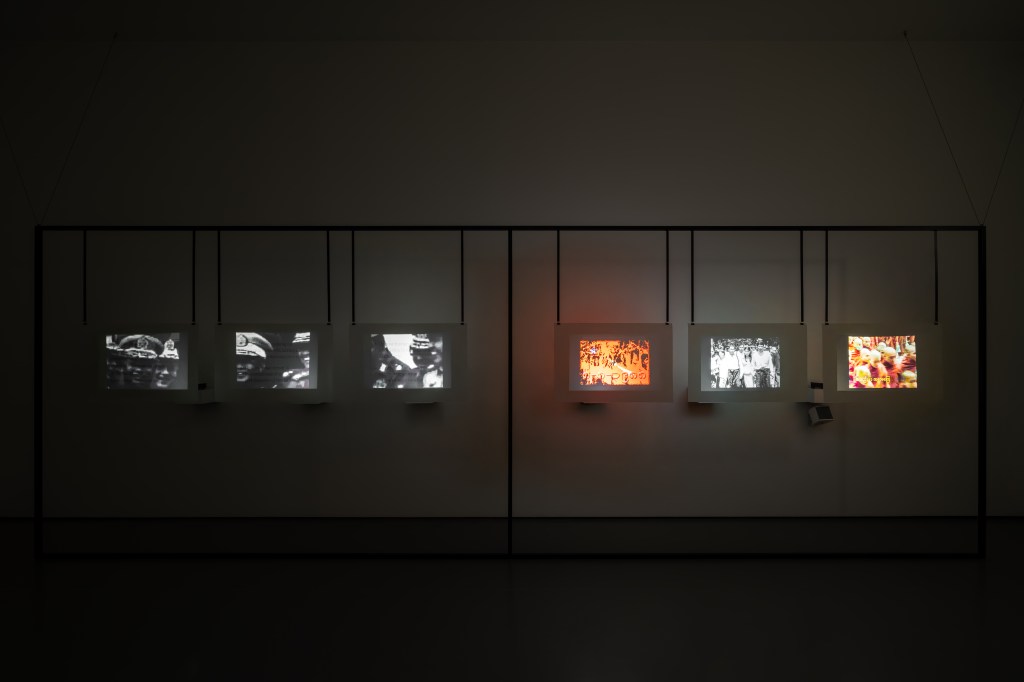
Amar Kanwar, The Torn First Pages, 2004-2008, Collection of the artist. Installation view Amar Kanwar. Co-travellers, 2026. Photo Marco Cappelletti Studio © Palazzo Grassi, Pinault Collection 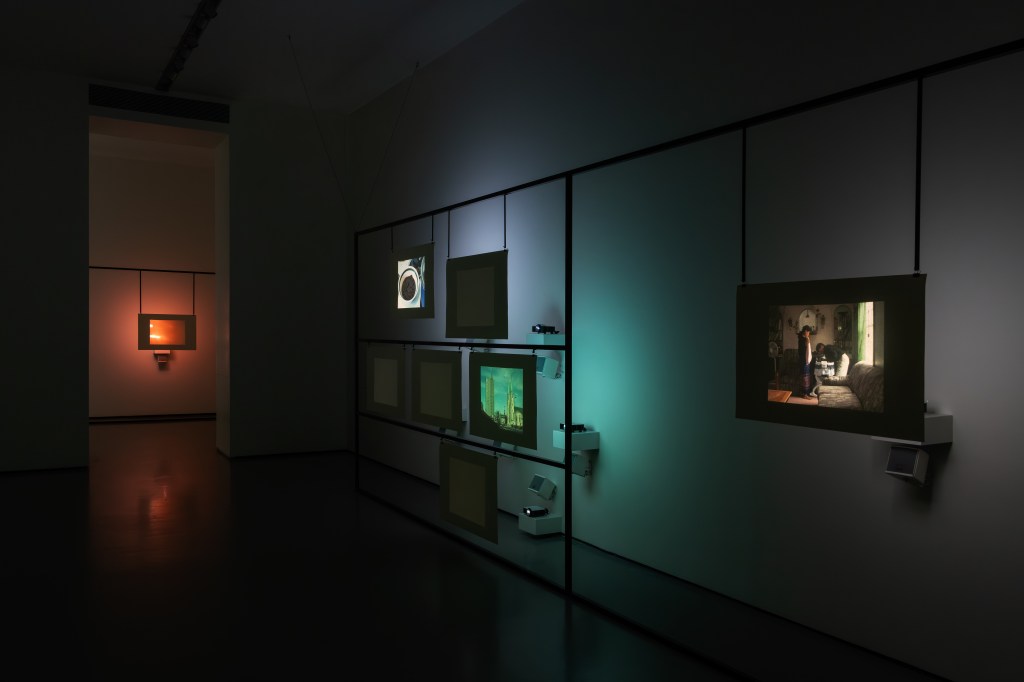
Amar Kanwar, The Torn First Pages, 2004-2008, Collection of the artist. Installation view Amar Kanwar. Co-travellers, 2026. Photo Marco Cappelletti Studio © Palazzo Grassi, Pinault Collection
The text has been translated in English using AI
 c plus c