Flavia Spasari explores the potential of artistic practice through intermedial research. Favoring fluidity over the categorization of art forms, Spasari conducts her research consciously, despite her young age.
Flavia Spasari, born in Calabria in 2000, graduated from the Academy of Fine Arts in Carrara in visual arts and sculpture and is currently attending the Master in Visual Arts course at the IUAV in Venice. Her interest in the realm of the sensible is reflected in the fluidity of her artistic practice. From sound to staging, Spasari touches on personal themes that open up to well-orchestrated critical insights.
AN INTERVIEW WITH FLAVIA SPASARI
What name would you give to your artistic practice?
Thanks to this question, I overcome the use of a single medium in my practice. I have embraced other languages, among which sound is now the most identifiable. I approached it in an experimental way, asking myself in what other way I could reach the physicality of a material. Furthermore, through sound, I could try to investigate various levels of reality, especially what is not understood among them, and it is this inaccessibility that guides me. For me, the model to emulate is that of children putting together as many pieces of plasticine as possible: reality is a piece of plasticine.
Is research central to your practice?
I always start from theoretical research, which I let guide me, leaving the choice of medium to it. The visual and sound parts complete the theory of the previous analysis, restoring its final meaning. My way of doing research is my way of understanding myself.
Looking at your work fix it till you make it, shown in the Venetian exhibition Overlapping Heads at Palazzetto Tito, you gave voice to the “thin” patina of anti-Southernism in Italy. Is it a work that conveys a clear position? Do you often make political choices for your works?
When I started working with sound, this more social component also arrived, becoming an anthropological tool. Leandro Pisano was a founding figure in my research, who states that sound has a verticality such as to allow it to penetrate reality, managing to eviscerate the levels of the sensitive. Recently, sound has become a way of discovering, aided by decolonial studies, of my internalized anti-Southernism. From listening to my sister’s accent, I realized that I was losing mine too, rejecting a part of my identity. I find it a political work, especially for the conscious introspection that the sound dimension can make us reach. From this moment of analysis onwards, I began to introduce parts of my culture both in my compositional and performative practice, inserting file recordings of Calabrian folk songs. A culture that I have systematically rejected because it is considered the bearer of the atavistic traits described by Lombroso. Using these sound materials is a way to penetrate society in a more functional way.
FLAVIA SPASARI AND VENICE
Is the city of Venice providing you with creative impulses and particular food for thought?
I felt a great sense of distrust towards myself and the art world. Venice as a city helped me to reset. I went from the phase of falling in love with art to a more disillusioned phase similar to the one you experience towards your parents when you grow up. You see them for who they are, that is, people with their flaws. But, through workshops such as that by Professor Filippo Maggia, I had the opportunity to rediscover a theoretical approach to my practice that helped me a lot. I think that many like me have come to IUAV precisely because of a great sense of discouragement towards the academic system. There is a strong crisis in art in Italy and the entire educational system is affected by this. The only positive note is that, in decadence, rules and structures are deprived of their meaning and you can effectively create what you want. But I would advise anyone who wants to embark on the artistic path to do so despite all the adversities, because I am trying and, even if I tried to do something else, I would always come back here.
What lesson have you learned from this moment of crisis and rediscovery?
I learned that the moment of awareness can coincide with a happy moment. You experience things with awareness, you know that you will toughen up to face reality and that acceptance is the key. It helped me so much to be in an environment where people fervently believe in art, where you get your hands dirty and feel you can count on a collective vision.
What is your relationship with the figure of the curator?
It is not easy to define what a curator is or is not, in fact to do so I think of the relationship with the curator Marco Augusto Basso. For the exhibition Tre Canti at Spazio TORRSO in Pesaro, in a very authorial way Basso curated and commented on the exhibition through assemblages. We did a sort of residency in the gallery and, with the pre-existing objects in the archive, we gave life to the exhibition. For me, this is a symptom of a true curator-artist relationship, where the boundaries exist and are rewritten.
Maria Rosaria Santosuosso

Flavia Spasari, fix it till you make it, 2025, installation of various dimensions. Archival materials, fax, ultrasound and X-ray images, engraving, laryngeal polyp forceps, walkman. Installation view from Overlapping Heads at Palazzetto Tito, Fondazione Bevilacqua La Masa, Venice. Courtesy of the artist 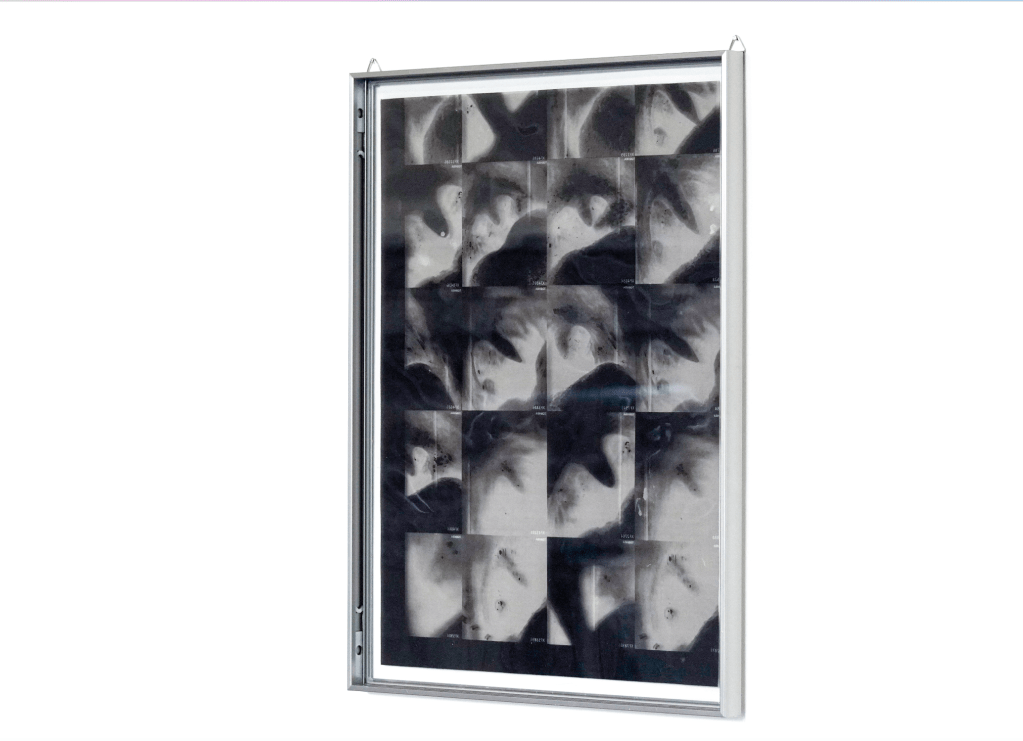
Flavia Spasari, fix it till you make it, 2025, installation of various dimensions. Archival materials, fax, ultrasound and X-ray images, engraving, laryngeal polyp forceps, walkman. Installation view from Overlapping Heads at Palazzetto Tito, Fondazione Bevilacqua La Masa, Venice. Courtesy of the artist 
Flavia Spasari, fix it till you make it, 2025, installation of various dimensions. Archival materials, fax, ultrasound and X-ray images, engraving, laryngeal polyp forceps, walkman. Installation view from Overlapping Heads at Palazzetto Tito, Fondazione Bevilacqua La Masa, Venice. Courtesy of the artist 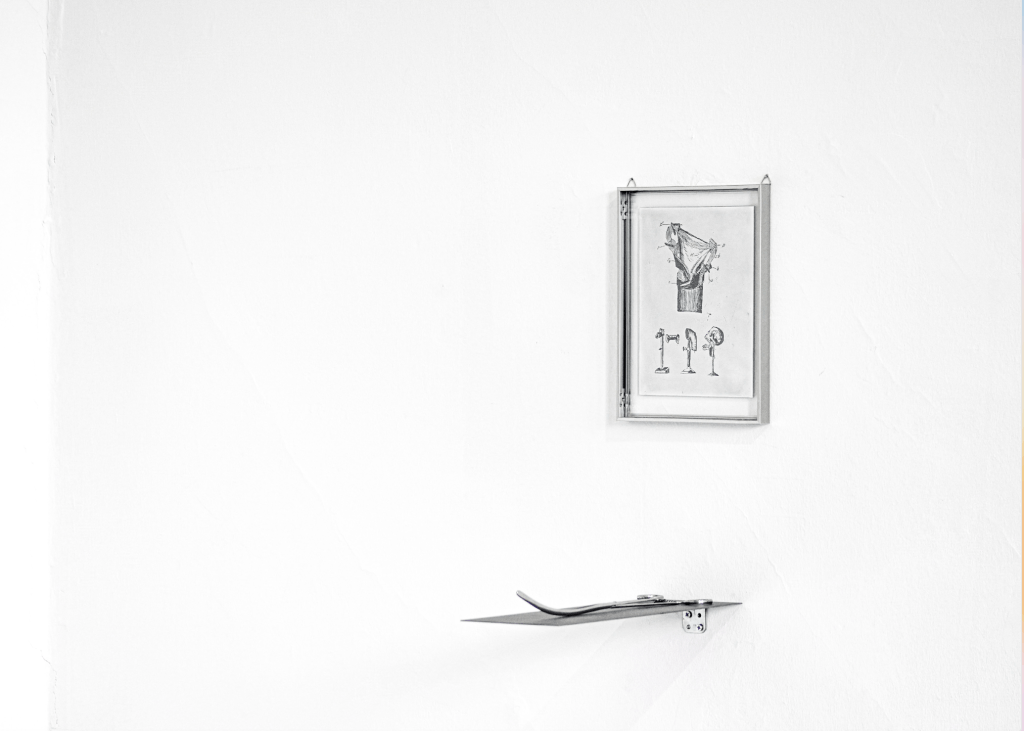
Flavia Spasari, fix it till you make it, 2025, installation of various dimensions. Archival materials, fax, ultrasound and X-ray images, engraving, laryngeal polyp forceps, walkman. Installation view from Overlapping Heads at Palazzetto Tito, Fondazione Bevilacqua La Masa, Venice. Courtesy of the artist 
Flavia Spasari, fix it till you make it, 2025, installation of various dimensions. Archival materials, fax, ultrasound and X-ray images, engraving, laryngeal polyp forceps, walkman. Installation view from Overlapping Heads at Palazzetto Tito, Fondazione Bevilacqua La Masa, Venice. Courtesy of the artist
Translated with AI

