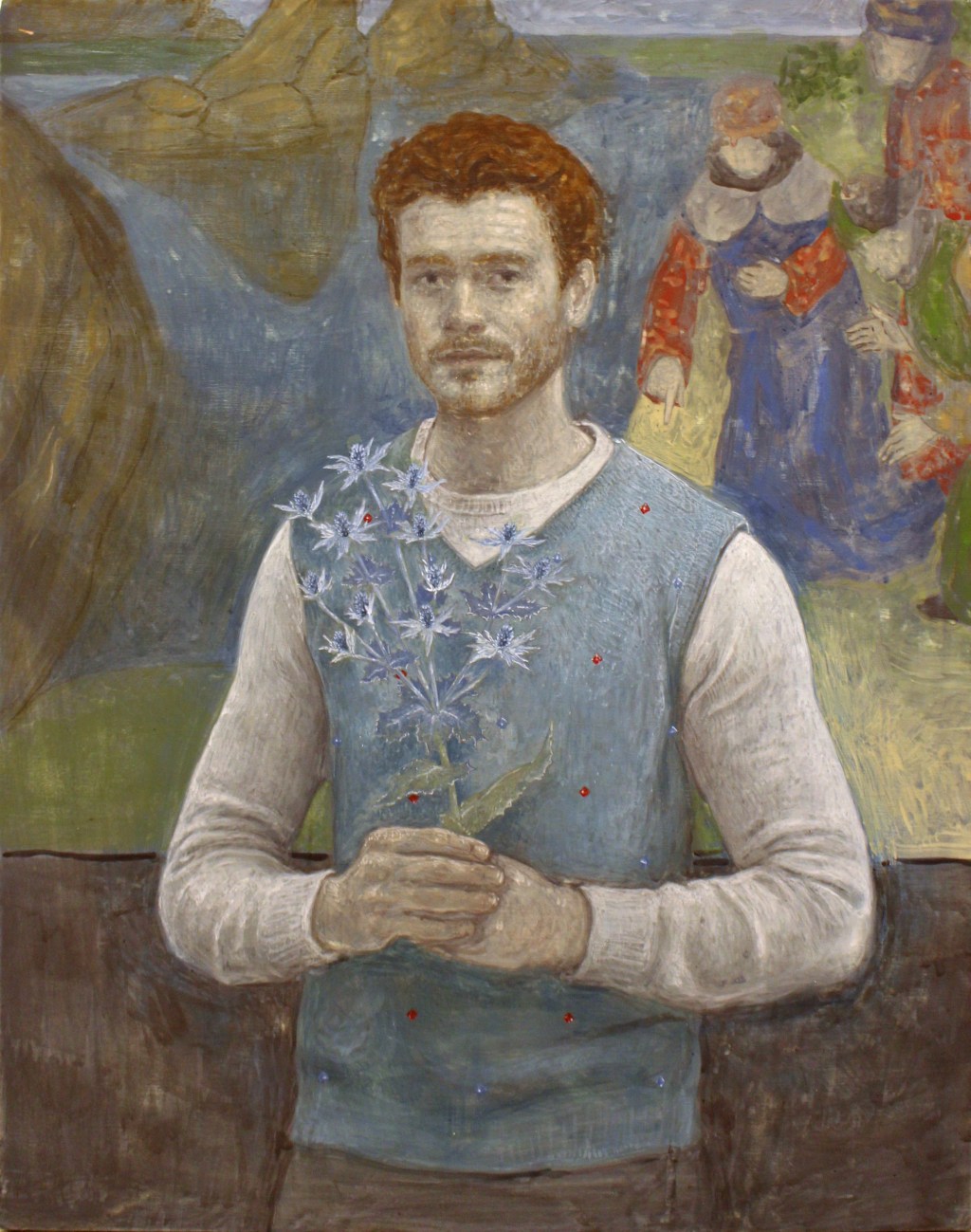
From Late Gothic to queer art, Riccardo Albiero’s painting is rich in historical references, yet marked by a strong personal identity and distinctive style.
Riccardo Albiero was born in 1996 in Chioggia. He studied painting at the Academy of Fine Arts in Bologna and is currently enrolled at Ca’ Foscari University of Venice in the program for Economics and Management of Arts and Cultural Activities. The young artist is represented by two galleries: Candy Snake in Milan and Double Double in Beijing, the latter of which hosted his solo show in March 2025. We met him in his studio on Giudecca Island, during his residency at the Bevilacqua La Masa Foundation in Venice.
THE INTERVIEW WITH RICCARDO ALBIERO
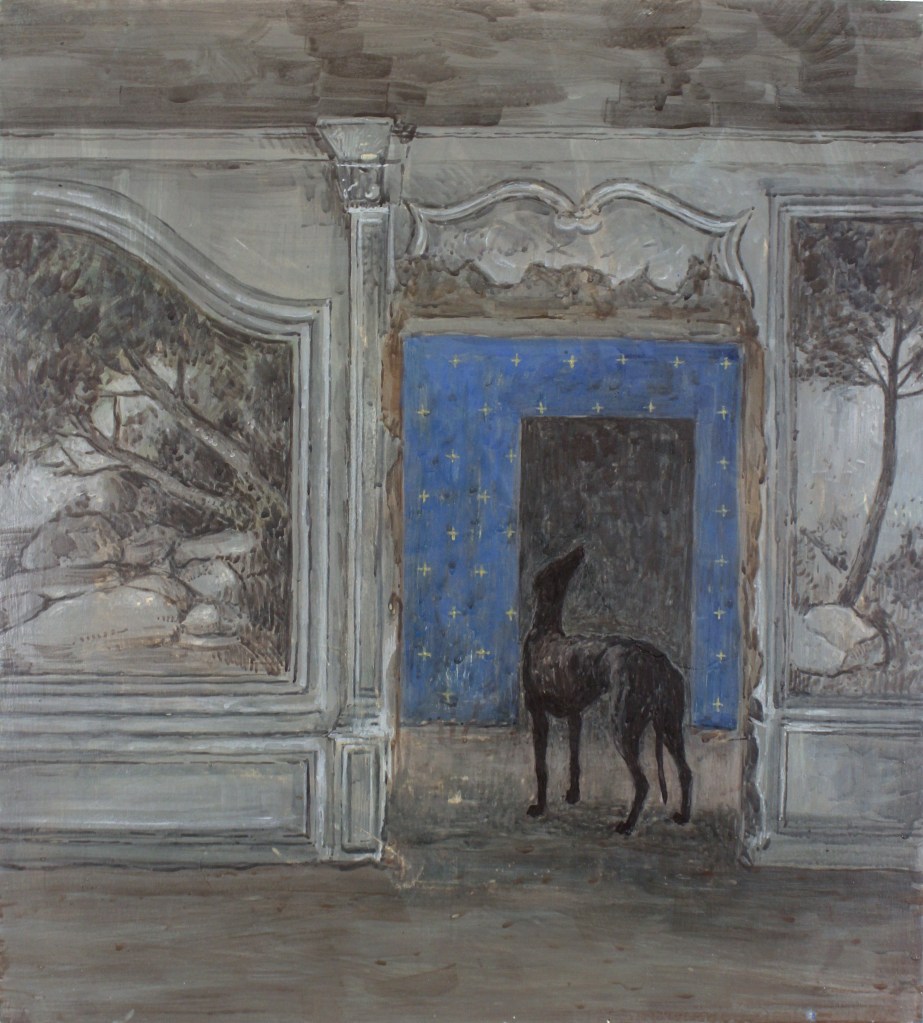
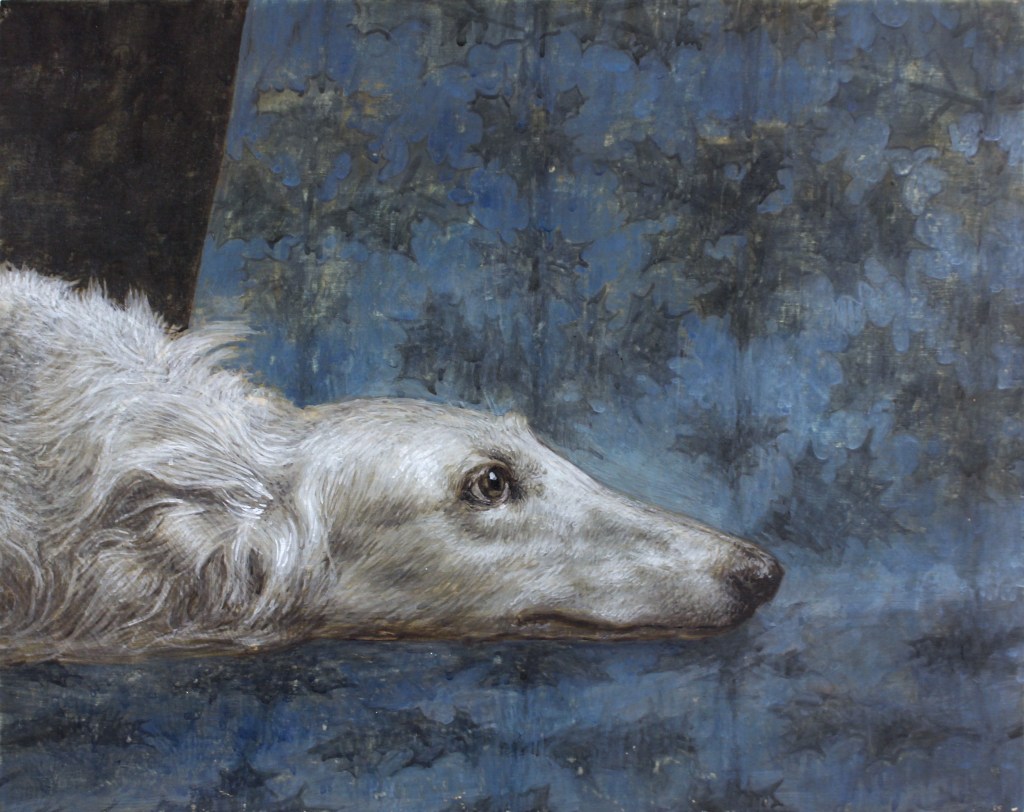
Your painting features recurring elements: the greyhound, the thistle, the stars. When did you start choosing these symbols and shaping your style through them?
About three years ago, I began selecting recurring subjects ‒ some drawn from art history, particularly from the Italian and Flemish Late Gothic, so more traditional and codified, and others more cryptic, rooted in personal biography.
Which artists or aspects of the Late Gothic period fascinated you and made their way into your painting?
Certainly, the most influential artists for me have been Gentile da Fabriano, Pisanello, and Botticelli. Formally, I feel very connected to the encyclopedic tendency and the organization of the image within the painting, where highly realistic elements are juxtaposed with particularly abstract or stylized symbols. As for content, the fantastic and magical imagery captivated me since childhood ‒ but so did the idea of spirituality, which for me doesn’t mean faith in God, but in a primordial Chaos.
One of your iconic figures, the greyhound, has moved from an immaterial realm into a room interior. Does this reflect an evolution in your poetics?
It reflects more the increasing complexity of spatial representation. I paint interiors and gardens with hedges that symbolize an inner, introspective space ‒ one where even imprecisions and perspective errors are allowed.
THE SUBJECTS PAINTED BY RICCARDO ALBIERO
Male figures, already central in your earlier works, now resemble saints. Can you tell us more about them?
I’ve noticed the resemblance too, but there’s no idealization or salvific connotation to them. Rather, they’re a visual phenomenon hovering between man and idea ‒ there’s no intent toward realism. I think of the Fayum funerary portraits, of Botticelli, but also of queer art, to show the many forms virility can take.
What kind of relationship do you hope viewers will have with your work?
I hope the natural-world subjects evoke delight, pleasure, and a sense of fulfillment, while I’d like the portraits to spark a kind of sentimental education. In general, I never see art as an isolated expressive act ‒ it’s always an offering to the public.
RICCARDO ALBIERO AND THE ART MARKET
You’re young but already well positioned in the art market. Was this always your goal? Actually, no. I’ve been represented by two galleries for about two years ‒ since I graduated with my MFA in Painting in Bologna. That’s when I realized that, if I wanted to make a living from my art, I had to commit to it seriously. Then luck played its part too.
How do you imagine your art will evolve in the future?
As far as painting goes, I think my subjects still have a lot to offer ‒ though physiognomies and faces may change. I’m also interested in the world of metals and installations. Plus, I feel the need to deepen my knowledge of art history, including other cultures, and that might influence my work as well.
You once said: “My research is based on introspection in search of a truth”. What kind of awareness do you feel you’ve reached today?
I believe I’ve developed spiritual convictions that form the foundation of my value system ‒ and, consequently, my representational system. Still, I think I’ll always keep questioning what new things I have to offer.
Alice Longo
https://www.instagram.com/riccardoalbiero_/

Translated with AI