Italy has the largest number of World Heritage Sites in the world. This is a factual but also a social reality, a source of pride and a statement of excellence. But it is also a great political slogan: for example, that of a landscape depicted with the face of Botticelli’s Venus or branded by the Olympics. Let’s start from here to make room for the words and practice of Giacomo Segantin: a perspective of care for the world around us.
Multimedia artist Giacomo Segantin (Abano Terme, 1995) uses photography and installations to offer reflections on living, raising questions about ecology and society. Graduated in painting at the Academy of Fine Arts in Verona, he developed his research during his residency at Campo di Brenzone (AIR Campo) and then at the Bevilacqua La Masa Foundation in Venice, finally reaching NABA ‒ the New Academy of Fine Arts in Milan ‒, where he studied theory and methods related to design and curatorship.
His curatorial career reached its peak with the creation of a curatorial collective (Critical Studies Department) and a residency at the University of Fine Arts in Zagreb. The common thread running through his education and practice is, in the artist’s own words, “the search for direct involvement with the object of study: not thinking first about the form of artistic research, but modelling the form on the content”.
Giacomo Segantin’s art is authentic in its research, references and realisation. It is art that is created in the process, attentive to detail and nuance. It is an urgency in the present and in the specific that speaks of global issues without losing track of what others have already forgotten. Segantin’s work stems from encounters and grows in abandoned places, delving into memories and bringing urgent issues to light.
We asked him to describe not only his works, but also his perspective on reality, art systems, and society. The result is a conversation that distinguishes between landscape and territory, discussing institutions, oblivion, activism, and communication.
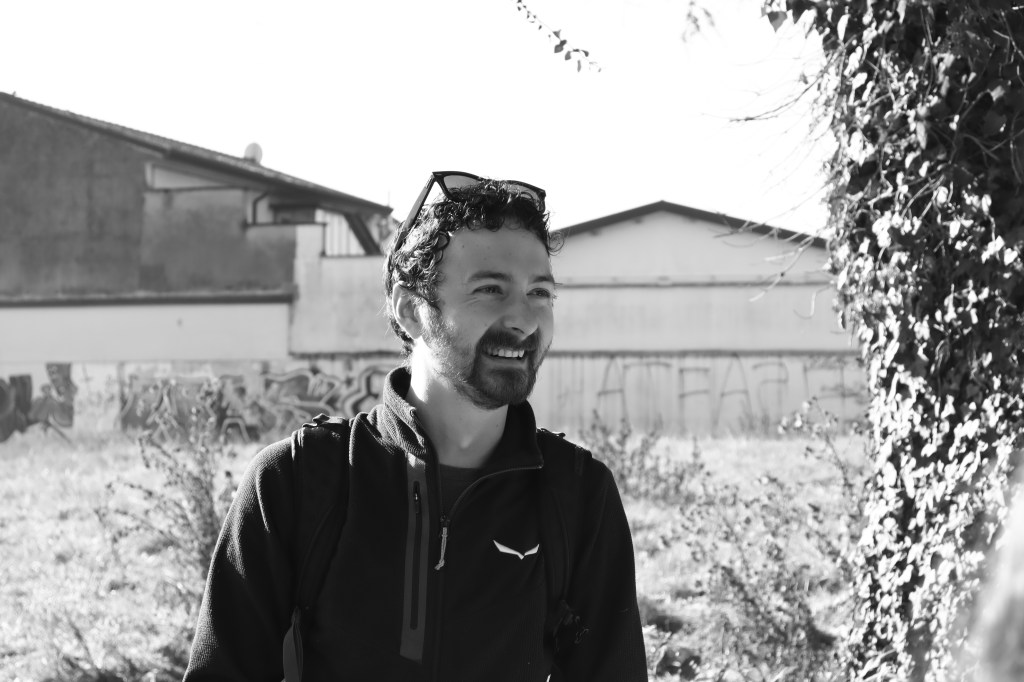
THE INTERVIEW WITH GIACOMO SEGANTIN
What are the themes of your artistic practice?
The themes of my artistic practice concern territory and landscape, with particular attention to how we inhabit and experience a territory. My research addresses the issue of public space and aims to deconstruct stereotypes related to landscape and rethink our relationship with the environment.
I believe it is important to do something like this, especially in Italy, where landscape often falls within nationalistic and patriotic discourses of identity in which local identity is exalted as something “unique”, which also becomes marketable and commodifiable. So, it’s a sort of branding of the territory. My interest is to articulate this issue in all its complexity, in an attempt to bring out the intersection between the social and cultural dimensions, but also the economic and political ones.
How fundamental is interdisciplinarity in your work? How do art and science ‒ but also sociology ‒ relate to each other within your practice?
The relationship between science and art is often thought of as one in which art must explain something complex or illustrate data that would otherwise have a different emotional impact. In my case, I try to establish different research dynamics, starting from direct observation and experience. I wouldn’t call it a strictly scientific approach, but in my practice, research and the desire to understand the dynamics that shape reality are always present. The results of my research are never something done in a studio or laboratory, as the works are created within residencies or even longer-term projects, where ‘being there’ is an essential condition. A theoretical reference that I greatly admire is the thinking of Isabelle Stengers, who argues that there is no such thing as objective science independent of the political and social reality in which it is formed ‒ despite the fact that it is often thought of as an objective practice. Right now, as I am talking to you, I realize how dangerous it is to make this argument at a time when the credibility of scientific data is being seriously questioned in terms of climate denialism. Let me clarify this point: Stengers highlights the fact that science is already oriented, financed and directed by economic policies and businesses. Her analysis compares the reality of the 1990s, taking the issue of GMOs as a reference case, in which the financialisation of research and its application developed within the close relationship between science, the state and business. I find Isabelle Stengers’ thinking very relevant today: although she refers to the 1990s and specific cases, she makes an even more abstract argument that is also applicable to the present day.
Given the sociological repercussions just mentioned, do you think art can be a valid medium for conveying important issues?
Yes, I really think so. I believe that the role of visual art is above all to reveal, that is, to make visible something that is not usually visible. My goal, then, is to make people perceive something that is not usually considered. I believe that the great potential of art lies in the fact that it is not unique, but that there are different types: the world of experimental artistic research, exhibition making in major museums, the world of the market and galleries, etc. However, no matter how insightful and powerful exhibitions may be, it is really difficult to raise awareness about the environment and thus trigger a change of course. This is a topic that interests me greatly and which I also addressed in my bachelor’s thesis, in which I asked myself: ‘What is the role of images and communication in bearing witness to environmental collapse? What is the impact on our society of the enormous amount of visual information documenting the climate crisis? These reflections are very similar to the questions posed by anthropologist Franco La Cecla and other scholars at the conference organised in Milan in 1990, entitled: Nature and communication. Are the mass media bad for nature?.
Although more than thirty years have passed, the risk remains the same: becoming trapped in the media structure of entertainment. Becoming a trend, the news of the moment. I also agree with the thoughts of activist Franco “Bifo” Berardi, who highlights the ambiguous nature of social media and the media in general: on the one hand, they are extremely effective platforms for communicating shared values and ideals, but on the other, they are inhibitory devices that tend to flatten and neutralise the role of active participation by individuals. There are cases in which social media can help to raise awareness of what is happening in the world, but with the risk of the side effect of producing addiction and superficiality.
Speaking of the spaces in which you have worked, you mentioned the idea of ‘encounter’. What is the ideal venue for exhibiting your works?
I really appreciate it when you have the opportunity to establish a dialogue with the space and the institution. So the ideal place is a permeable space, open to different possibilities, both in terms of concept and actual layout. I believe it is very effective to create situations rather than simply exhibiting objects. This is why I believe that the best context in which to work is a site-specific relationship that generates an encounter: an encounter with the work but also with a local reality.
How do you relate to institutional spaces and private galleries?
I also work in contexts more similar to white cubes, and the challenge is to give context to the work, always within the space, both architectural and institutional. Another aspect that I believe is important is contradictions. In fact, in a gallery, one expects a marketable object, and I believe it is very useful to go beyond this limit. I do exactly the opposite: not only to create an alternative, but precisely to reflect on the system in which one is observing. Space is never a neutral container, and I am personally more interested in public space than others.
CURATORSHIP, CONSERVATION AND COLLECTING
Considering the importance of process in your artistic practice and, consequently, the potentially ephemeral nature of your works, how does your work relate to curatorship and conservation?
You mention curatorship and conservation, so you are already opening up a field that is that of the institution, which can be public – such as a museum – or private. From a practical point of view, I work with documentary photography, which is very often the documentation of a process, a situation, a testimony. Ultimately, the documentation of an event is necessarily an abstraction: you are no longer there, so it is also necessarily a mediation of what has been. For this reason, it is not entirely objective, and I find it interesting to have points of view that are not limited to the work itself, but rather to the (visual) narrative of a work.
This discussion considers curatorship, conservation and, necessarily, collecting. How does one collect a perishable object?
As for materials, and therefore their perishability, a very practical example came to mind. I have never sold to a private collector. The only work sold to a private individual, at Arte Fiera in Bologna in 2025, was purchased by Giorgio Fasol.
It is important that the work becomes part of a collection such as that of Anna and Giorgio Fasol (AgiVerona). The collector’s interest has often led him to purchase works by young artists and, above all, “non-existent” works. In short, becoming part of a collection such as that of the Fasols sounds like a legitimisation in this sense.
I completely agree. The work Dima for Hunting and Fishing Scenes is a “dima”, a template, of a work of art preserved at the Metropolitan Museum of Art in New York. I purchased the rights to a high-resolution image of an 18th-century English tapestry. It is one of the finest examples of English printing, because there are so many overlapping prints that create a very detailed image, full of detail. The work was one of my first reflections on the relationship between power and the representation of nature, which arose during my experience at the Antonio Ratti Foundation, works in which I reflected on conservation and the institution of the work itself, and therefore on the status of the work of art. Working at the Prada Foundation, I often found myself making these templates, these shapes in Melinex, a heat-insulating material used mainly to protect documents and works from the humidity of the exhibition space. I think it’s really amazing to see all the work that goes into an exhibition. Very often, visitors have no idea of the enormous amount of work or technical considerations that go into exhibiting a work. The work Dima for Hunting and Fishing Scenes reverses the hierarchy between technical support and work. The material has specific characteristics, including the peculiarity of reflecting an image in a distorted manner. This creates an additional step: a support that is not usually seen becomes a work and assumes the authority of the image producer.
How do you think curating can enhance your work?
When I think about promoting my work, I don’t think from a historiographical point of view, but rather from a procedural one. I have worked within a process and, through dialogue with a curator, arrived at a result that I had not initially planned. I believe that the most rewarding encounter is one that takes place within a project residency, where we create a work together.
Your works reflect on landscape first and foremost, and more recently on territory. What do you consider landscape and what do you consider territory?
Territory, landscape and nature are complex terms that take on different meanings depending on the context. I believe that the term landscape is more closely linked to aesthetics, in terms of representation and framing. Very often, in fact, it is a concept relegated to aesthetics, synonymous with harmony and value to be protected, as if it were a bank account, as if it were something embalmed, when in fact it is exactly the opposite. It is a battlefield in which various economic, political and environmental actors clash. Territory, I believe, is more closely linked to local identity: a place of sharing, a place of belonging, both social and animal. It could also be synonymous with range, the place where a particular species lives.
LANDSCAPE AND TERRITORY IN THE PROJECTS BY GIACOMO SEGANTIN
Considering the specific characteristics of each territory, there is a clear relationship between this and other central themes in your works: centre-margin or use-disuse. Do you think your works succeed in proposing a deconstructed vision of landscape? How does this conceptual shift from landscape to territory manifest itself in your work?
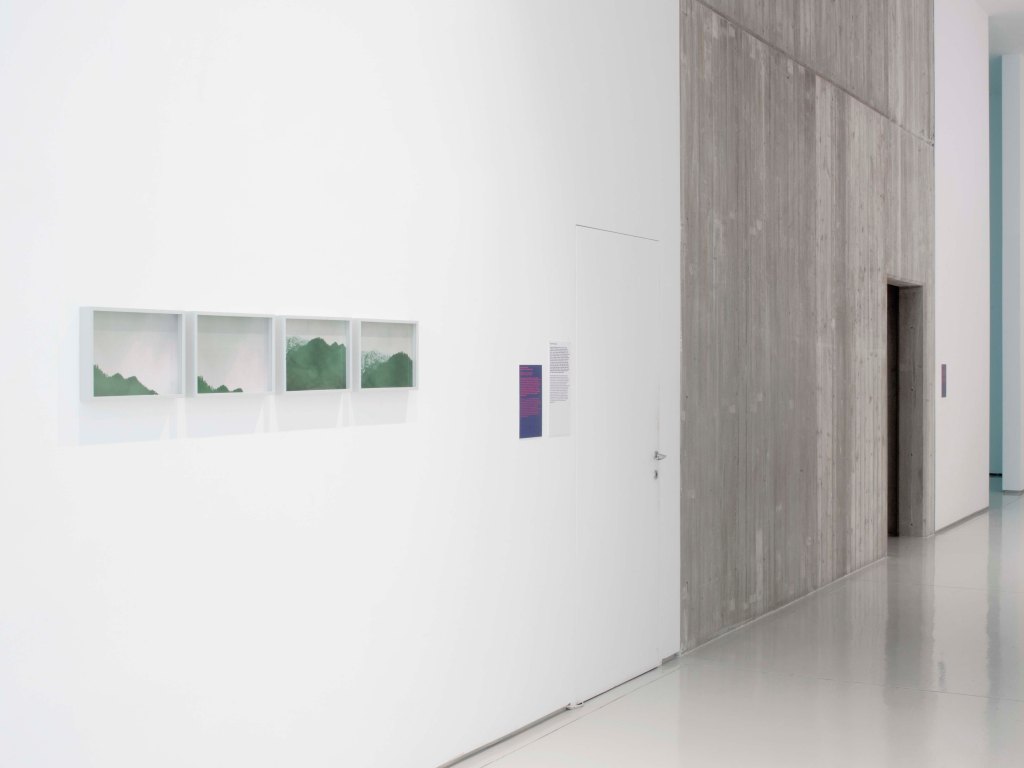
I would not consider a direction in which the landscape is something negative and the territory something positive. First of all, I believe that my works do not provide answers, but rather convey an atmosphere of ambiguity, which I consider to be one of their strengths. I think it is very effective to talk about a work I created entitled Appunti per un film sull’oblio (Notes for a film on oblivion) (2025): a series of photographs taken specifically for the Ettore Fico Museum in Turin for the exhibition of artists from the Bevilacqua La Masa Collection.
The work Appunti per un film sull’oblio disappoints, suggesting something that does not yet exist. There are four photographs that appear to be a stumbling block, because they were taken with a different zoom that simulates a movement from top to bottom, as if it were a camera. A cinematic development is suggested, but it is not there: here too, I work on the construction of an ambiguous meaning. The photographs show mountain profiles, snow-capped mountains filtered by a greenish tint that is not immediately understandable. They are film shots of the reflection of the mountain on a hydroelectric reservoir. The colour is natural, that is, the objective colour of reality, where there is this lake that is very green because it is a lake closed off by a dam, inside which particular sediments generate a very bright green colour that is deeply unnatural. “What are we looking at then?” There is ambiguity: it appears to be a classic portrait of the landscape, but it presents all these levels of interpretation.
Ultimately, this creates a paradox: however unnatural it may seem, colour is natural and spontaneous. Colour, however real, filters the image through a light that accentuates a picturesque aspect – which is not, however, picturesque. Once again, we see an ambiguous relationship between landscape and territory, but also between centre and margin.
Exactly. In this work, the friction between the centre and the edge is fundamental. Very often, a landscape is considered a destination, a place sought after for its beauty. On the other hand, I am interested in places of discard, spaces that are a sort of side effect of our society. I am interested in these places because they allow us to fully understand the dynamics that structure the territory in which we live. I am thinking of the photographic project I did in Val Gallina: an unhappily exposed valley, full of ticks, where no one goes and few people know there is a dam, no one cares. It is an active Enel dam, it plays its part in terms of local energy production, and this inevitably opens up a discussion about the transformation of the landscape and the environmental balance of a given place. Building a dam is not an innocent process. This does not mean that dams should not exist, I do not want to fall into a primitivist discourse, but I believe that critical reflection is necessary. When we recharge our computers, we don’t think about the tonnes of concrete in Val Gallina. I believe it is very useful to bear in mind the infrastructure behind our devices and keep in mind all the materiality behind energy. I am therefore interested in working within these places of waste in order to gain a broader view of the system of relationships in which we are immersed. These places are completely removed from our attention, which is why I believe it is very useful to reflect on representation, on removal from history, on production and on the conflict between engineering and landscape, but also on ecology, both environmental and social.
Still on the subject of centre and margin, I would like to talk about Indesiderate. Marginal spaces and urban foraging practices, the project funded by the Sustainable Art Prize (which you won in 2024) and the installation of the same name created at the University of Padua. Exhibited in a highly distinctive setting – the rationalist architecture of the Cortile Nuovo del Bo in Padua –, the work explores the concepts of appropriation and reinterpretation. Do you think that the project, even in its limited time frame, was able to leave a mark?
The Indesiderate project is complicated because it is heterogeneous, divided into seminars held at different universities (Ca’ Foscari University, University of Verona and University of Padua) and a workshop held at the Botanical Garden of Padua with students from the respective universities. I decided not to hold an exhibition as planned in the sustainability project. I thought that working to create a travelling exhibition, to be displayed in Venice, Padua and Verona, made little sense, especially in terms of the expenditure of energy and resources, and I found it more interesting to work on different levels to create a restitution in the public space – which was the installation in the Cortile Nuovo del Bo – and to create an exhibition within the university. This will be followed by a publication, as required by the call for proposals. As for the limited time frame, i.e. the short duration, I think that a work can reclaim a space and reinterpret it, considering the identity value of the Cortile Nuovo del Bo.
How do you think your practice, and this project in particular, relates to the concepts of deconstruction, appropriation and reinterpretation?
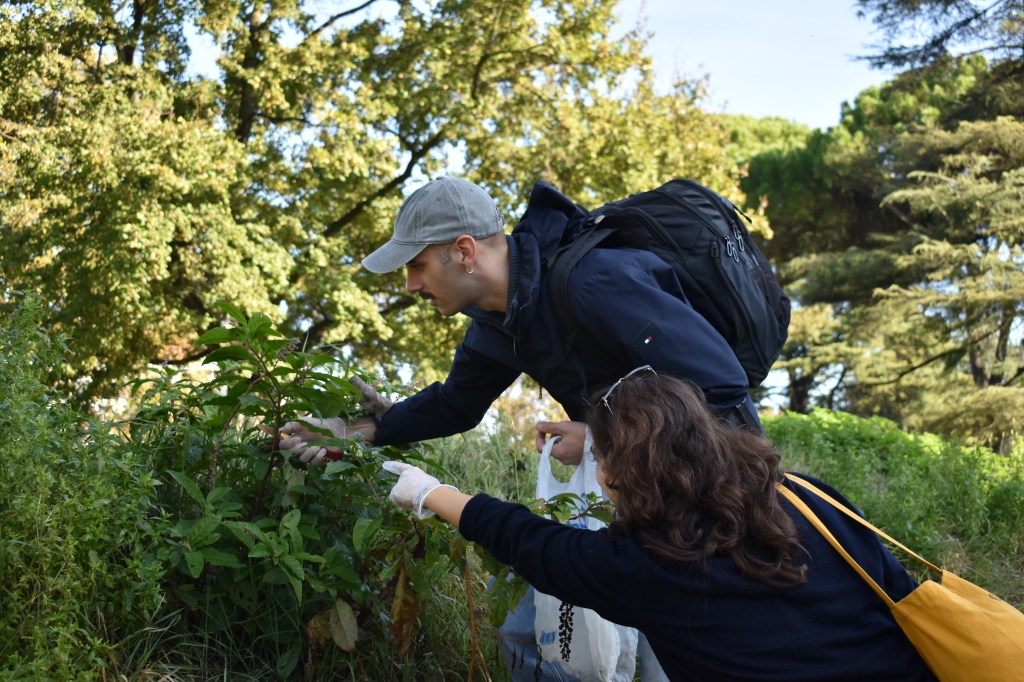
Firstly, through “urban foraging” – during the collective harvesting of phytolacca berries – there was a sort of reappropriation of public space. Using something that can be considered a common good is a very important starting point. As for the installation at the Cortile Nuovo del Bo (entitled Margine Rosso), it reinterprets a fascist legacy, a cultural heritage that manifests itself in the rationalist architecture of the 1930s and is in continuity with Jannis Kounellis’ work Resistenza e Liberazione (1995). It is a site-specific work that stems precisely from this need: to reinterpret, and thus change the meaning of, a cultural context that was defined by fascism. It is precisely this context that defines the deeper meaning of the work I have created.
It is important because monuments, history and the perception of space are not fixed, but also change over time. Think about how much the political context in which the work was created has changed: it is no longer that of Jannis Kounellis in 1995. On the contrary, there is a worrying trend towards extreme right-wing extremism (not only in Italy), which makes it even more necessary to reaffirm certain values. A few months ago, there was news about politicians appointing university officials; this is the context in which Trump defines universities as enemies. The choice of the University of Padua as the venue for the event is very significant, also from a historical perspective on this issue: think of the concept of Patavina Libertas, a sort of independence of the university from the political climate. Creating a work within the university is very timely because it reaffirms the value of the university institution, which must be defended.
What are your future projects?
The past year has been very intense, so my future projects aim to continue what is already underway. I am always working on these issues, especially in relation to the dynamics of the Milan Cortina Olympics. It is an interesting case because it involves branding (narrative and promotion): the landscape as an Italian excellence that has seen enormous investment funds shaping the territory. What interests me is carrying out a project by asking myself what the sacrifice is. If every process requires an economic sacrifice but also an ecological and territorial sacrifice (at different levels), what has been sacrificed for these Olympics? I plan to carry out a project that has yet to start – so it will be next year’s challenge – in areas outside the spotlight. Unlike what might be a journalistic investigation, which focuses precisely on the subject of study, what interests me is understanding what is happening around it, in places that have remained in the shadows or in ambiguous dynamics. This does not mean forgetting what is happening in the spotlight, but rather approaching it from a different point of view.
Rebecca Canavesi
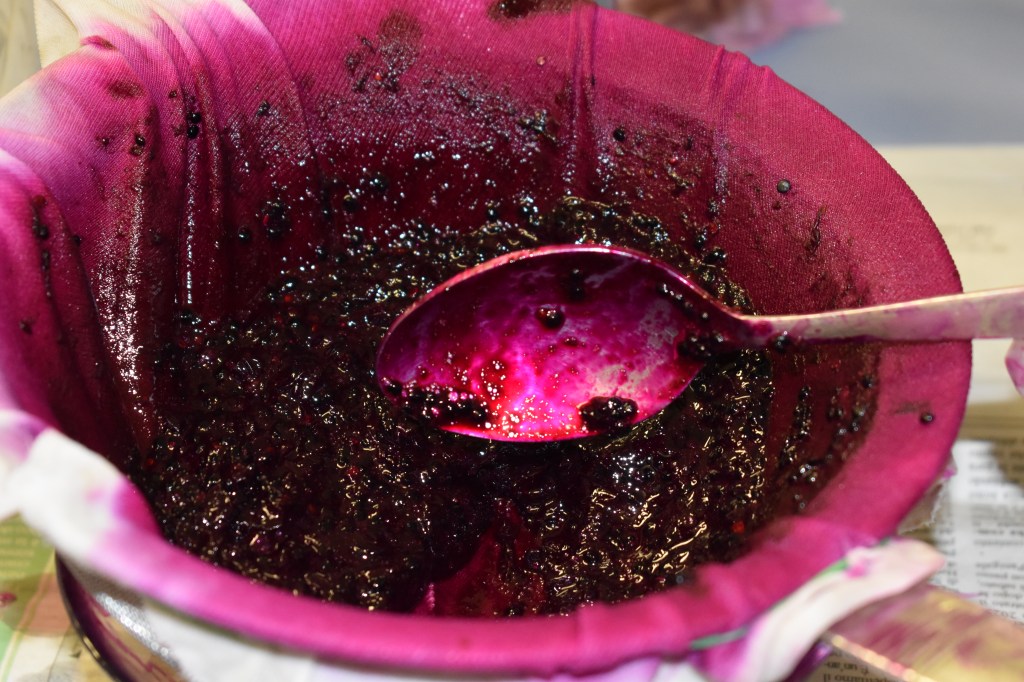
Estrazione del colore (Indesiderate project). Photo Elisa Braccini 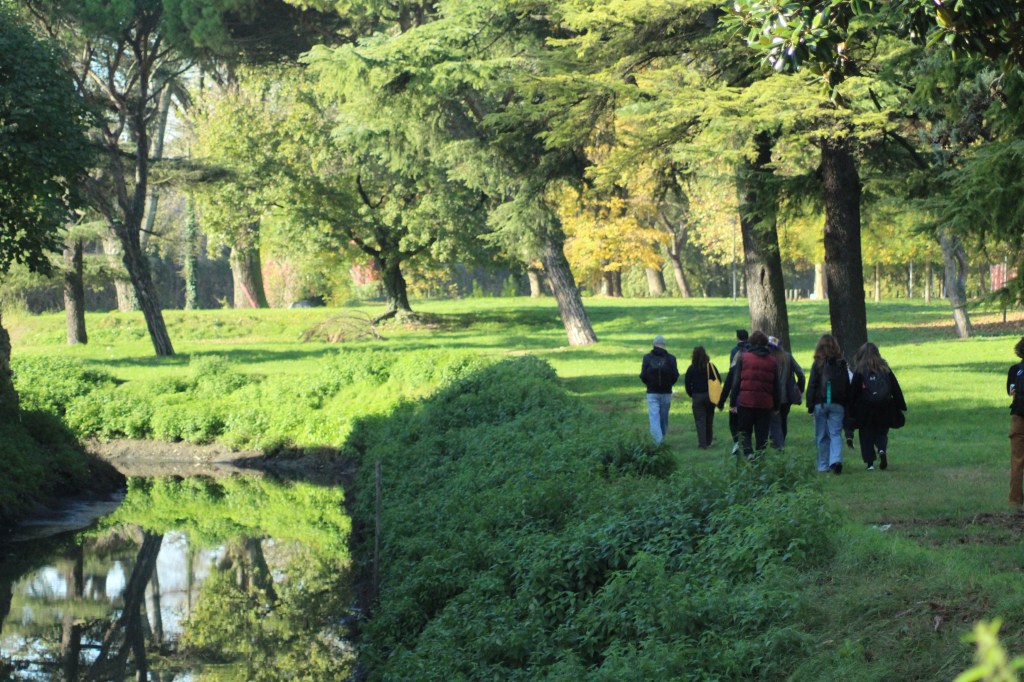
Foraggiamento urbano, Giacomo Segantin 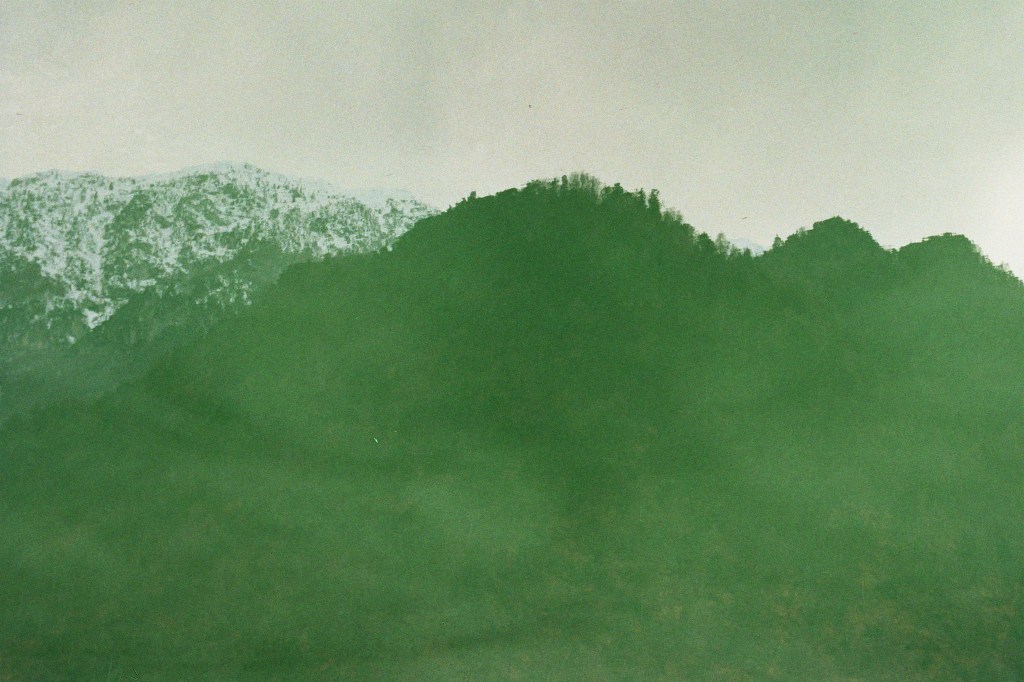
Appunti per un film sull’oblio, inkjet printing on photographic paper, 30 x 40 cm 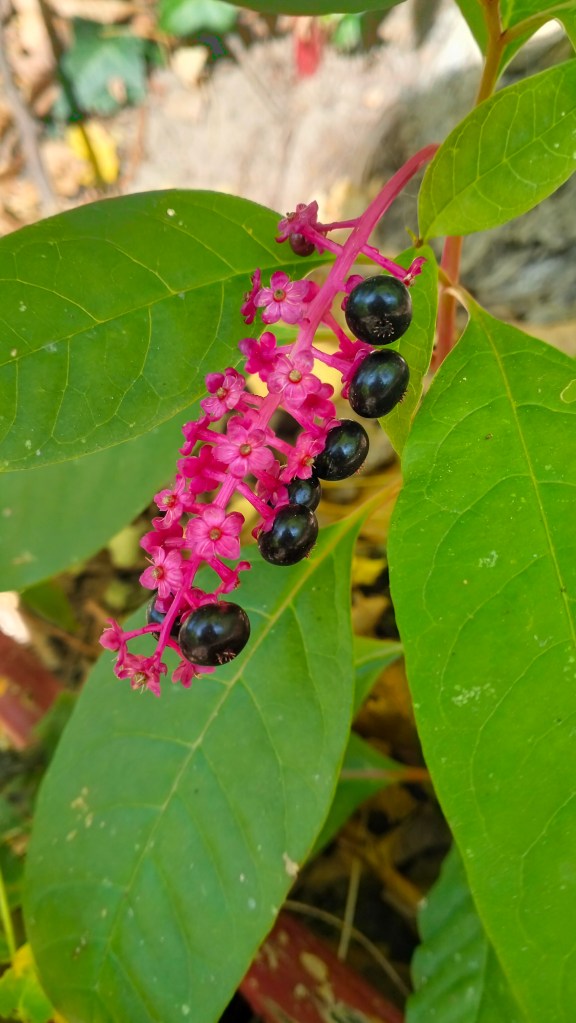
Foraggiamento urbano, Padua, Photo Elisa Braccini 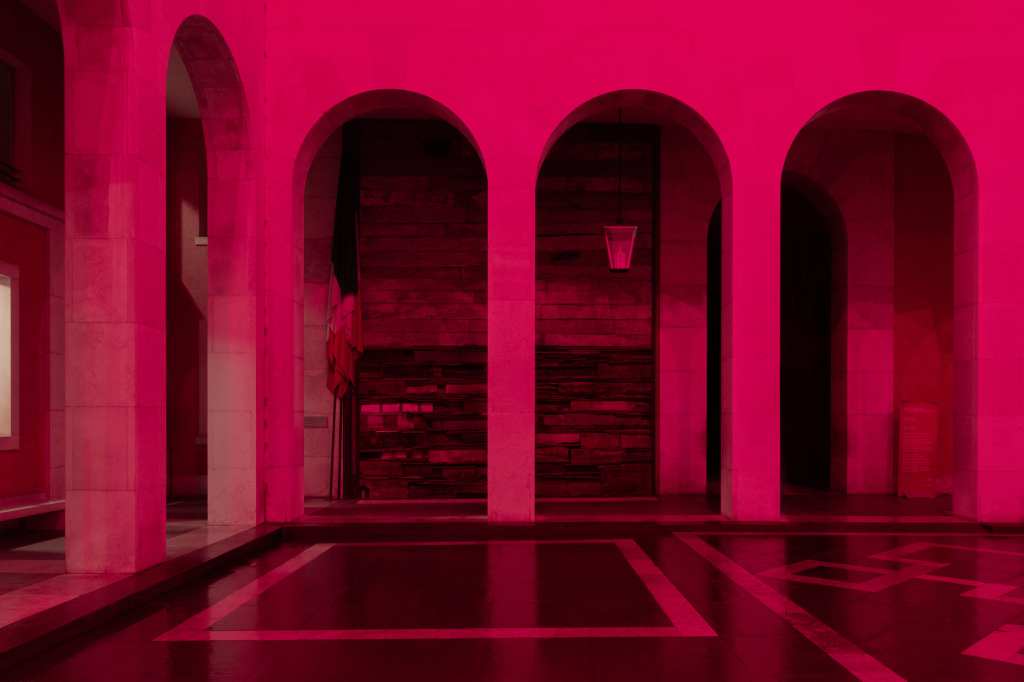
Margine rosso, Giacomo Segantin, Exhibition view, Cortile Nuovo di Palazzo del Bo, Padua. Photo Edoardo Bonacina, 2025 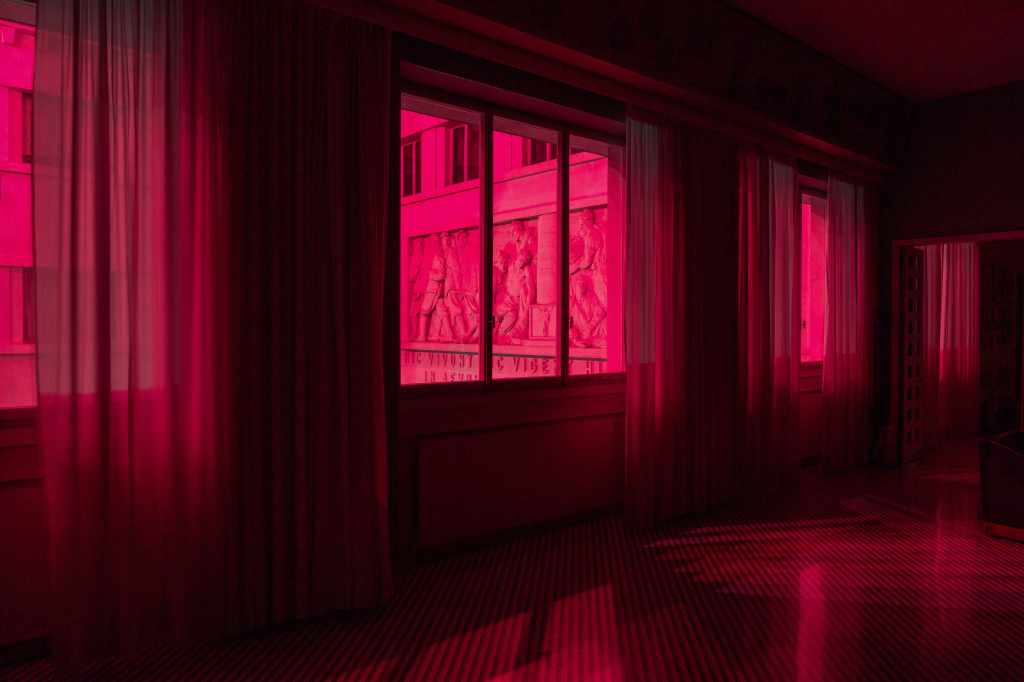
Margine Rosso, Giacomo Segantin, Exhibition view. Cortile Nuovo di Palazzo del Bo, Padua. Photo Edoardo Bonacina, 2025 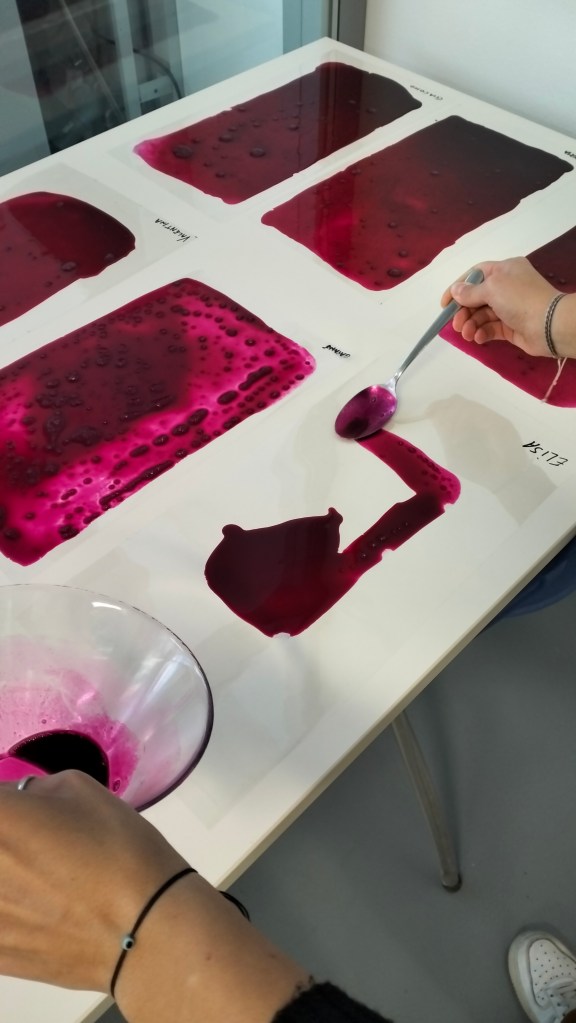
Production of lighting filters (Indesiderate project) 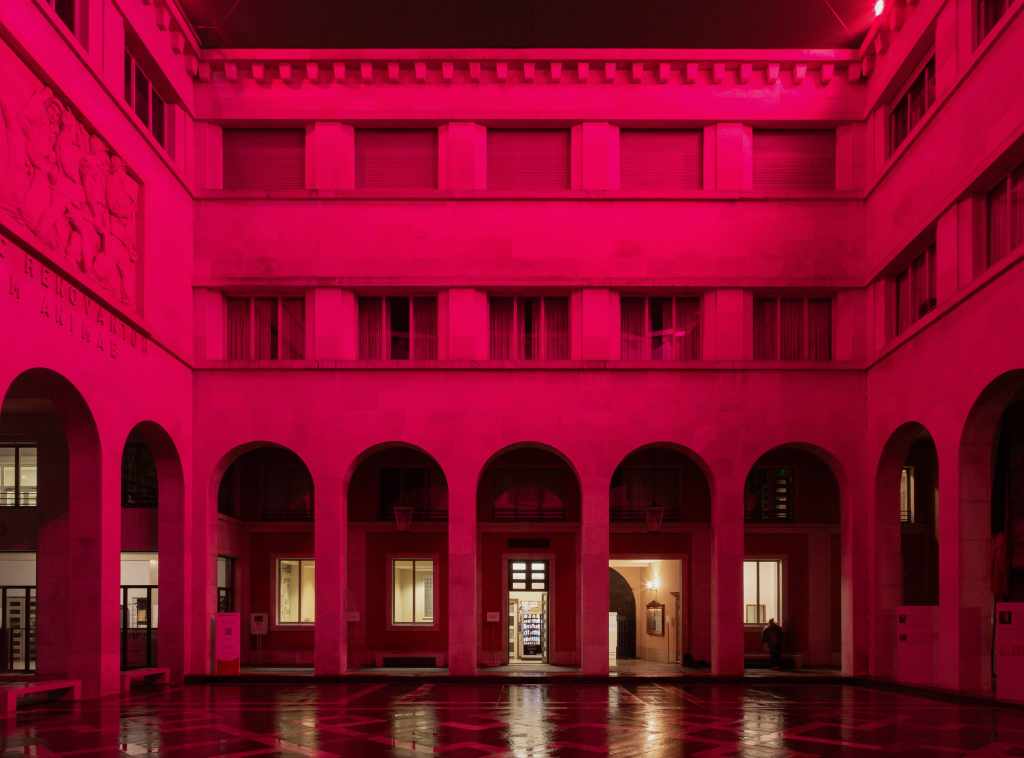
Margine rosso, Giacomo Segantin, environmental light installation, Cortile Nuovo di Palazzo del Bo, Padua. Photo Edoardo Bonacina, 2025 Appunti per un film sull’oblio, inkjet printing on photographic paper, 35 x 26 cm. Exhibition view, Museo Ettore Fico, Turin, 2025. Photo courtesy Fondazione Bevilacqua La Masa Foraggiamento urbano, Padua. Photo Elisa Braccini
The text has been translated in English using AI
 c plus c