Curator Filipa Ramos discusses how contemporary art can shift mindsets, foster interspecies empathy, and drive urgent ecological change.
We live in an era of profound planetary crisis. The accelerating realities of climate change, mass extinction, and systemic pollution have become the defining context of our time, prompting a powerful ecological turn within contemporary art. Artists are increasingly moving beyond simply representing nature to engaging with it as collaborators, advocates, and healers. At the forefront of this movement is Filipa Ramos, an international curator, writer, and thinker whose work consistently challenges anthropocentric perspectives. As a curator of major international biennials and editor of influential publications, she has become a key voice in articulating how art can foster a more-than-human worldview. Her new book, The Artist as Ecologist: Contemporary Art and the Environment, provides the framework for this conversation, outlining the key strategies contemporary artists are employing to confront our shared environmental predicament.
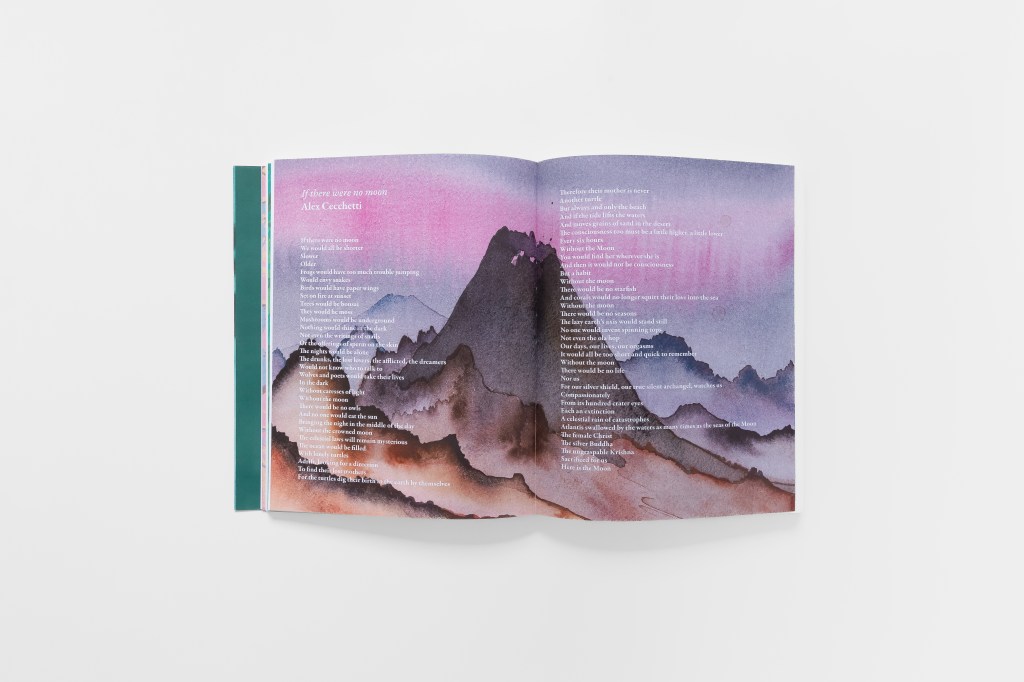
Filipa Ramos (Lisbon, 1978) has charted a curatorial and intellectual path marked by an ever-deepening ecological engagement. Her journey began with a foundational focus on animal representation, most notably as the editor of the influential book Animals in Whitechapel Gallery’s Documents of Contemporary Art series. This inquiry soon expanded into a far-reaching exploration of interspecies consciousness through The Shape of a Circle in the Mind of a Fish, a long-running, interdisciplinary research platform she co-developed for the Serpentine Galleries. As a curator of major exhibitions, she has brought this vision to an international stage: from Bodies of Water (the 13th Shanghai Biennale) and Biennale Gherdëina ∞ (Persones Persons), to Bestiari, Carlos Casas’ immersive, multisensory installation curated by Ramos for Catalonia in Venice, presented as a Collateral Event of the 60th International Art Exhibition of La Biennale di Venezia (2024). Across these varied roles, Ramos has cultivated a practice that moves from theory to lived experience, sharpening how we navigate the relationship between art and the more-than-human world.
INTERVIEW WITH FILIPA RAMOS
You’ve curated landmark exhibitions like Bodies of Water, which was directly inspired by the hydrofeminism of Astrida Neimanis. How do you translate such a profound philosophical concept into a large-scale biennial experience for a broad public, and how does this relate to the emerging blue humanities anthropological studies and oceanic thinking in curatorial practice?
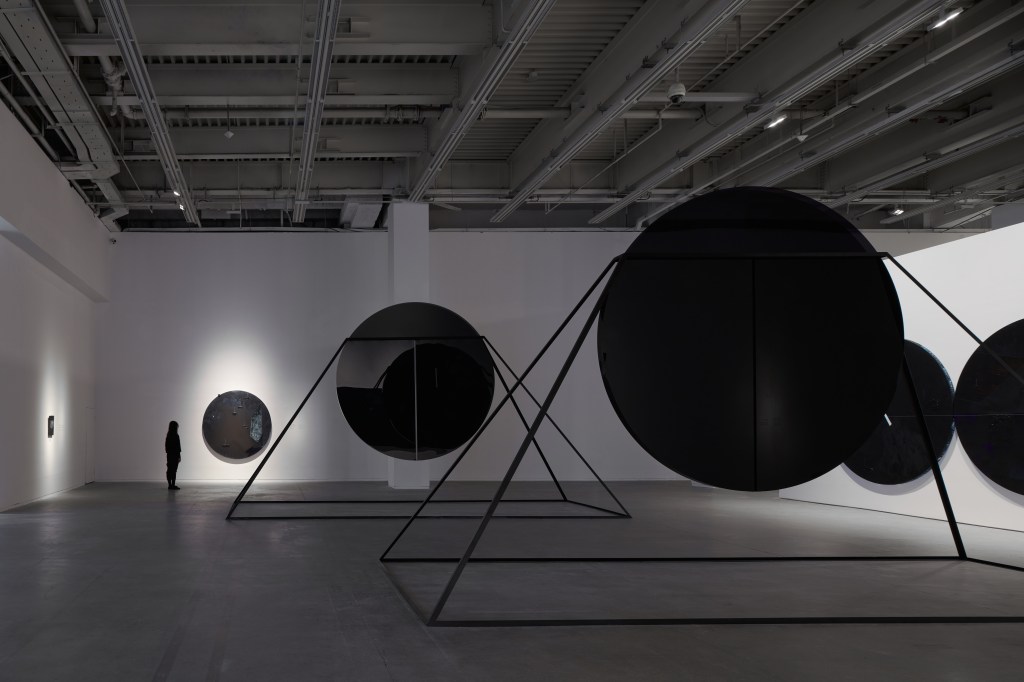
Bodies of Water, the 13th Shanghai Biennale (2020-21), was a project conceived by the show’s Artistic Director Andrés Jaque and I was honoured to join his curatorial team and contribute to his thinking. Astrida Neimanis’s hydrofeminism was not a theme to illustrate but a method to explore how art may address forms of fluidity, proximity and flow, between rivers, forms of automation and intimacy. With Andrés and the whole team, I tried to think with tides, circulations and porosities: how works touch, leak into and modify one another; how audiences drift rather than proceed through fixed interpretive channels; how the biennial itself could feel tidal, rhythmic, unstable. The challenge in a large-scale public exhibition is to translate these philosophical insights into forms that can be sensed before they are understood ‒ humidity, resonance, sound, flow, dispersion ‒ so that visitors feel invited into a relation rather than instructed about an idea.
Your work consistently moves away from anthropocentrism; in projects like Bestiari you use sensory immersion to decenter the human. What are the main challenges and responsibilities of curating for a more-than-human audience, and is empathy enough to drive systemic change? How can curators stage urgency and immediacy around climate breakdown?
That is a very interesting question and I would love to conceive an exhibition for animals or plants, but Bestiari, a project I conceived with artist Carlos Casas for the 2024 Venice Biennale, was entirely dedicated to a human audience. What it attempted, however, was to invite humans to inhabit a sensorial position that is not strictly their own ‒ to feel the instability, vulnerability and altered perceptual scales that other beings experience every day. In that sense, rather than curating *for* a more-than-human audience, the challenge becomes curating *towards* a more-than-human awareness: opening up the conditions for visitors to recognise their entanglements and responsibilities within a shared, fragile environment.
Your collaborative practice with Lucia Pietroiusti, which you’ve described as functioning as “one entity”, is a defining feature of your work. How does this model of shared curation shape long-term, research-intensive projects like The Shape of a Circle in the Mind of a Fish at the Serpentine? Do you see this as a space for what Claire Bishop calls relational antagonism, where conflict and asymmetry can surface rather than be smoothed over?
With Lucia we are instinctively porous to one another’s instincts, doubts, obsessions and workflows. Projects like The Shape of a Circle in the Mind of a Fish do not have a singular authorial voice; they are shaped by our readings, listenings and mutual trust. I am not familiar with that notion of Claire Bishop (I read so little art theory, as I am much more interested in fiction and science) so I don’t know how to address that. What I can say is that the long duration of the project, and its permeability across disciplines, species and formats, emerges from friendship and enthusiasm, meaning that the curatorial framework is a relationship rather than a blueprint, an ecology of thought rather than a division of labour.
FILIPA RAMOS’ CRITICAL PERSPECTIVE
The theme of “returning” seems to critique an urban-centric art world. In the spirit of Bonnie Ora Sherk’s The Farm or Fernando García-Dory’s INLAND, what role can art institutions realistically play in supporting regenerative agriculture and rural knowledge systems?
The idea of “returning” in the book is not nostalgic; it is a critique of the centripetal force that pulls artistic value towards the city. Projects like Bonnie Ora Sherk’s The Farm or Fernando García-Dory’s INLAND propose that cultural production can be rooted in regenerative agriculture, in rural expertise, in forms of knowledge that have sustained life for centuries. Institutions can play a role, but only if they are willing to shift power and resources away from the metropolitan centre. See what Grizedale is doing for instance, or Salmon Creek Farm. This means long-term commitments: land-based residencies, collaborations with farming communities, funding that follows seasonal rhythms rather than fiscal calendars, and an acceptance that knowledge circulates differently outside the city. It requires humility ‒ institutions must learn to listen to territories rather than extract from them.
The “performing” chapter highlights works like Sun & Sea. What is it about liveness and embodied performance that you feel is uniquely capable of communicating the emotional complexity of the climate crisis, perhaps in ways static objects cannot?
Performance moves at the pace of bodies ‒ sweating, breathing, tiring, persisting. Works like Sun & Sea make us feel climate crisis not as an abstraction but as a physiological condition and ask you to choose the way in which you participate in them, physically but also emotionally and mentally, by recognising yourself (or not) in the kinds of narratives that the performers are singing. Liveness allows for a more complete relationship to simultaneity and contradiction, which are inevitable in the times we are living: beauty and dread, leisure and exhaustion, pleasure and ecological grief.
This is difficult to convey through static objects, which often risk becoming illustrative, allegorical or didactic: about something. I’m interested in the way time-based media, including perfromance, can metabolise climate emotions ‒ not by representing catastrophe, but by revealing the fragile, rhythmic, low-frequency registers that traverse bodies and shape the living through ecological instability.
The concept of “entanglement”, central to thinkers like Donna Haraway, appears throughout your work. How does this idea challenge traditional exhibition-making, which tends to separate objects, disciplines and viewers, and what might an entangled exhibition look or feel like in terms of display, mediation or institutional structure?
Donna Haraway’s notion of entanglement challenges the historical role of exhibitions as separating devices: this object, that discipline, those audiences. To curate entangled exhibitions is to challenge and ultimately refuse those separations, that membrane (which often is physical: a vitrine, a frame, a cage). It means acknowledging co-dependence: that artworks, visitors, materials, climates, species and infrastructures are constantly intra-acting and that the classical divisions of subject-object, nature-culture, are artificial dualisms imposed by Westernised modernity.
I never thought about the concept of entangled exhibition before so I don’t really know what it would look like. Maybe it tries to understand how to create zones instead of rooms; generate overlapping soundscapes; bring together displays that require care rather than control. Mediation becomes less about explanation and more about facilitating relations ‒ a guide rather than a script. Institutionally, this might mean cross-departmental teams, porous budgets, co-authorship with environmental scientists, farmers, activists or animal ethicists. Entanglement became a very trendy word lately, particularly since Merlin Sheldrake’s bestseller book. Yet it remains useful as a curatorial ethic and a spatial strategy.
Looking at the theme “exhibiting” projects like Pierre Huyghe’s Untilled or Anicka Yi’s In Love with the World create living, evolving system inside institutions. What new demands do such works place on curators and museums that have historically been geared towards preservation and stasis?
Works like Huyghe’s Untilled or Anicka Yi’s In Love with the World are not stable; they breathe, decay, adapt, sometimes die and to a certain extent exist beyond our control. For curators, this means relinquishing control and accepting that the artwork’s behaviour may contradict institutional expectations ‒ including the expectation of preservation.
Museums need new protocols: biological expertise, adaptive lighting and ventilation, live-species welfare guidelines, maintenance teams that understand ecosystems rather than vitrines. These works demand that the institution itself becomes a living system. The question is not only how to care for the artwork, but how to care with it.
EXHIBITIONS AND CURATORSHIP ACCORDING TO FILIPA RAMOS
Exhibition requires a certain amount of CO2 both to be produced and visited by people all over the world. From your perspective, what are the most concrete strategies curators and institutions should adopt at the earliest planning stages, not only to build compelling narratives about the climate crisis, but also to actually reduce and, where possible, offset the emissions their exhibitions generate? Where do you see genuine structural change, and where do you see greenwashing?
Exhibitions, like most things we do, produce emissions ‒ through materials, shipping, travel, construction, energy. The question is how early in the process we confront that fact. For me, the planning stage is where the most meaningful reductions occur: local production rather than global shipping; reusing and adapting existing structures; slow travel; telepresence when possible; reducing scale; collaborating with nearby institutions to consolidate transports; prioritising works that do not require excessive technological infrastructure.
Offsets are not enough; they risk becoming moral alibis. Structural change happens when curators, artists and institutions accept constraints as generative. Greenwashing arises when sustainability becomes a communication strategy rather than an operational one ‒ when the only “green” thing in a project is its press release.
Finally, drawing on the “Reverberating” chapter, where you discuss Documenta 13 and its afterlife across art, science and ecology initiatives, how do exhibitions reverberate in the midst of the current climate and ecological crisis? Which curatorial frameworks or cross-disciplinary collaborations do you find most effective in turning that echo beyond the gallery into concrete ecological and climate action, rather than remaining at the level of discourse?
In the Reverberating chapter, I reflect on Carolyn Christov-Bakargiev’s Documenta 13 (2012) because it showed, in a pioneering way, how an exhibition can behave like a seed dispersal mechanism ‒ initiating relationships, research clusters, scientific projects, activist alliances. In the context of the climate crisis, this reverberation becomes even more critical and I feel that her role needs to be better acknwoledged, as she really introduced discourses on ecology and science within mainstream art.
Some of most interesting frameworks that treat an exhibition as one moment in a longer trajectory: projects that have life before and after the gallery, and that build infrastructures for collaboration across art, science, ecology and local governance. What matters is not the intensity of the opening week but the durability of the relationships that follow. When exhibitions invest in situated knowledge, long-term accountability and transdisciplinary companionship, their echoes become forms of action ‒ not representations or metaphors.
Linda Rubino

Filipa Ramos, photo by Rob Harris Torkwase Dyson’s artworks, installation view at the 13th Shanghai Biennale PHASE 03: AN EXHIBITION, 2021. Courtesy Power Station of Art, photo by Chen Hao 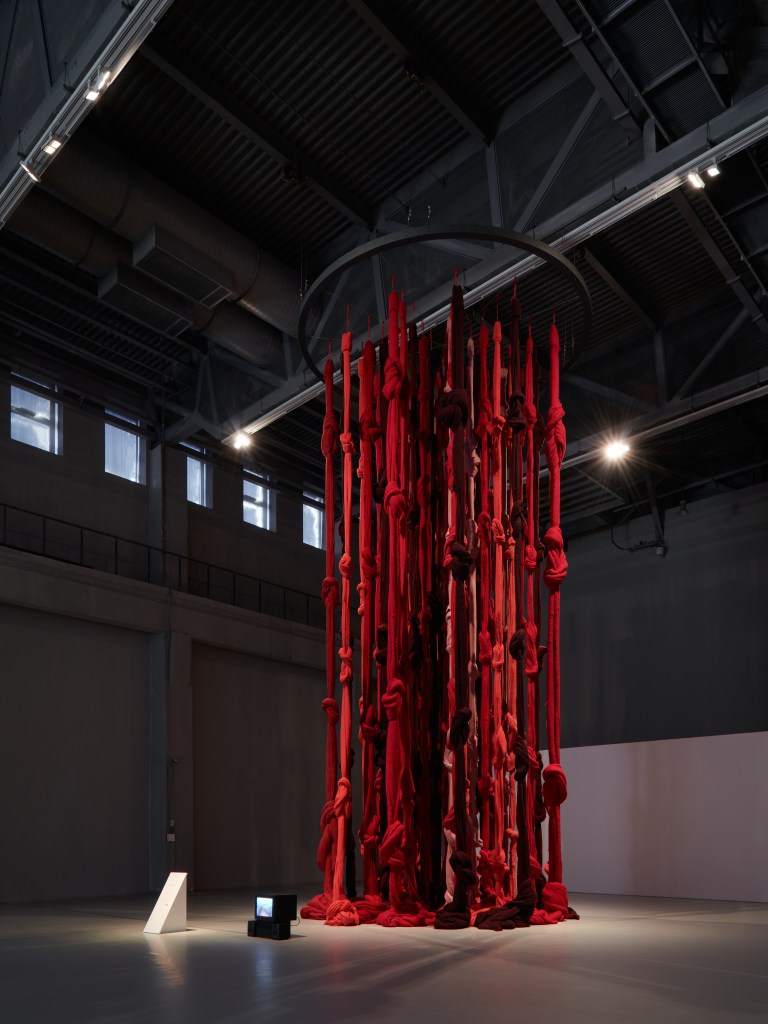
Cecilia Vicuña, Quipu Menstrual (Shanghai), 2006/2021, mixed media installation with unspun wool and videom dimensions variable, 04:12 minutes, courtesy of Lehmann Maupin and the artist, installation view at the 13th Shanghai Biennale PHASE 03: AN EXHIBITION, 2021. Courtesy Power Station of Art, photo by Chen Hao The Shape of a Circle in the Mind of a Fish. Edited by Lucia Pietroiusti and Filipa Ramos. Hatje Cantz + Serpentine 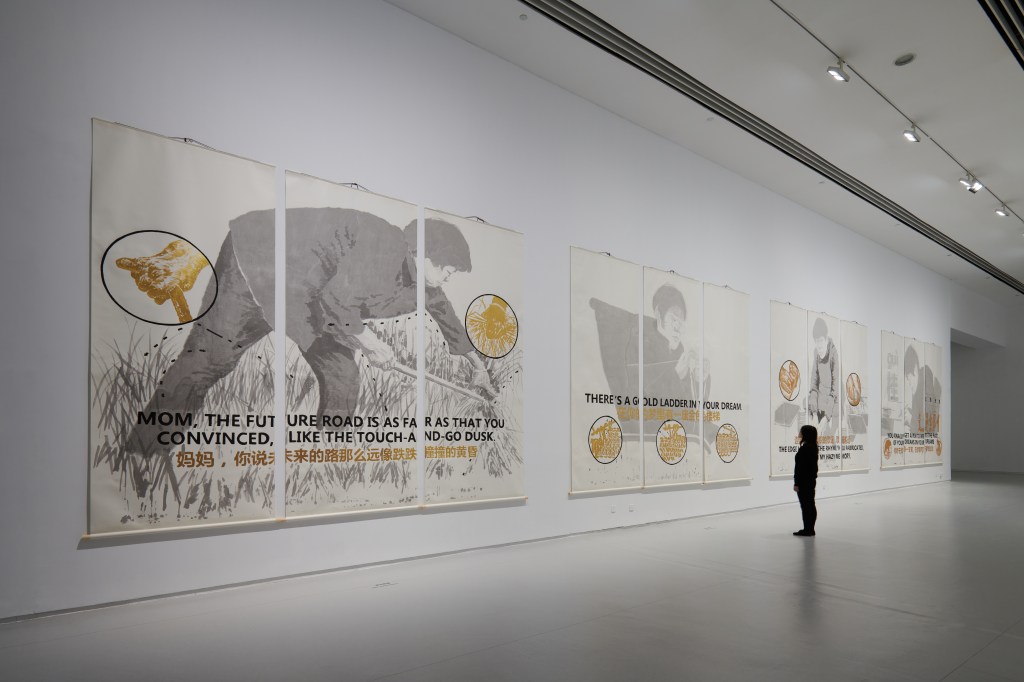
Dai Chenlian, Waxing and Waning of the Augustness 3, 2020-2021, painting, installation, 365 × 435 cm each, installation view at the 13th Shanghai Biennale PHASE 03: AN EXHIBITION, 2021. Courtesy Power Station of Art, photo by Chen Hao 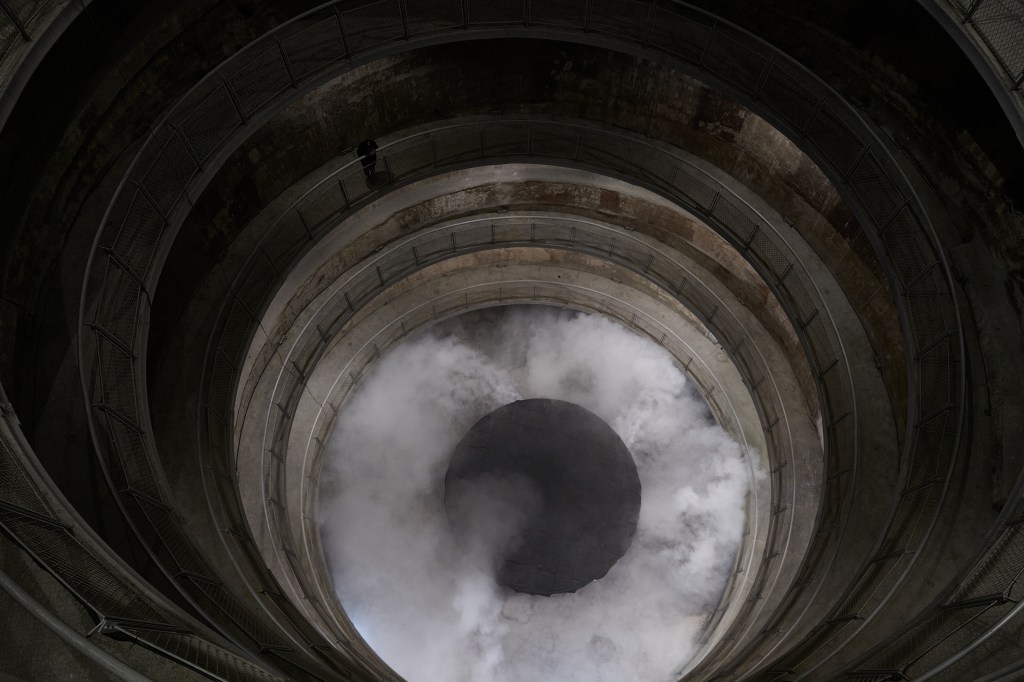
Carlos Casas, 1883/Krakatoa, 2021, sound installation, dimensions variable; continuous loop (approx 40 min cycles), commissioned by the 13th Shanghai Biennale/Power Station of Art, installation view at the 13th Shanghai Biennale PHASE 03: AN EXHIBITION, 2021. Courtesy Power Station of Art, photo by Chen Hao
 c plus c