Until 23 November 2025, the spaces of S.a.L.E Docks in Venice host “Contested Waters”, the exhibition curated by ɪ-ʏ ʜꜱɪᴇʜ. With the organizational collaboration of the Hong-Gah Museum and the support of organizations such as the Taiwan National Culture and Arts Foundation, RSI Group, Lion Pencil CO, and NICHE – Center for Environmental Human Sciences at Ca’ Foscari University of Venice, the exhibition explores water and its role – real and metaphorical –in contemporary ecological and social issues.
Contested Waters brings together five works in the exhibition running until 23 November 2025 at S.a.L.E Docks in Venice. Installations and videos introduce the water as a physical but also political place, in its sense of a narrative device. This perspective creates bridges between areas that are distant in terms of aesthetics, culture and nature, finding a common denominator in water – and, more broadly, in the concept of liquid. On display, scientific, geopolitical, and metaphorical aspects blur their boundaries through the works of artists who describe their reality and imagination.
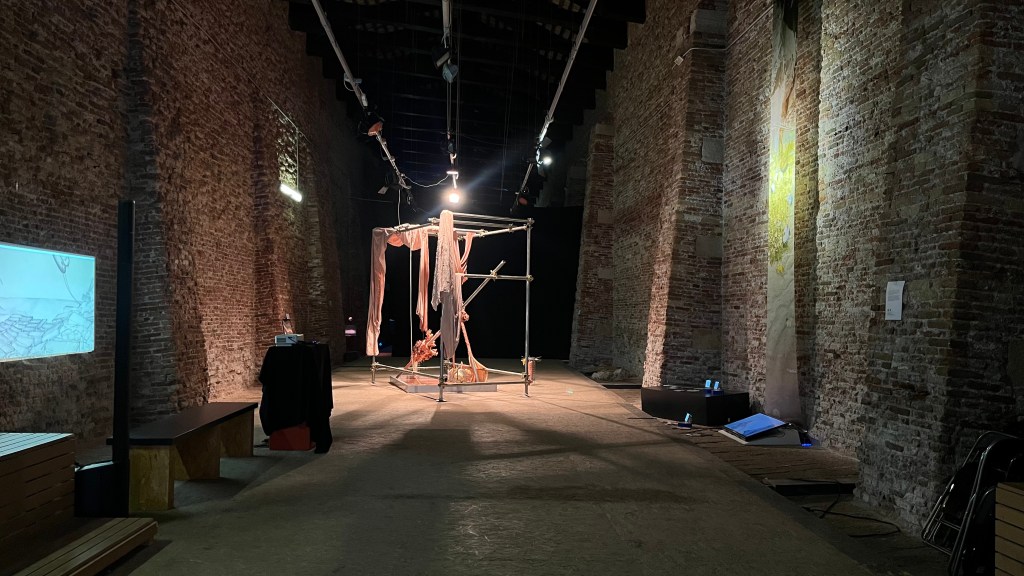
THE WORKS ON DISPLAY AT S.A.L.E. DOCKS IN VENICE
No body makes its own bodies (2024), the sculpture created by Chen Chen Yu and placed at the centre of the exhibition space, explores the body as a viscous composition of ideologies. The artist’s multimedia practice encompasses an interest in the fluidity of identity, offering reflections on gender and the material expressions of typically contemporary sensations, such as anxiety and desire. The flow and the body are also key elements in the installation presented at S.a.L.E. Docks, where a shapeless mass, located in the centre of a cage, melts into murky waters. The fading of the body, its construction and its disappearance convey the image of the fragility of today’s individual: glued to ideology, they appear as a mass ready to melt away.
Ranjit Kandalgaonkar’s decade-long research, on the other hand, finds in water a fertile ground for connections and invisible interests in the shipbuilding industry. In [shipbreak_dossier] (2009-2025), the artist collects and maps hidden and opaque dynamics, revealing the phases of shipbuilding and demolition. The latter phase is often characterised by obscure and neglected data that conceal large-scale speculation.
![Installation view of Ranjit Kandalgaonkar’s long-term project [shipbreak_dossier] (2009–2025), featuring diagrams, images, and research-based materials displayed at S.a.L.E. Docks. Photo by Rebecca Canavesi.](https://cplusc.xyz/wp-content/uploads/2025/11/ranjit-kandalgaonkar-shipbreaking_dossier-2009-2025-installation-view.jpg?w=1024)
Jui-Lan YAO’s work connects scientific research and participatory practices. The installation The Replicate Blue.eu (2023-2025), on display in the exhibition and commissioned by the Hong-Gah Museum, highlights the artist’s investigations in the intertidal zones – between high and low tide levels – of Kinmen Island, opposite the Taiwan Strait. Jui-Lan YAO weaves together an ecological reflection on the exploitation of biotechnology, with particular reference to limulids: defined as “living fossils”, they are often used in medical material sterilisation tests.
No single drop of water diminishes in the world (2024-2025) by Szu-Ni Wen and Chia-Hsuan Sun considers water as a necessary resource, triggering a reflection on the quantity of resources present on Earth. In fact, to quote the curatorial text referring to the work, “the water we drink today is the same water that dinosaurs drank”.
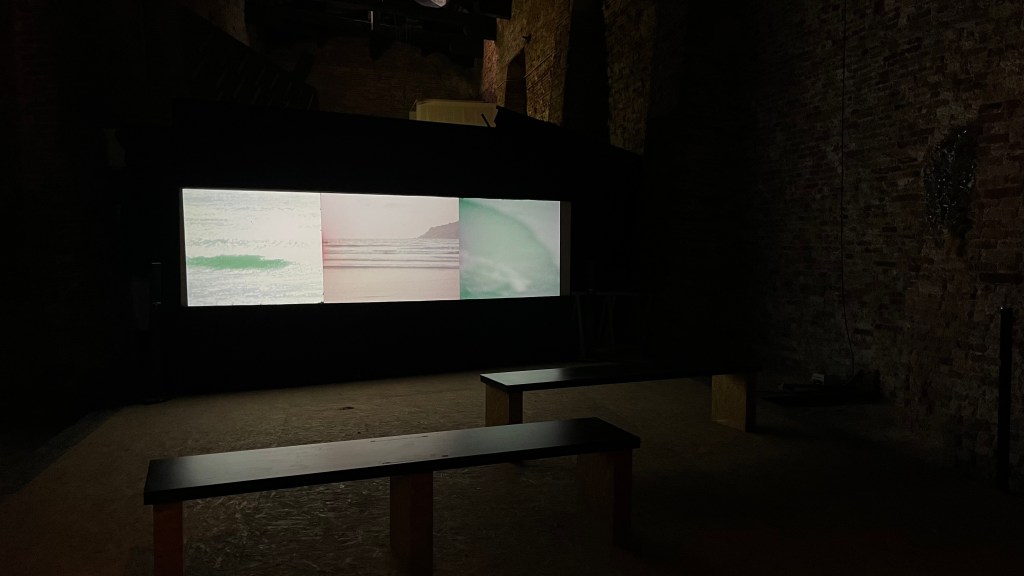
Finally, behind a curtain that divides the large continuous space of Magazzini del Sale, Tzuan Wu’s The Sirens (2022-2025) presents a different kind of water, less scientific and more mythological. The inhuman, the liminal, the blurring of boundaries between a child underwater and a mermaid become fluid. The work, with its apocalyptic aftertaste, marks the end of the exhibition, in a deeper space, far from the entrance. It is no coincidence that the exhibition ends with a metaphorical and superimposable “end of the world”, given the themes dealt with in the other works.
ACTIVISM AND CURATORSHIP
Contested Waters traces a path towards the unknown, a journey that begins with careful and attentive scientific research, passes through the ideological contradictions of contemporary society, and arrives at fiction. The exhibition speaks of water through a multiplicity and stratification of meaning, suggesting investigations in various forms: economic, ecological, political, metaphorical. The reflections are characterised by water as a content and media factor, but also by a spirit of struggle and participation, necessary in a space such as S.a.L.E. Docks.
The different languages on display allow visitors to develop knowledge and awareness of various specific and sectoral case studies, in which art and science coexist. The combination of these parts gives shape to an investigation that is not limited to aesthetics in order to generate awareness, but brings to the surface data that is often obscured by larger logics. Contested Waters evokes stories of waters that are not neutral: the discourse then becomes political, concrete and participatory, in line with the principles that animate S.a.L.E. Docks, an independent venue for contemporary arts founded in 2007 by a group of activists following the occupation of one of the Magazzini del Sale.
Rebecca Canavesi
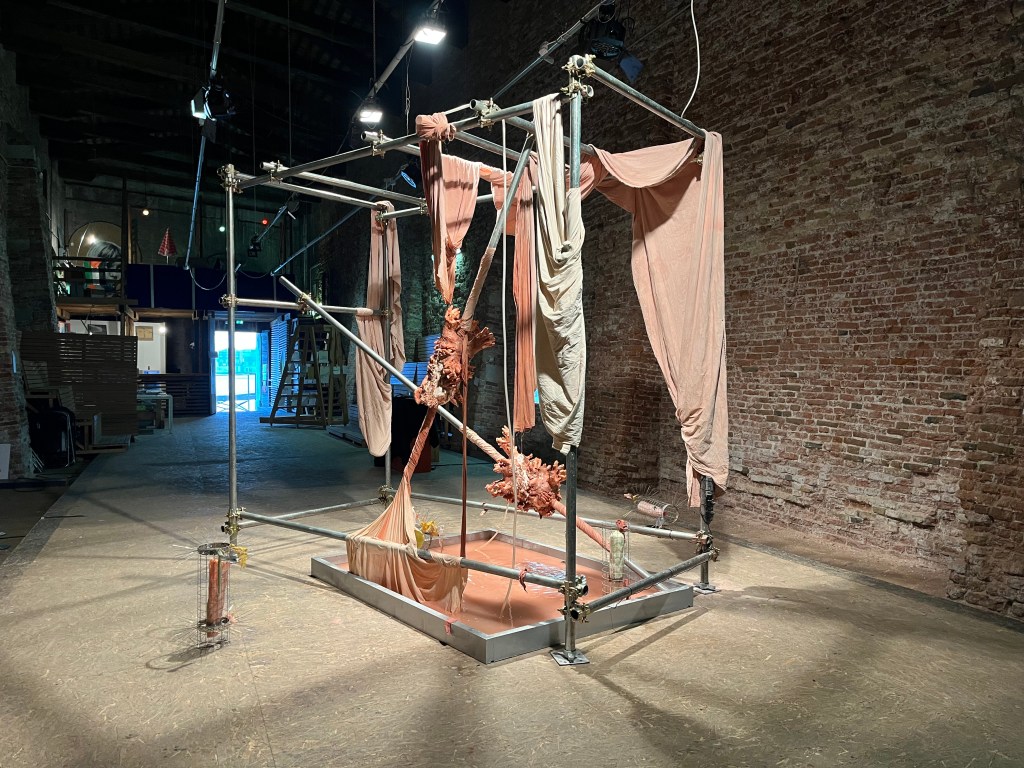
Chen Chen YU, No body makes its own bodies (2025), installation view, S.a.L.E. Docks, Venice 2025. Photo by Rebecca Canavesi 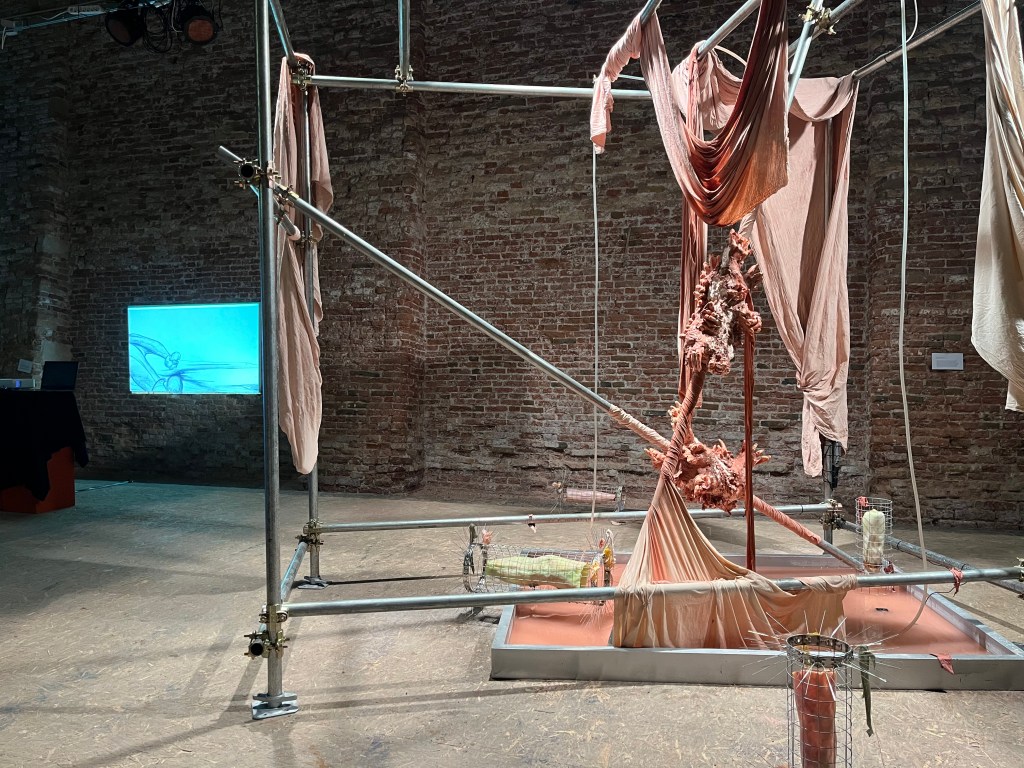
Chen Chen YU, No body makes its own bodies (2025), installation view, S.a.L.E. Docks, Venice 2025. Photo by Rebecca Canavesi 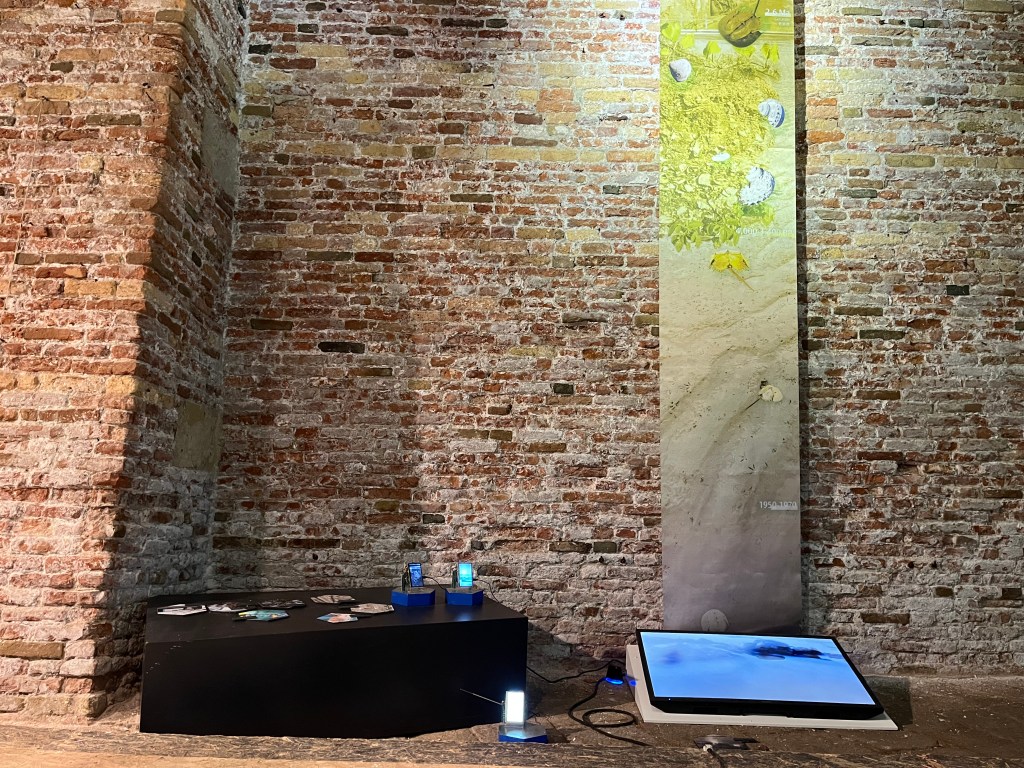
Jui-Lan YAO, The Replicate Blue.eu (2023–2025), installation view, S.a.L.E. Docks, Venice 2025. Photo by Rebecca Canavesi Ranjit Kandalgaonkar, [shipbreak_dossier] (2009–2025), installation view, S.a.L.E. Docks, Venice 2025. Photo by Rebecca Canavesi 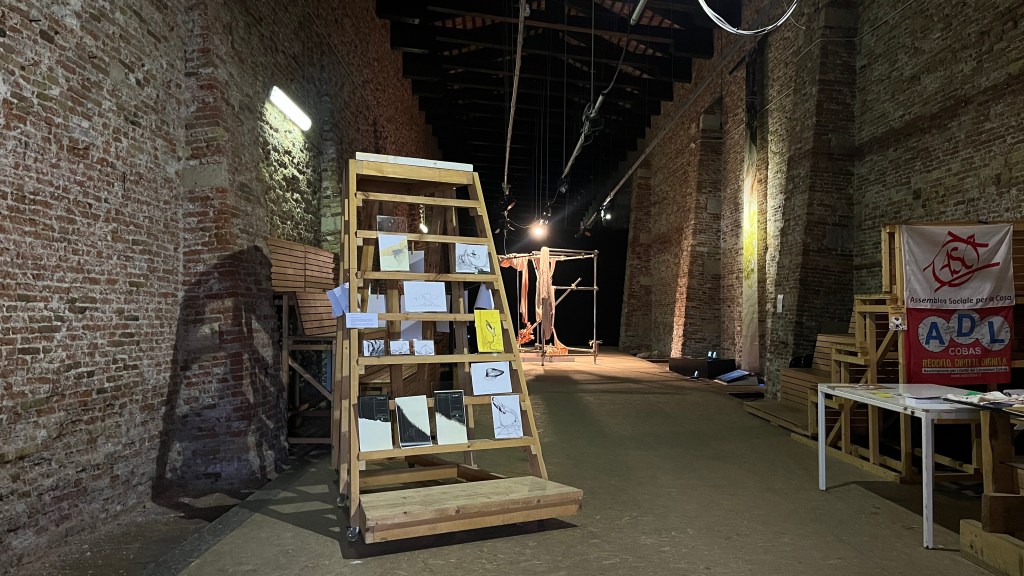
Contested Waters, exhibition view, S.a.L.E. Docks, Venice 2025. Photo by Rebecca Canavesi Contested Waters, exhibition view, S.a.L.E. Docks, Venice 2025. Photo by Rebecca Canavesi 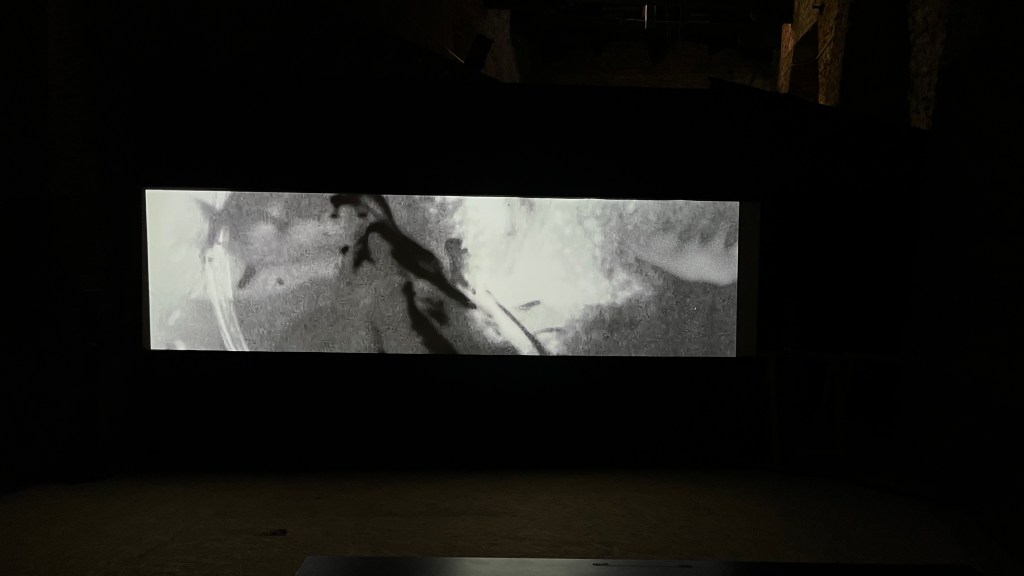
Tzuan Wu, The Sirens (2022–2025), installation view, S.a.L.E. Docks, Venice 2025. Photo by Rebecca Canavesi 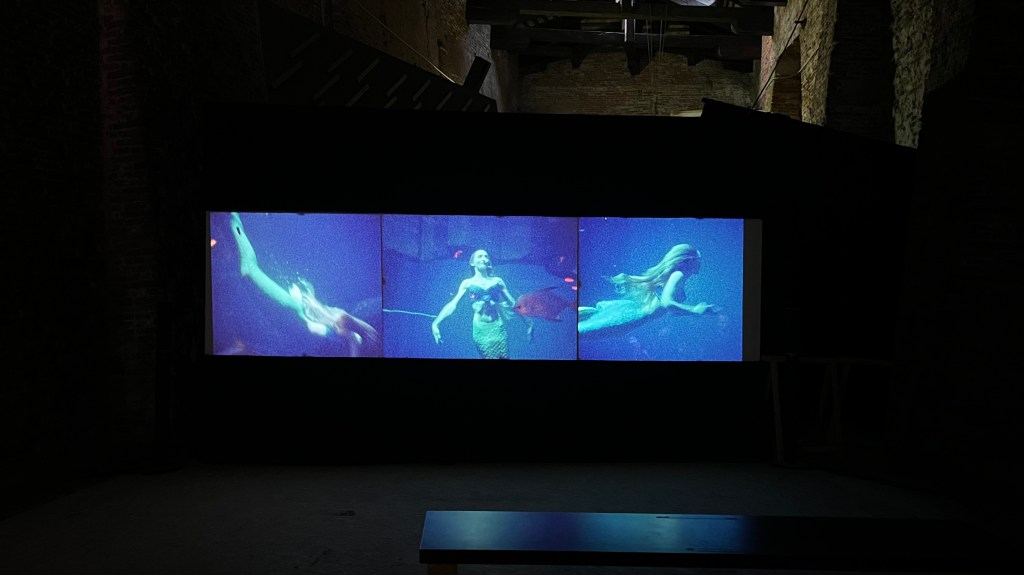
Tzuan Wu, The Sirens (2022–2025), installation view, S.a.L.E. Docks, Venice 2025. Photo by Rebecca Canavesi Tzuan Wu, The Sirens (2022–2025), installation view, S.a.L.E. Docks, Venice 2025. Photo by Rebecca Canavesi
The text has been translated in English using AI
 c plus c