The exhibition “feed (/) me”, open until 19th September 2025 at HAAM Gallery, Lahore showcased works in various mediums and styles by thirteen contemporary Pakistani artists who were inspired by the content of their public Instagram accounts. Artists had exhibited works in various mediums ranging from oil/acrylic paintings to video and digital art. Ultimately “feed (/) me” raised cogent questions about how an algorithm-driven virtual world has shifted the discourse on art from “what art is” to “how art works”.
On August 29th 2025, the exhibition feed (/) me curated by Ghazala Raees opened at HAAM Gallery, Lahore, Pakistan. The title of the exhibition is pivotal to understanding the crux of the exhibition and its significance. The use of a noun and pronoun together in the title alludes to a peculiar tension that now defines the relationship of the artist with the self in a commodity driven world that exists in virtual space. In this process the newsfeed of the artist takes on a life of its own, consuming, “feeding” and fueling the ambitions and desires of both viewer and artist alike. Artworks featured in the exhibition can be interpreted as a layered exploration of the digital space be it as muse, catalyst, voyeur, addiction or archive.
THE EXHIBITION AT HAAM GALLERY
The structure and layout of the exhibition consisted of a side-by-side layout where two spaces/large rooms adjacent to each other allowed visitors to segue between both spaces. Most artworks had been displayed on the walls. Some were grouped and displayed in accordance with audience engagement so that the first room connected to the entrance allowed visitors to engage directly with certain artworks.
Some artists chose a more painterly approach such as Ayaz Jokhio, who had reproduced an enlarged oil painting of his phone that featured his Instagram profile. Perhaps it was commenting on a new epoch, one where the phrase “global village” had segued into a new phase; the artist was now visible, connected and available all the time. More than commodification, the painting could be interpreted as a sort of metonym for an addiction to social media because it had ironically been titled Still life. Other artists such as Sohail Zuberi had blown up and transformed their newsfeed into a lenticular print. The work resembled a sort of indexical display of daily life in an urban city captured as a collage of posts, shifting and wavering as one moved across the gallery space. The work teetered between various realities and compelled one to question the artist’s vantage point: the newsfeed as a performative embodiment of an artist’s social reality or merely a voyeuristic archive of the inhabitants of a city? Hoor Imad Sherpao had created an entire feature film using AI that featured herself in various avatars engaging in battle and posing with famous personalities. Many of these works attempted to question the validity of content even on their own newsfeed; a pressing concern in a world where fake news, misinformation and messy AI slop purported to democratize creativity.

THE ARTISTS INCLUDED IN THE EXHIBITION AT HAAM GALLERY
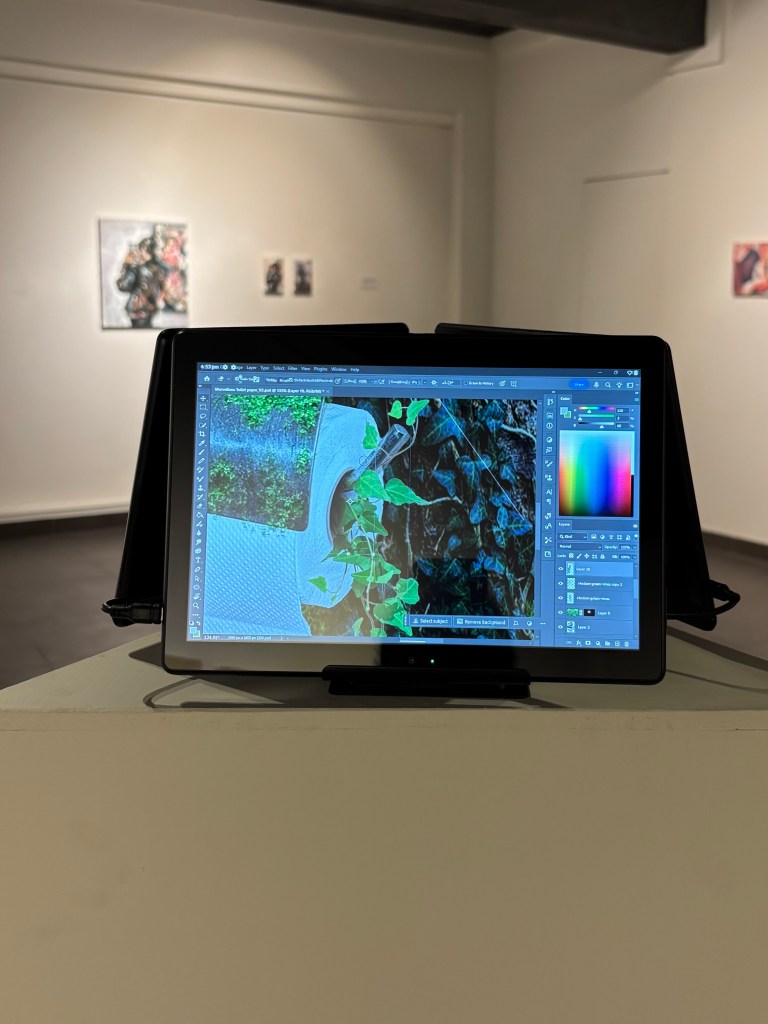
Other works commented on this idea through documentation of the process of making digital imagery. Would the value and authorship of digital artworks be further compromised if the process of airbrushing and photo manipulation were to be uploaded on a newsfeed? Nakshab Rehman’s works consisted of three small LCD monitor screens placed in a triangular layout on a single plinth. The use of the plinth can be analyzed art-historically; there was a time when it was specifically designed to give importance to the prized object on display so as to add grandeur, elevating its value and significance. Rather than a precious bust in marble or wood, instead Rehman opted to question this conventional primacy of skill and craft by replacing it with sleek screens that were relaying the laborious process of the making of his digital paintings. Rehman’s sly pun that celebrated the capitulation of technology over the use of conventional mediums such as oil on canvas or marble also extended to his subject matter. The three LCD screens not only captured how Rehman was making his paintings by manipulating and reimagining existing images but it also prompted questions about where he was sourcing his images from for the creation of his works.
One of the screens showed a singular banana emerging from a mountain range evoking a skewed notion of the Sublime, a second screen featured a roll of toilet paper being lovingly airbrushed into a photograph of a lush green landscape while the third featured a pair of flip-flops nimbed in the heavenly light of Transfiguration: Rehman’s irreverence and parody of the past questioned what is consumed and what kind of gatekeeping now determines the myth of artistic genius in an age of commodification. Rehman’s digital paintings mocked the redundancy of a past that felt almost atavistic with its reliance on history: banal and even mass-produced objects were reimagined with an aesthetic dollop of humour and digital kitsch.
ARTISTS AND SOCIAL MEDIA
Safwan Sabzwari’s Please Like Me series attempted to dismantle the iconic design interface and logic of Instagram and social media platforms itself. Social media platforms and influencer culture in particular sustains itself by feeding off of the fear of cancel culture; the monetization of one’s life comes with the anxiety of counting “Likes” to determine one’s worth. It is entwined with an unhealthy addiction to obsessively abiding by the algorithmic preferences of followers in a digital age where the approval of anonymous strangers, more than anything determines one’s self-esteem.
After all, every time we see a “Like” on our post on social media it is accompanied by a release of dopamine that enhances our joy and increases our desire to please. Sabzwari’s interactive sculptural piece channeled this desire into parody and the playfulness of child-art to comment on this culture of instant gratification. His artwork consisted of six rectangular bricks of equal size mounted on a wall. Each brick held a contraption that bore a striking resemblance to butterstamp telephones from the late 1870s evoking memories of redundant technologies and lost forms of interaction/ communication. This redundancy was exemplified by childish doodles or graffiti-like artworks on each surface accompanied by the use of a hand-held device that could easily double as a butterstamp telephone “receiver”. Interestingly the receiver functioned as a stamping cylinder and was attached by a chain. Visitors were provided with instructions that accompanied the display labels: they were asked to stamp their “Likes” for specific images in the form of hearts so that the artist could encourage viewers to reflect on the futility and childishness of our desires on social media platforms.
feed (/) me was an unconventional show that attempted to push the boundaries of what constitutes as artistic production in today’s age. Its relevance resonated with younger artists, students and visitors who reflected on the blurred boundaries between the real and virtual world. Each artwork carried this kernel of truth: some fragment of the zeitgeist of their age had been encapsulated in the works.
Zohreen Murtaza
Sohail Zuberi, #culturlbloodbank_karachi, feed (/) me, exhibition view, HAAM Gallery, Lahore 2025. Courtesy HAAM Gallery, Lahore, Pakistan 
Safwan Sabzwari, Please Like Me series, feed (/) me, exhibition view, HAAM Gallery, Lahore 2025. Courtesy HAAM Gallery, Lahore, Pakistan Nakshab Rehman, Toilet Pata, feed (/) me, exhibition view, HAAM Gallery, Lahore 2025. Courtesy HAAM Gallery, Lahore, Pakistan 
Safwan Sabzwari, Please Like Me series, feed (/) me, exhibition view, HAAM Gallery, Lahore 2025. Courtesy HAAM Gallery, Lahore, Pakistan 
Safwan Sabzwari, Please Like Me series, feed (/) me, exhibition view, HAAM Gallery, Lahore 2025. Courtesy HAAM Gallery, Lahore, Pakistan 
Nakshab Rehman, A-kela Banana, feed (/) me, exhibition view, HAAM Gallery, Lahore 2025. Courtesy HAAM Gallery, Lahore, Pakistan

 c plus c