Until 6 January 2026, Palazzo Grassi in Venice will host “La strana vita delle cose”, the first major monographic exhibition in Italy by Tatiana Trouvé. An immersive journey through drawings, installations and objects that retraces over twenty years of research by the artist born in Cosenza.
There is a silent life in the objects that accompany our existence. They are silent witnesses of our daily lives, custodians of time and our memories. It is to this life imbued with memory that Tatiana Trouvé (Cosenza, 1968) gives shape in her personal exhibition La strana vita delle cose, displayed at Palazzo Grassi in Venice.
The artist builds environments that oscillate between reality and fiction, where every element that is sculpted, drawn or created in scale seems to hold an invisible event, a lost gesture. Her research is characterized by a meticulous attention to detail: objects replicated with hyperrealistic precision but moved out of context, drawings that seem to emerge from sleep, materials that simulate what are not ‒ bronze that gets the softness of fabric, marble that imitates the lightness of book paper.
THE EXHIBITION BY TATIANA TROUVÉ AT PALAZZO GRASSI
The exhibition, curated by Caroline Bourgeois and James Lingwood, builds a real mental maze that unfolds in thirty rooms, alternating recent works with historical sculptures, new site-specific installations and unpublished drawings. The exhibition draws inspiration from the invitation carte blanche addressed by the Pinault Collection to artists, guaranteeing them full freedom of action within the space. The exhibition does not imply a hierarchical order, but develops as an open ecosystem where materials, techniques and languages are interwoven in a continuous dialogue.
Hors-sol is the monumental intervention that opens the exhibition on the lower floor of Palazzo Grassi. It is a large floor installation consisting of a layer of asphalt dotted with drains collected from different cities. The title means “out of the ground” or “without roots”, thus evoking a shift both temporal and physical.
In the lower rooms of the building, you will find some sculptures that belong to the series Notes on Sculpture. Sculptures born in the artist’s studio from aggregations of marginal objects. Starting from the title, each work alludes to a moment dear to the artist, a sort of biographical fragment suspended in time. They are three-dimensional still lifes, but with an almost affective inner tension.
In each room of Palazzo Grassi are placed some elements of the series The Guardians. Sentinel figures composed of clothes, shoes, blankets, some carved in different stones such as marble, and objects cast in bronze and brass. They act as surrogates for the museum’s guardians who watch over the exhibition and keep their own thoughts to themselves. The titles of the stone “books” ‒ often texts written by women ‒ reveal the artist’s inner trajectories and her attention to alternative knowledge.
THE CURATORSHIP OF TATIANA TROUVÉ’S EXHIBITION
The upper floor is dedicated to drawing, which occupies a central place in the work of Tatiana Trouvé. Many of the drawings exhibited here echo the constellations of sculptures on the upper floor. During the Art Conversations organized on the sidelines of the exhibition, the curators and the artist discussed the role of drawing as an extension of the sculptures on the lower floor, and setting up as a narrative gesture. The curatorial work, built in dialogue with the artist, has led to the realization of an immersive exhibition project that rejects linearity and pushes the viewers to create their own emotional map within space. It is not about illustrating a work, but creating an experience.
La strana vita delle cose is more than a retrospective; it is a reflection on time and care. On the time it takes for an object to become a memory, and on the care needed not to lose it.
Valeria Eneide
https://www.pinaultcollection.com
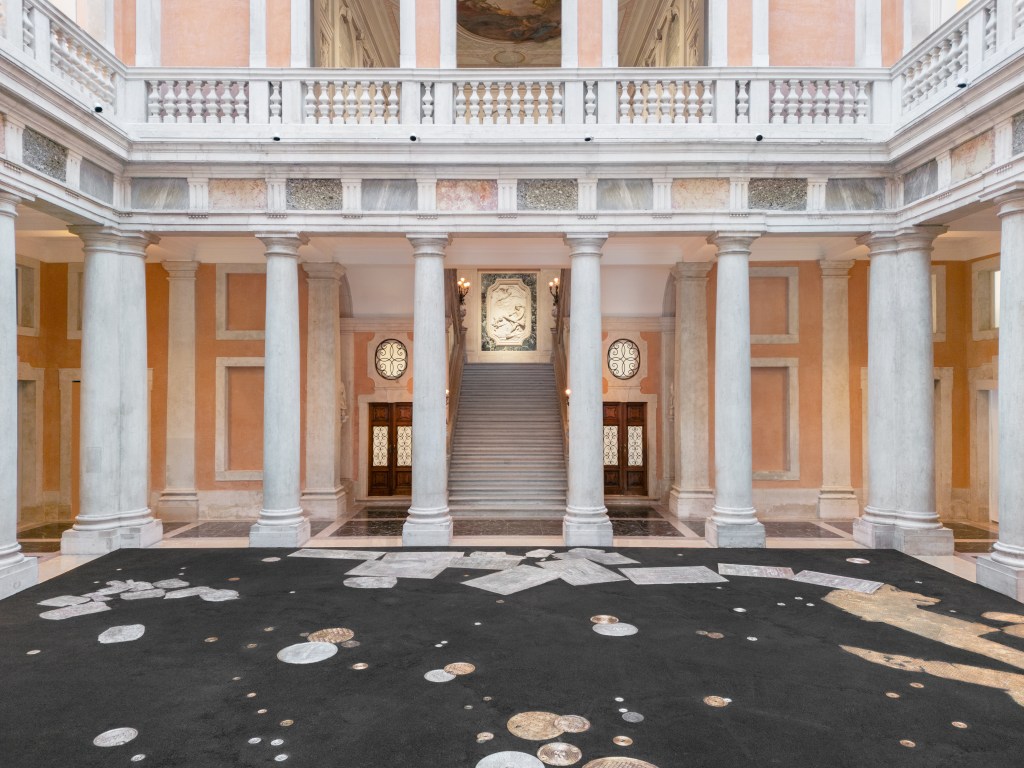
Tatiana Trouvé, Hors-sol, 2025, Collection of the artist © Tatiana Trouvé, by SIAE 2025. Installation view, “Tatiana Trouvé. The strange Life of Things”, 2025, Palazzo Grassi, Venezia. Photo Marco Cappelletti and Giuseppe Miotto / Marco Cappelletti Studio © Palazzo Grassi, Pinault Collection 
Tatiana Trouvé, Studies, 2012-2023, Collection of the artist © Tatiana Trouvé, by SIAE 2025. Installation view, “Tatiana Trouvé. The strange Life of Things”, 2025, Palazzo Grassi, Venezia. Photo Marco Cappelletti and Giuseppe Miotto / Marco Cappelletti Studio © Palazzo Grassi, Pinault Collection 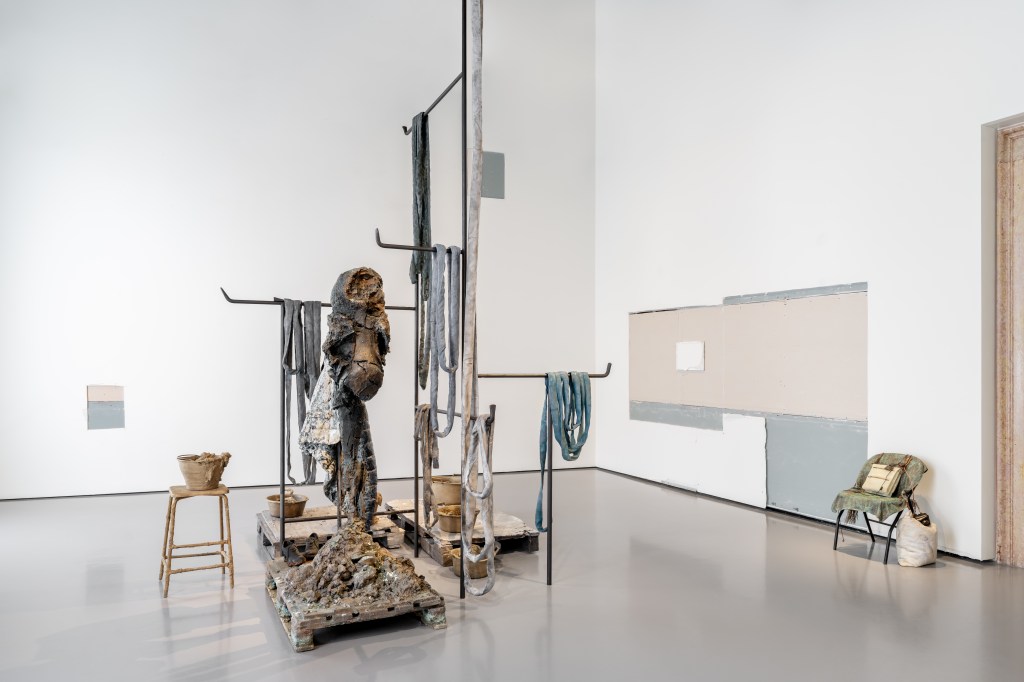
Tatiana Trouvé, The Residents, 2021-25, Collection of the artist, courtesy Gagosian; The Guardian 2019, Pinault Collection © Tatiana Trouvé, by SIAE 2025. Installation view, “Tatiana Trouvé. The strange Life of Things”, 2025, Palazzo Grassi, Venezia. Photo Marco Cappelletti and Giuseppe Miotto / Marco Cappelletti Studio © Palazzo Grassi, Pinault Collection
Translated with AI
 c plus c