A young artist who uses the photographic medium to rediscover and interpret nature, in search of lost faith, Eleonora Busato tells the themes and dynamics that characterize her work.
Eleonora Busato was born in 1999 in Vicenza, where she spent her childhood immersed in the nature of the Veneto countryside. She moved to Paris for a Bachelor’s degree in Art History and Archaeology at the Université Paris 1 Panthéon-Sorbonne and a Master’s degree in Photography at the Université Paris 8. Between 2022 and 2024, she participated in several group and solo exhibitions in France and in Italy and also experimented in the curatorial field. We met her during a studio visit at one of the ateliers of the Bevilacqua La Masa Foundation on the island of Giudecca in Venice. What is most striking is her passion in telling her story, in talking about photography and her love for nature, as can be seen from the black and white shots and cyanotypes displayed on the studio walls. Busato’s research, which begun with her thesis project, explores the spiritual through photographic practice, using nature as a starting point in the rediscovery of God. Documentary approach and poetic investigation meet and merge, generating images charged with mystery and spirituality.
THE PHOTOGRAPHER ELEONORA BUSATO
Can you tell us about your studies and how this has affected your artistic research? I spent almost all of my academic career in France, combining theoretical and practical studies. My three-year degree in Art History at the Sorbonne have certainly influenced me on a didactic level, getting used to writing, criticism, the foundations of art history and a global understanding of artistic institutions. They are solid foundations, from which I began to trace my path of research and creation.
From the Sorbonne I moved to the University of Paris 8, in order to study practical and theoretical subjects specific to photography. The Paris 8 years were an exceptional moment of discovery. I had the freedom to confront myself with a variety of approaches and different tools, to understand gradually which subjects and which working methods suited me best. The master’s degree course initiated me, specifically, to conduct double research, parallel and complementary, theoretical and practical. It is a type of approach that has proved very effective in my case. The hours spent in the library are balanced with those spent in the laboratory, history and theory of photography become a reassurance, a map to consult when you want to create something of your own, to contextualize it, not to feel lost.
What made you choose photography as your main medium of expression? How do you approach it?
Among a multitude of mediums, since childhood I felt a particular predisposition towards photography. Over time it has confirmed itself as a practice that can amaze me. The photographic image often causes me a sense of wonder, because it depends on a mechanism that sometimes seems almost magical to me, because of how it relates to tangible reality. In this way I seem to have in my hands a prodigious instrument! It seems to me, thanks to it, that I can experience some fundamental principles of our existence: light, time, matter.
I have often asked myself: “Why photograph?”. I believe that in my case the answer may revolve around the desire to establish a connection with something special. I also think that photography can really be a practice of reconciliation towards a multitude of spheres that concern us, from the social to the geographical.
Is there any photographer you feel particularly close to or inspired by?
There are a lot of them! As I said, I like to build my discourses and works on the basis of an observation of the experiences and artistic achievements of those who have come before me. There are works that touch me, that particularly move me, where I have identified what for me are expressive and human truths. I am referring to the work of Sally Mann, Robert Adams, Minor White, Emmet Gowin, Alessandra Sanguinetti.
What photographic techniques are you using at the moment and which ones would you like to experiment with?
At the moment I’m shooting a lot in analogue black and white and I’m working with cyanotype printing. I would like to experiment with anthotype printing, which exploits the photosensitivity of plants and flowers.
THE PROJECTS BY ELEONORA BUSATO
The search for God explored through photography resulted in Looking for God, a poetic and paradoxical undertaking in which you try to capture with a snapshot something that our senses cannot perceive. Do you think you have succeeded? Would you retrace the steps of this process?
I believe I have succeeded in reproducing photographically an experience that was truly particularly sensitive, in the sense of very related to my senses. It was a bit like making images that are, as Alfred Stieglitz said, “equivalents” of what I felt emotionally, but in a very concrete context. A real game of correspondences between the inner world and the outer world. Perhaps what we sometimes fail to do is not so much to perceive, but rather to explain, to interpret these reciprocities.
To make Looking for God I basically went “in search of God” by retracing the same path over and over: the one between the church in my country along the banks of the river, leading to the Beata’s house. The landscape, with all its elements and characters, was the territory of meeting between my personal experience and a universality of symbols and geographical and cultural references. In all this, the photographic image has become the support of a miraculous and documentary revelation, which is manifested in this case in the enchantment of a poetic discourse that deals with belief, magic, nature, tradition.
Finally, I understood the spiritual in photography as a human attempt to relate and to understand its own contexts and mysteries, through the very terms of tangible reality: photography can carry a message and become an instrument of hope.
Why, after you left, did you feel the need to return home to search for the faith that you were slowly abandoning?
Very banally, I went back to look for God where I had last seen him, I retrace the road in reverse, as you do when you lose something and you want to find it again.
Le Jardin d’Éden is your latest project in development. It revolves around the theme of the garden, but it is also a search permeated by other topics dear to you and well connected to it, such as spirituality, culture, territory and ecology. Where does the will to examine this space come from?
I knew that I wanted to continue my work from the very topics you mentioned, and I needed a foothold, an idea that would determine the connection with a new phase of research. In my readings, I identified an interesting weighting that placed the concept of the garden on the same level as the landscape, making them de facto sanctuaries of truth. The word paradise comes from Persian and literally means “walled enclosure”, delimited: the synopsis, in a certain sense, of what the photographer sees through the optical viewfinder. The garden then seemed to me an extremely interesting starting point.
During the studio visit you often mentioned Robert Adams’ text Beauty in Photography. Essays in defense of traditional values. Could it be said that he played a central role in the development of your current research?
Absolutely. He talks about the garden in that sense. I studied the integrality of his work, photographic and critical, and began to trust it deeply. There is something extremely comforting in his work, it is a reference and a guide for me.
ELEONORA BUSATO, VENICE AND THE FUTURE
How did you get to do a residency at the Bevilacqua La Masa Foundation? Why did you choose Venice to pursue your projects?
I came to the residency in Venice because, in order to pursue my work, I had to be close to the geographical context that I wanted to study and represent. I think this is one of the cons (or pros) of photography, which sometimes stresses you physically, body and soul. The Bevilacqua La Masa seemed to me the perfect framework in which to fit in, where I could have a space and a human and institutional confrontation, while I work on my photographic project in the Veneto region.
Have you already participated in exhibitions or fairs? If so, did you take care of the set-up or were you assisted by a curator?
Of course, I have participated in numerous exhibitions. I took care of the set-ups both independently and in collaboration with curators.
What do you expect from a good curator?
I expect, perhaps more than anything else, a certain curiosity: an attitude that then excludes a result impersonal and cold. I also appreciate when a curator has good editorial, writing skills.
What are your plans for the future?
I’m trying to think of my path one step at a time. For the months I see ahead of me, the prospect is to deepen and then master the printing techniques I have approached, in particular anthotypy. Beyond that I’m not thinking too much about the future, the present moment is very exciting to me, I don’t want to lose sight of it.
Laura Ferrone
https://busatoeleonora.wixsite.com/photography
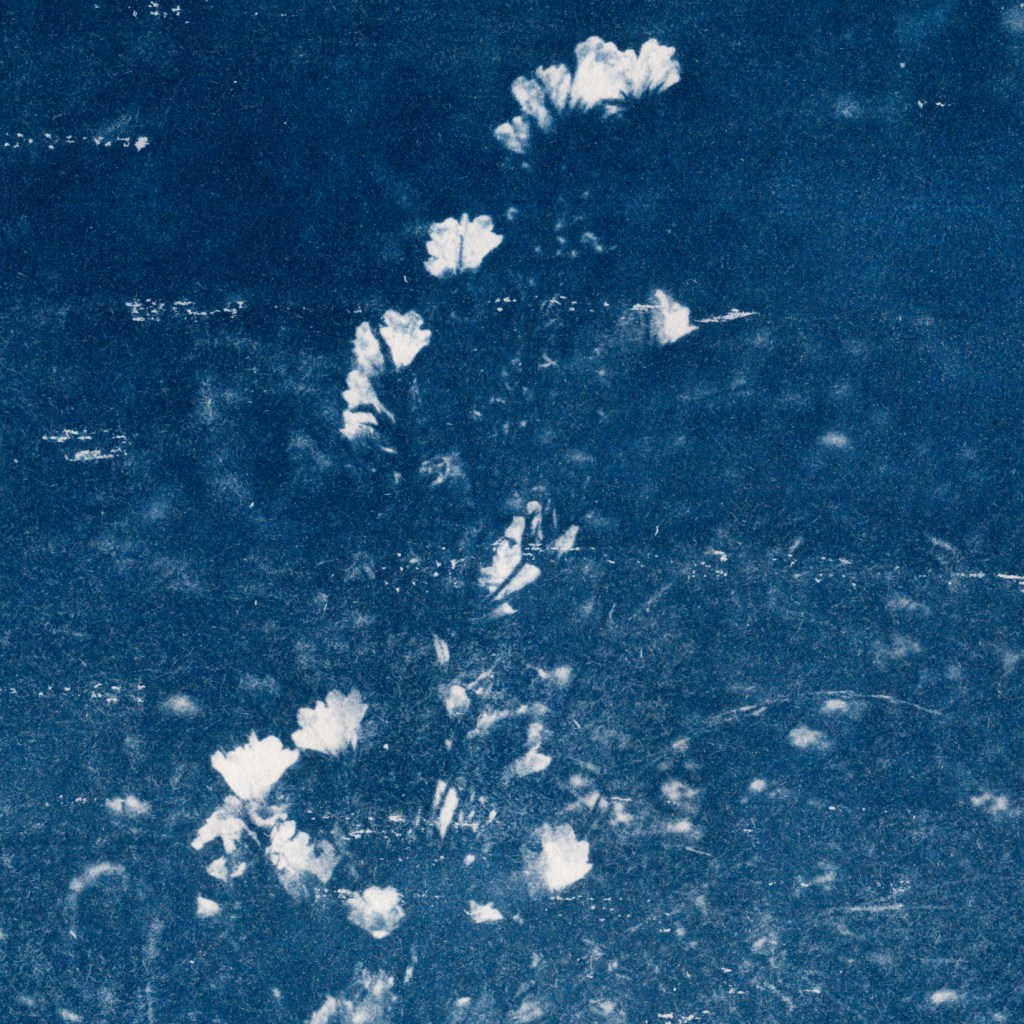
Eleonora Busato, Untitled, from the series Le Jardin d’Éden, 2024, cyanotype print on paper, 12.5 × 12.5 cm 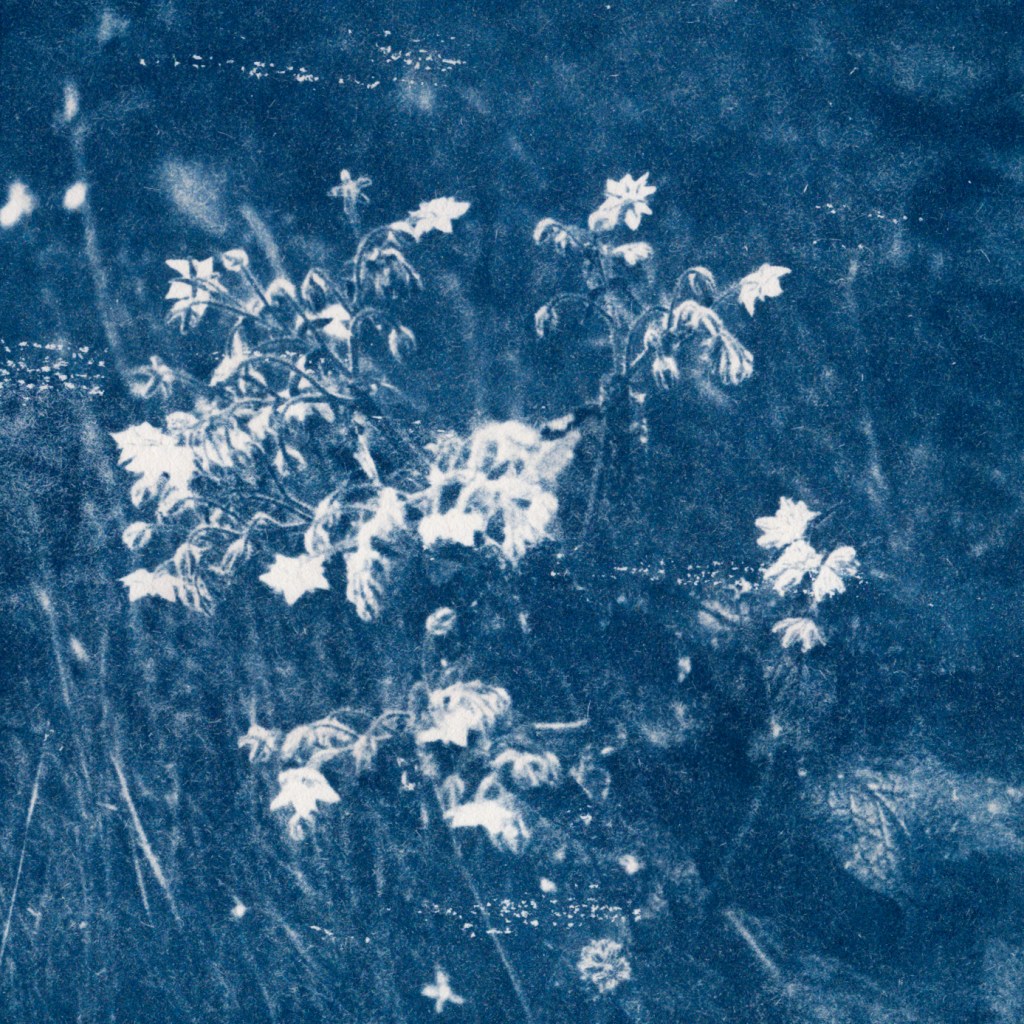
Eleonora Busato, Untitled, from the series Le Jardin d’Éden, 2024, cyanotype print on paper, 12.5 × 12.5 cm 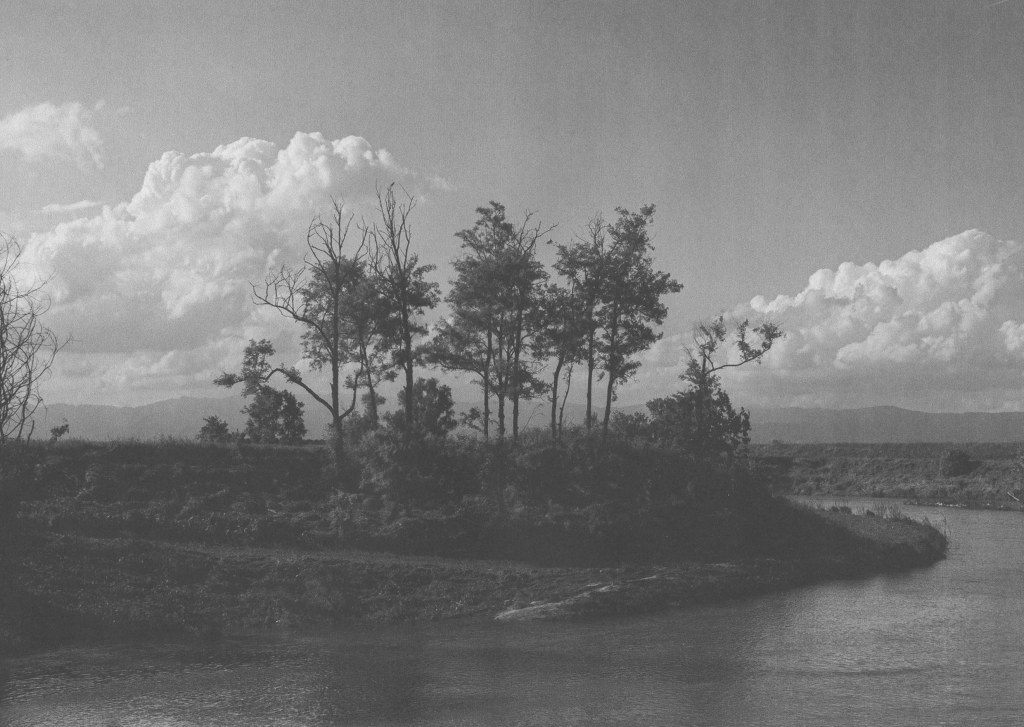
Eleonora Busato, Untitled, from the series Looking for God, 2024, digital scan of inkjet print, variable dimensions 
Eleonora Busato, Untitled, from the series Looking for God, 2024, digital scan of inkjet print, variable dimensions
Translated with AI
 c plus c