IT
The painting of Anastasiya Parvanova, a young Bulgarian artist who found in Venice the ideal setting for her research, takes shape in a colorful subset born from the encounter between the unconscious and the exploration of quantum physics.
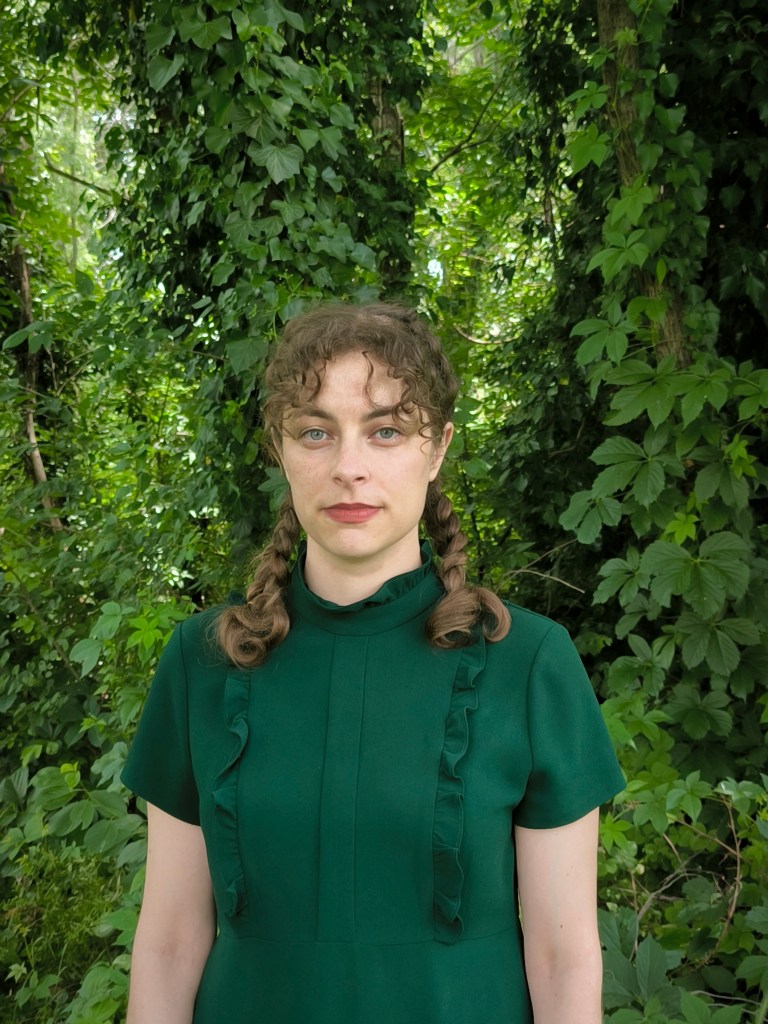
Born in 1990 in Burgas, Bulgaria, Anastasiya Parvanova lives and works between Venice and Sofia. After graduating in Visual Arts and Pedagogy at the Academy of Fine Arts in Sofia, she chose the Academy of Fine Arts in Venice to study painting. From that moment on, Venice became home for Anastasiya Parvanova, as well as being the cradle of her fairy-tale painting. We met her in the Venetian art space zolforosso.
THE INTERVIEW WITH ANASTASIYA PARVANOVA
When did you start to develop your distinctive style?
I think I was strongly influenced by Luisa Badino. It was around 2014, we attended Atelier F during the years of the Academy in Venice. Luisa painted by pouring liquid colors on the canvas that was placed on the floor, like the famous painter Helen Frankenthaler. I liked that way of creating because it’s impossible to control the movement of the colors and their position on canvas. I found it fascinating that water and acrylic act independently of my will. The surprise effect that is generated for the backgrounds of my works allows me to concentrate and control what I want to put in the foreground.
So, your technique is characterized by acrylic and water?
Mainly yes, but also by oil and resin. I use acrylic especially for the bases.
Your expressive force welcomes and externalizes your introspective sphere; however, your research is also based on scientific contents. What are they and how do they fit into your painting?
Yes, science in my art has an important weight. I consider nature and the inner world of each of us to be extremely close and compatible entities. If science is a means to discover nature and the universe, for example by approaching quantum physics I feel I have the possibility of looking inside myself, of understanding the relationships that bind me to other people, to things. At the same time, however, I like to think that we know that we don’t know. This reassures me because the curiosity to know leads to imagination, which is fundamental for me. My fantastic worlds, represented in my works, give space to my imagination.
THE SUBJECTS AND THE TECHNIQUE CHOSEN BY PARVANOVA
Shoes are recurring objects in your works. What do they represent for you? Do they allude to a movement and to your personal evolution?
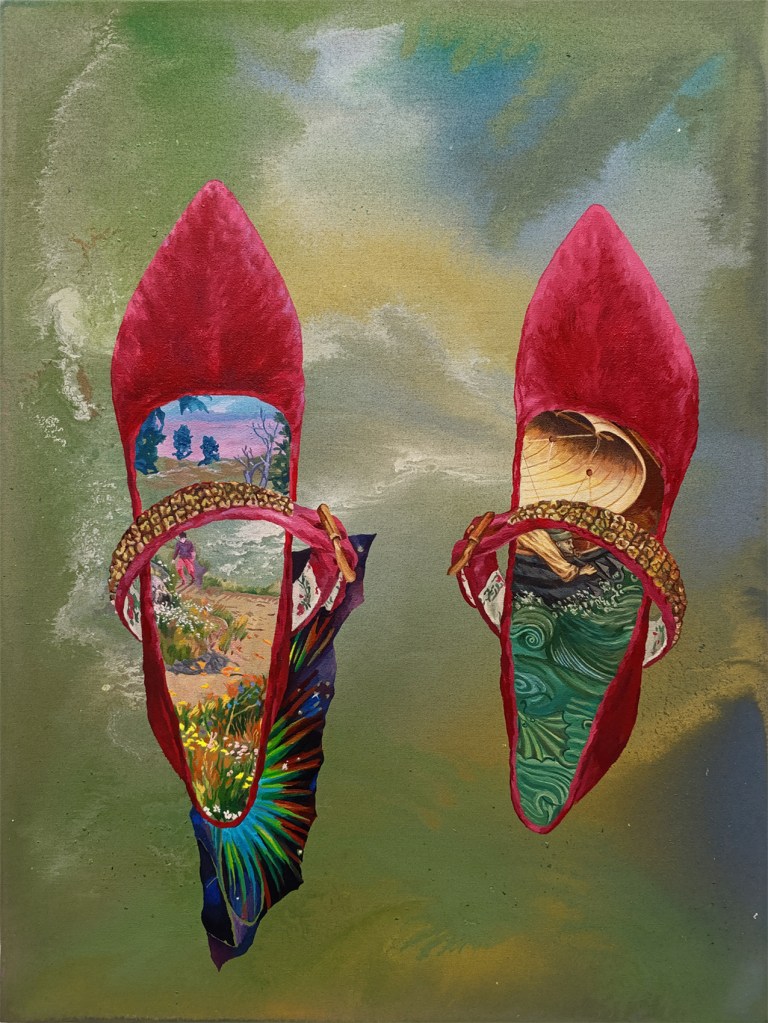
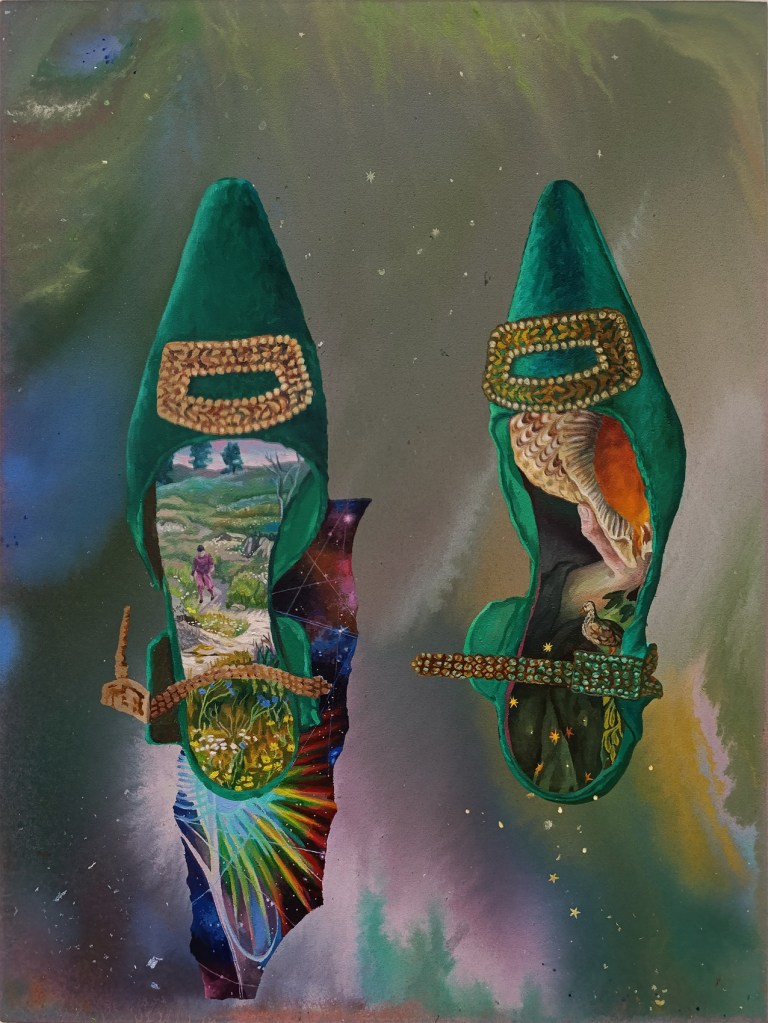
The shoes I paint are not shoes. They are creatures, objects to which I attribute a soul. I started representing them by chance, then I liked them and continued. I am pleased when the observer suggests to me the idea that they can be considered a symbol of feminist culture; however, this is not my intention. I am afraid of becoming banal when dealing with such an important topic. I do not want to have the responsibility of narrating and describing a particular gender, I speak of the human. For me, shoes are a portal, they express the idea of travel and therefore of transformation. Shoes come in pairs, there are two, I see them as a crossroads in front of which one must choose which path to take, or they are the faces of the same coin, the two different impulses that can coexist within human being.
Do you think that your fairy-tale-like painting is influenced by Slavic mythology and its iconography?
I don’t know, in this case I could answer you with a Bulgarian saying: “When you’re in the soup, you can’t taste it”.
Speaking of influences, do you think that your aesthetic can be assimilated to the surrealist one?
I don’t like to categorize myself, I want to feel free. Paradoxically, even though I myself can find affinities between my painting and Surrealism, I distance myself from this idea. Perhaps my eyes and my head have abused this style during my childhood years, my school was full of Dalí’s paintings. Involuntarily I share with Dalí my favorite word which is “hypnagogic” and refers to soft thoughts, those that emerge just before actually falling asleep.
What is your favorite pictorial movement?
Impressionism. I like the research behind it, an impressionist painting vibrates, it is not static, you feel it, you perceive for example the atmospheric condition of the landscapes represented.
What is your desire on a professional level?
I would like to be able to experiment, not to lock myself in a single style.
For a visual artist is experimentation always an added value?
Not necessarily. I believe that it depends a lot on the nature of the artist, I need to change, to feel free. I appreciate those who experiment, just as I respect those who focus on their own style, improving it more and more.
Lorenza Versienti
https://anastasiyaparvanova.com
Translated with AI
 c plus c