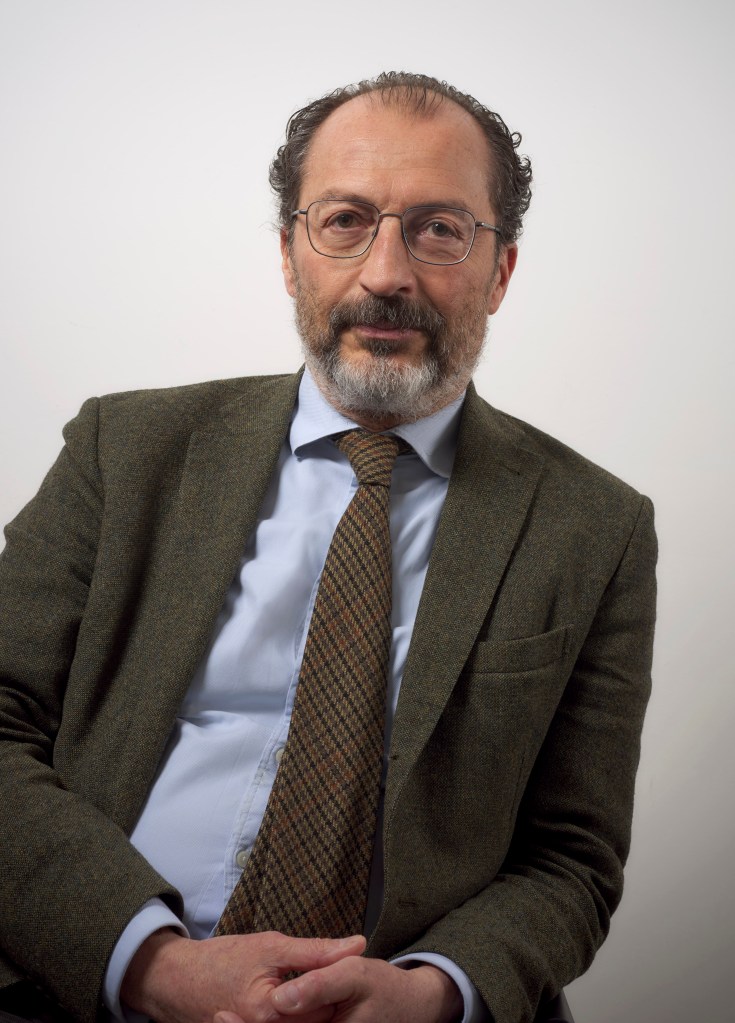
Filippo Lotti, former director of Sotheby’s Italia, and now CEO of Art Defender – a company specializing in the safeguarding, conservation, and protection of valuable artworks – reflects on the meaning of “curating” in art today, where market dynamics, critical thought, and responsibility converge. This interview explores recent transformations in the art world and the increasingly strategic role of curatorship.
Born in Arezzo in 1963, Filippo Lotti is a singular presence in the Italian art scene. His unconventional career has seamlessly bridged thought, discipline, strategy, and aesthetics. After graduating in Philosophy from the University of Florence, he joined Sotheby’s Italy in 1987 as the head of rare books department ‒ pursuing a lifelong passion. He worked at the prestigious auction house for nearly four decades, eventually becoming its General Manager.
In 2024, he took on a new role as CEO of Art Defender, which provides logistics, protection, and conservation services for artworks. This transition is not a farewell to the art market, but rather a return to the original sense of curating: to take care.
We met him to discuss what it means to “curate” today, the value and responsibilities embedded in the art market, and the often subtle, sometimes tense, dialogue between artists, collectors, and institutions.
THE INTERVIEW WITH FILIPPO LOTTI
You have a background in philosophy. How did you balance critical thinking with the commercial logic of your professional career?
One of the advantages of studying philosophy is that it proves useful in virtually any profession. A minimum of critical thinking is essential even in a commercial role like mine, which also includes a part of academic research.
Over your forty years at Sotheby’s Italy, you’ve witnessed many shifts in the art market, such as the transition from live auctions to private sales and digital platforms. What are the key differences in managing these formats?
The procedure is largely the same, but live auctions rely on the auctioneer and the auction house to create a compelling, almost theatrical atmosphere to encourage participation. Online sales are user-friendly and convenient, but inevitably more impersonal. The rise of private sales was a natural response to a globalized market with increasingly varied client needs.
Auctions are often perceived as distant from curatorial practices, yet formats like Contemporary Curated involve curators and cultural figures from fashion, food, and other sectors to help shape the sales catalogue. How important is curatorship from a commercial perspective? Could it help attract younger collectors?
Absolutely. Beyond the academic or scholarly value, strong curatorship brings specificity and uniqueness to a project ‒ even a commercial one ‒, making it more appealing to buyers and more engaging for younger audiences.
Has a curatorial intuition – yours or someone else’s – ever had a decisive impact on an artist’s career or a sale?
Perhaps not decisive, but it certainly contributed to the commercial consolidation of an artist. One example is the monographic sale dedicated to Damien Hirst by Sotheby’s London in 2008.
AUCTIONS, THE MARKET AND CURATING ACCORDING TO FILIPPO LOTTI
The role of the curator is changing: a hybrid between advisor, strategist, sometimes even becoming a brand for artists and collections. Is this an evolution that you also notice?
I think it can be defined as such, especially at an international level. I’m not sure how desirable this evolution is, but it certainly reflects the times we live in.
After dedicating most of your career to the art market, you’re now leading Art Defender. What does it mean to care for an artwork today?
Caring for an artwork can be expressed in many ways: conservation, restoration, research, or enhancement, and each of these aspects requires increasingly specialized professional figures.
Alice Longo
Translated with AI
 c plus c